
Swanbench-Speech vs MMAE: What Each Audio Benchmark Actually Measures
Two 2026 audio benchmarks grade different skills: Swanbench-Speech scores long-form TTS against real recordings (1,101 samples, 17 scenarios), MMAE grades edit instruction following (2,000 samples, EMR under 5%).
The two questions
Audio generation demos all sound convincing for thirty seconds, which is exactly why benchmarks matter. Two papers from mid-2026 attack the evaluation problem from opposite ends of the audio pipeline, and together they cover most of what a team shipping speech or audio features actually needs to measure.
Swanbench-Speech (arXiv:2605.28618, ACL 2026 Findings) asks: when a model generates minutes of speech, how close does it get to a real recording, dimension by dimension? MMAE (arXiv:2606.07229) asks a colder question: when a user tells an audio editing model what to change, does the output actually satisfy every part of the instruction? One benchmark measures quality drift in generation, the other measures correctness collapse in editing. Neither replaces the other, and the teams that need both are the teams building products where a voice is generated first and then edited.
Swanbench-Speech: how close is generated speech to a real recording?
The motivation is a real measurement gap. Short-clip MOS studies keep showing TTS systems near the top of the scale, yet anyone who listens to a five-minute generated audiobook or podcast hears prosody flatten, emphasis land in the wrong place, and scene changes go unmarked. Swanbench-Speech turns that vague impression into 1,101 test samples spanning 17 speech scenarios (customer service, podcast, audiobook, drama, talk show, sportscast, and others), averaging 228.6 words with 1 to 4 speakers per sample, covering both single-speaker long-form TTS and multi-speaker dialogue generation.
The framework scores every sample on 7 metrics grouped into 3 axes. Acoustics covers timbre consistency, reverb consistency, and sound fidelity. Semantics covers content accuracy (CER/WER of the transcript) and prosodic coherence. Expressiveness covers expressive richness and expressive hierarchy, the two dimensions where long-form speech is supposed to differ most from a flat read. The protocol is fully automatic, with the paper reporting human-alignment SRCC of 0.82 for prosodic coherence, 0.71 for expressive richness, and 0.62 for expressive hierarchy for its Gemini3-Pro-based evaluator.
The evaluation is broad: the paper benchmarks over 20 models, specifically 10 open-source and 6 closed-source systems for single-speaker long-form generation (ZipVoice, SparkTTS, CosyVoice2 and CosyVoice3, GLM-TTS, MegaTTS3, IndexTTS2, FishSpeech, F5TTS, VibeVoice against Gemini TTS, OpenAI tts-1-hd, ElevenLabs Multilingual V2, Minimax-Speech-02-hd, InWorld-TTS, and Seed-TTS2), plus 6 open-source and 4 closed-source systems for dialogue generation.
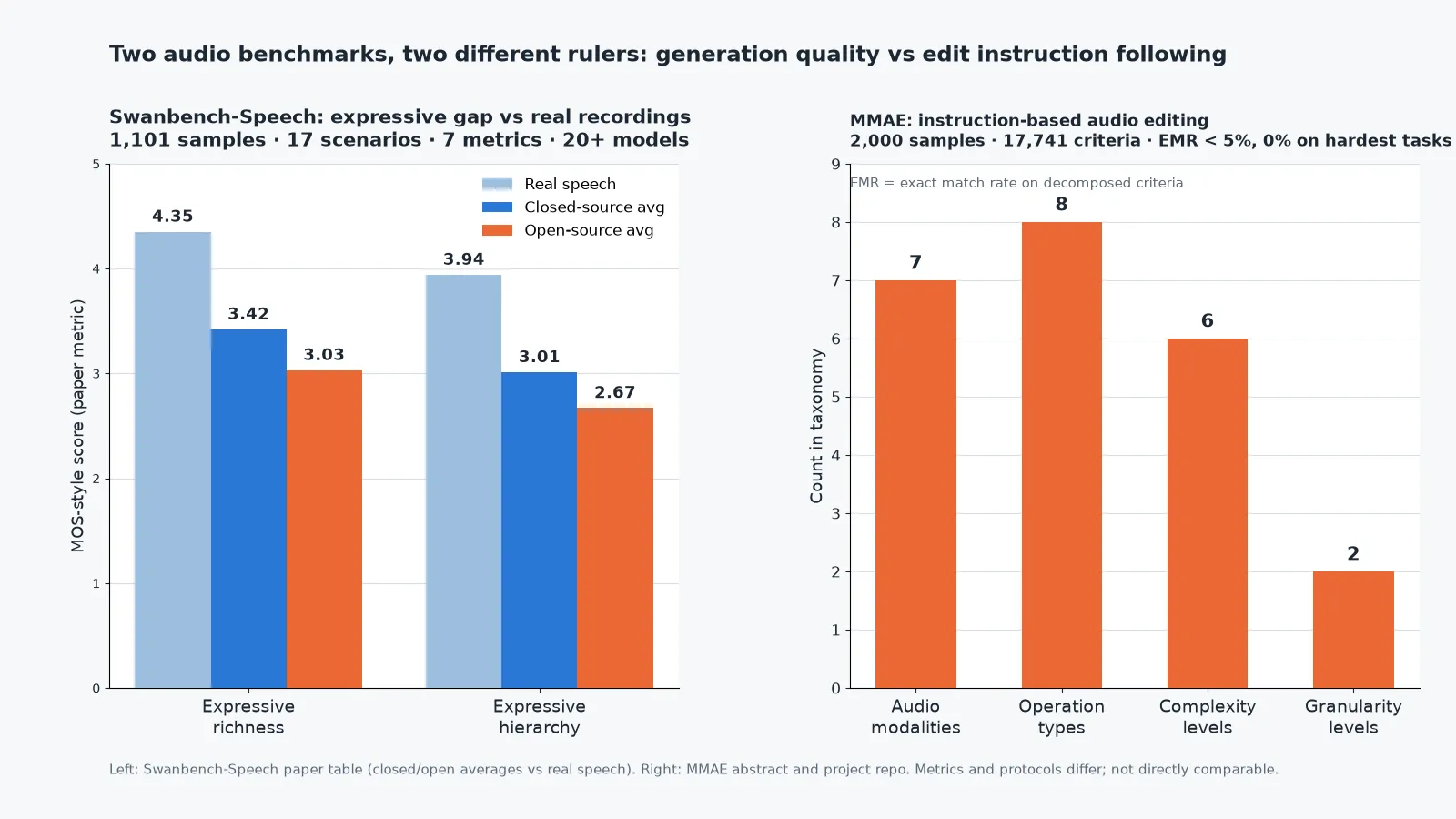
The headline finding, stated in the paper’s own words, is that the closed-source average still lags real speech by nearly one MOS point in expressive richness and over half a point in expressive hierarchy. The paper’s table makes this concrete: real recordings average 4.35 on richness and 3.94 on hierarchy, while the closed-source model average sits at 3.42 and 3.01, and the open-source average at 3.03 and 2.67. Content accuracy is the one dimension where generation is nearly on par, and even there the open-source average WER of 0.164 trails the closed-source 0.138. The paper also reports that SparkTTS degrades in content accuracy as sequence length grows, which is the specific failure mode long-form evaluation exists to catch.
MMAE: can models follow audio editing instructions at all?
MMAE starts from an even more basic observation: instruction-based audio editing (remove the siren from this clip, make the footsteps louder, add reverb to the voice) has no standardized test at all, and model demos hide how brittle the capability is. The benchmark defines a taxonomy of 7 audio modalities (sound, speech, music, and mixtures among them), 8 operation types, 6 levels of task complexity running from basic modifications to multi-hop reasoning and multi-round editing, and 2 granularity levels, all applied to 2,000 high-fidelity samples curated jointly by humans and agents.
The scoring design is the paper’s main contribution. Instead of asking a judge for one holistic score, a rubric framework decomposes every editing task into verifiable sub-criteria, 17,741 criteria in total, and scores each one. The published metrics are Instruction Following Rate, Consistency Rate, and Exact Match Rate (EMR), with the released pipeline using Qwen3-Omni as the judge model; the project repository (ddlBoJack/MMAE) ships the taxonomy, per-sample annotations, and evaluation code so teams can run their own models.
The result is a deliberately uncomfortable number: the exact match rate of leading models stays under 5% across the benchmark and drops to an absolute 0% on the hardest mixed-modality tasks. Read that carefully. It does not say models produce bad-sounding audio; it says that when every clause of a compound editing instruction is checked independently, current systems almost never satisfy all of them. Partial success, which is what demos show, is not what compound instructions require.
Key numbers
| Dimension | Swanbench-Speech | MMAE |
|---|---|---|
| Paper task | Long-form speech generation (single-speaker TTS and dialogue) | Instruction-based audio editing across sound, speech, music, mixtures |
| Scale | 1,101 samples, 17 scenarios, avg 228.6 words, 1 to 4 speakers | 2,000 high-fidelity samples, 17,741 verifiable criteria |
| Structure | 7 metrics on 3 axes: acoustics, semantics, expressiveness | 7 modalities, 8 operation types, 6 complexity levels, 2 granularity levels |
| Models evaluated | Over 20 (10 open + 6 closed long-form, 6 open + 4 closed dialogue) | User-run pipeline; Qwen3-Omni as judge model |
| Scoring contract | Automatic 7-metric protocol, real-speech reference row per metric | Rubric decomposed into per-criteria checks: IFR, CR, EMR |
| Headline numbers | Closed-source avg richness 3.42, hierarchy 3.01 vs real speech 4.35, 3.94; open-source avg WER 0.164 vs closed 0.138 | EMR under 5% overall, 0% on hardest mixed-modality tasks |
| Same harness? | No shared task, metric, or judge between the two benchmarks | No shared task, metric, or judge between the two benchmarks |
Read this table as two one-dimensional cuts, not a ranking. A MOS-style richness score of 3.42 and an exact match rate under 5% are not convertible into a single “audio model quality” number, and neither paper claims otherwise. What is comparable is the shape of the finding: in both cases, the headline failure is not that audio sounds bad, but that a specific checkable contract (match a real recording dimension, satisfy every editing criterion) is missed by a wide margin.
Two rulers, one shared conclusion
Put the two papers side by side and a pattern emerges that generalizes beyond audio. Swanbench-Speech shows models nearly matching real speech on fidelity and content accuracy while remaining a point-scale behind on richness and hierarchy: the failure is selective, concentrated exactly where demos are shortest. MMAE shows models passing casual inspection while satisfying every clause of a compound instruction less than one time in twenty: the failure is compositional, invisible until the task is decomposed. Both are instances of the same lesson 2026 keeps teaching across modalities: aggregate impressions overrate systems, and only disentangled, checkable dimensions expose where the gap actually lives.
For context on the generation side, our pages on SwanVoice and VALL-E cover two very different TTS design families (codec language modeling versus neural-codec continuation), which is the layer Swanbench-Speech evaluates rather than designs.
When to use which
- You ship or select a long-form TTS, audiobook, podcast, or dialogue feature: Swanbench-Speech is the direct instrument. Its 17 scenarios map to product surfaces, its real-speech reference row tells you how far each dimension is from recordings, and the richness/hierarchy gap is the number to quote when a vendor demo sounds too good.
- You build an audio editing tool that takes free-form instructions: MMAE is the only one of the two that measures you. Run its released pipeline on your model, and treat EMR, not a listening test, as the release gate; the 17,741-criteria decomposition tells you which instruction clauses fail most.
- You need one number to compare two TTS vendors: neither benchmark gives it to you, and forcing one would be manufactured. Use Swanbench-Speech’s per-dimension table and compare vendors dimension by dimension on the same protocol.
- You are choosing a model architecture rather than evaluating outputs: go to the model pages instead; benchmarks answer “how good,” not “how it works.”
Limits and open questions
Both papers are recent (May and June 2026) and their model generations will age; the protocols are the durable part. Swanbench-Speech’s evaluator, however well aligned (SRCC 0.82 at best), is still an LLM-based judge, and its 0.62 hierarchy alignment is noticeably weaker than its 0.82 coherence alignment, so hierarchy scores carry more judge noise. Its scenario list is broad but finite, and all 17 are Mandarin-centric in the released data, so transfer to other languages is an open question rather than a measured result. MMAE’s EMR is strict by construction (every criterion must pass), so the under-5% figure measures full compliance, not usefulness; the paper itself pairs it with looser IFR and CR rates, and readers should quote all three. The released repo names Qwen3-Omni as judge, which means judge swaps could shift scores. And the two benchmarks share no models, no harness, and no metrics: any composite “audio benchmark score” across them would be invented, not measured.
FAQ
Which audio benchmark should I use for a TTS product, Swanbench-Speech or MMAE?
Swanbench-Speech. It is built for exactly your artifact: long-form generated speech and dialogue, scored on 7 dimensions against a real-speech reference, with 1,101 samples across 17 scenarios. MMAE measures audio editing instruction following, which only matters if your product edits existing audio from free-form instructions.
What is the exact match rate of models on the MMAE audio editing benchmark?
Under 5% overall, and 0% on the hardest mixed-modality tasks, per the paper’s abstract. EMR counts only outputs that satisfy every verifiable criterion of a decomposed instruction, so it is a strict full-compliance metric; the paper also reports looser Instruction Following Rate and Consistency Rate that are higher.
How far are the best TTS models from real speech on expressiveness?
On Swanbench-Speech’s own scales, the closed-source average reaches 3.42 on expressive richness and 3.01 on expressive hierarchy against real recordings at 4.35 and 3.94; the paper summarizes this as nearly one MOS point behind on richness and over half a point on hierarchy. Open-source averages are lower still, at 3.03 and 2.67.
Can I compare Swanbench-Speech scores with MMAE scores?
No. They measure different tasks with different metrics and different judges: MOS-style dimension scores against a real-speech reference are not convertible into a criteria-level exact match rate. Compare each benchmark’s numbers against its own reference points (real recordings for Swanbench-Speech, full criterion satisfaction for MMAE).
Do these benchmarks prove current audio models are bad?
No. They prove current audio models are uneven. Swanbench-Speech shows generated speech nearly matches recordings on fidelity and content accuracy while lagging on expressiveness; MMAE shows editing models often get most of an instruction right while almost never getting all of it. The unevenness, not the average, is what to engineer against.