
Speech Recognition · Multimodal Models
Whisper vs Mega-ASR: Two Ways to Survive Real-World Audio
Whisper bets 680,000 hours of messy web audio on one robust generalist; Mega-ASR synthesizes 2.4M degraded clips to cut WER to 45.69% vs 54.01% on VOiCES. The numbers are not on the same exam.
The fork: scale the world, or simulate its worst rooms
Speech recognition is close to solved on clean read speech, and badly unsolved on a phone call from a noisy street. Two papers on this site attack that gap from opposite directions, and the contrast is the useful thing to understand.
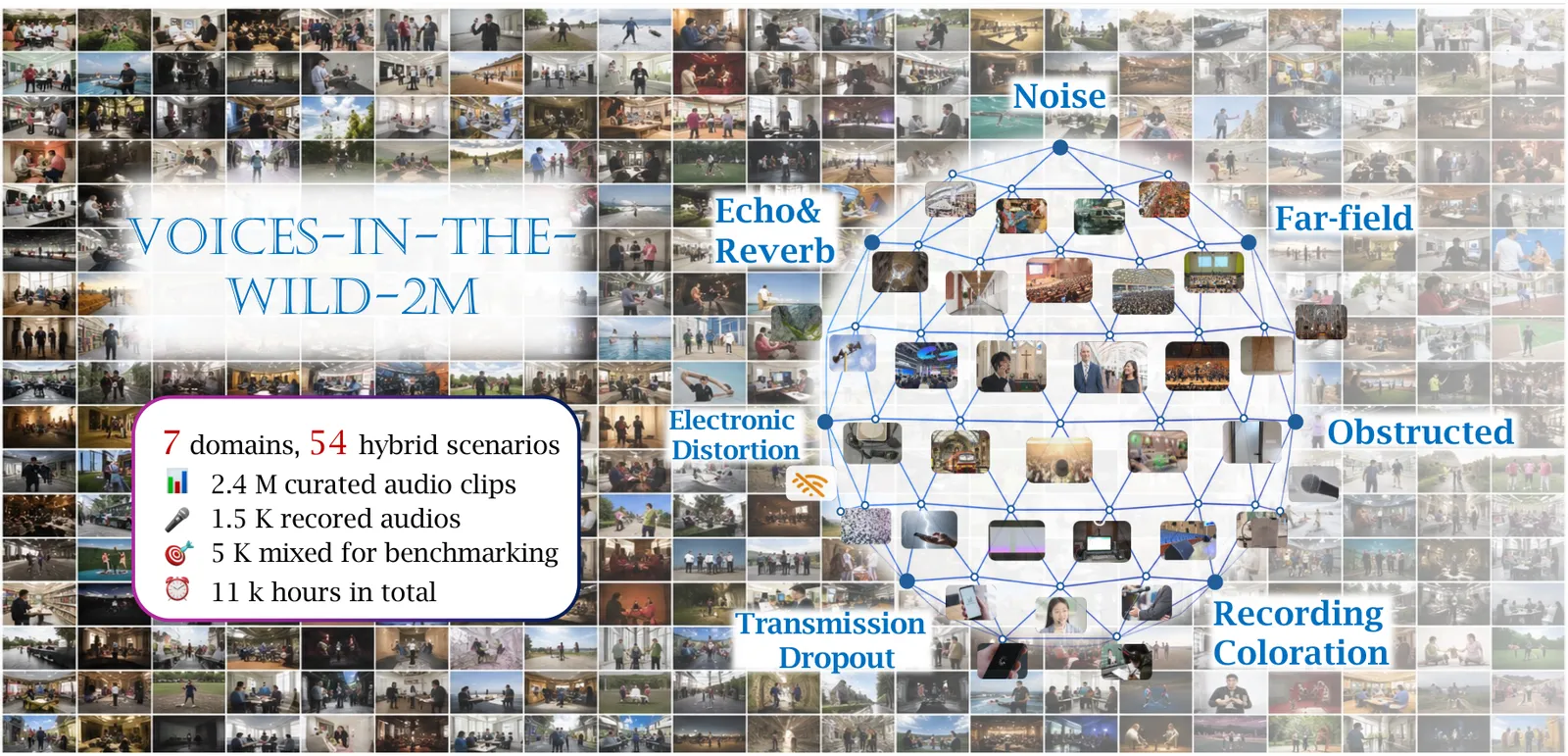
Whisper, from OpenAI, scales real data: one vanilla Transformer encoder-decoder trained on 680,000 hours of web audio with whatever captions came with it, betting that sheer diversity makes the model degrade gracefully on anything. Mega-ASR scales controlled hardness: since nobody has a large corpus of compound-degraded speech, it simulates one, building 2.4M clips that cover 7 acoustic phenomena composed into 54 physically plausible compound scenarios, then fine-tunes an existing 1.7B model on the result.
Both call the result robustness. They mean different failure modes, report different numbers, and never appear on each other’s benchmarks. Read the table, then read what it cannot tell you.
Key numbers
| Dimension | Whisper | Mega-ASR | Same harness? |
|---|---|---|---|
| Core bet | 680,000 hours of weakly supervised web audio | 2.4M simulated clips (~11k hours) of degraded speech | No |
| Training data character | Real, messy, multilingual; ~125,000 hours is translation data | Synthetic, physically grounded; 7 base phenomena (noise, far field, obstruction, echo and reverb, coloration, distortion, dropout) composed into 54 compound scenarios; English and Mandarin | No |
| Base architecture | Vanilla Transformer encoder-decoder, log-Mel input | Fine-tune of Qwen3-ASR-1.7B; gains attributed to data and training, not a larger backbone | No |
| Headline benchmark numbers | Zero-shot competitive with fully supervised systems on standard benchmarks; approaches human accuracy in OpenAI’s comparisons; no single trophy WER | VOiCES R4-B-F: 45.69% WER vs 54.01% prior SOTA; NOIZEUS Sta-0: 21.49% vs 29.34%; over 30% relative WER reduction on hardest compound conditions | No shared benchmark |
| Training recipe | Single large supervised run on filtered web pairs | Two stages: A2S-SFT (difficulty-ordered curriculum) then DG-WGPO (WER-gated RL, utterance plus word-level rewards) | No |
| Evaluation focus | Accuracy that holds up under distribution shift, vs fine-tuned specialists | Adverse conditions: far-field capture, reverberation, codec loss, stacked degradations; benchmark mixes 3,500 synthetic with 1,500 real clips | No |
| What ships | Models and inference code released | Dataset construction and recipe described; benchmark is 5,000 clips | n/a |
What this table does not contain matters more than what it does: no number here puts Whisper and Mega-ASR on the same audio. Whisper’s evidence is “zero-shot, competitive, stable across shift,” a claim about the variance of error across conditions rather than a single score. Mega-ASR’s evidence is specific WER drops on VOiCES and NOIZEUS, benchmarks built for degraded audio. Any comparison page that crowns a winner with a margin is fabricating a measurement neither paper made.
What Whisper actually bought
The 680,000-hour number is the paper. Academic ASR typically trains on around 1,000 hours of clean labeled speech; Whisper trains on three orders of magnitude more, and accepts the noise that comes with it: auto-generated captions, misaligned pairs, wildly uneven quality. OpenAI filters machine-generated transcripts, because training on another ASR system’s output teaches you its mistakes, and drops misaligned pairs heuristically, but the supervision stays weak by design. The bet: a model that has seen every accent, codec, and recording setup on the internet does not need fine-tuning for your setup, because your setup is already in the data.
The engineering trick that made this deployable is almost embarrassingly simple. Transcription, X→English translation, language identification, and timestamp prediction are all just text tokens at the start of the decoder sequence, so one checkpoint family covers all four tasks. That, plus released models and inference code, is why Whisper became infrastructure rather than a paper.
The honest caveat is equally well documented on the page. Whisper hallucinates fluent text during silence and non-speech audio, a dangerous failure in medical, legal, and accessibility settings where a confident wrong transcript is worse than none. Language coverage skews hard toward high-resource languages. And the 680k-hour corpus itself was never released, so the result does not fully reproduce.
What Mega-ASR actually bought
Mega-ASR’s diagnosis is that the field’s remaining failure is not generic shift but stacked degradation: not one nuisance at a time, but far-field capture plus reverb plus codec loss plus packet loss at once, which is what a real phone call is. No training corpus systematically covers that, so the authors built Voices-in-the-Wild-2M: 2.4M clips, ~11k hours, 7 base acoustic phenomena composed into 54 physically plausible compounds rather than random mixes. The companion benchmark deliberately holds out 1,500 real recordings against 3,500 synthetic ones, so a model cannot win by overfitting the simulator.
The training story is the second half of the contribution. Rather than scaling the backbone, Mega-ASR fine-tunes Qwen3-ASR-1.7B in two stages: A2S-SFT orders examples by difficulty using WER thresholds so the model moves from acoustic decoding to semantic recovery, and DG-WGPO adds a reinforcement stage whose reward is gated by actual WER at two granularities, so the policy is only credited when transcription accuracy truly rises. The page’s framing is explicit: the gains come from data and training, not from a larger model.
The measured results are the most concrete in this comparison: 45.69% vs 54.01% WER on VOiCES R4-B-F and 21.49% vs 29.34% on NOIZEUS Sta-0 against prior state of the art, with over 30% relative WER reduction on the hardest compound conditions. The honest limits: most of the training corpus is synthetic; 54 scenarios are a designed taxonomy rather than the true long tail; and strong VOiCES numbers say nothing about clean LibriSpeech-style audio, where there is little room left to improve.
The number you cannot compute
Readers want one thing from a “Whisper vs Mega-ASR” page: a winner. The truthful answer is that the question is malformed in two ways.
First, the metrics live in different regimes. Whisper’s central claim is that it loses less accuracy under distribution shift than models fine-tuned on clean benchmarks, a claim about the slope of degradation rather than a point score. Mega-ASR’s claims are point scores, but only on degradation-focused benchmarks. A model can satisfy Whisper’s criterion, flat error across conditions, and still post a higher absolute WER on VOiCES than a degradation specialist, or satisfy Mega-ASR’s and degrade on shifts the benchmark never tested.
Second, the two papers disagree about what “the wild” is. Whisper treats the wild as already in the training data: scrape enough of the internet and the wild becomes in-distribution. Mega-ASR treats the wild as structurally absent from any corpus: the long tail of rooms, devices, and stacked effects is infinite, so the only controllable lever is a simulator that composes the hard cases. Both positions have evidence and both have holes. Whisper’s corpus is unreleased and unfixable when it misses a domain. Mega-ASR’s simulator is a model of the world, and the 1.5k real clips in its benchmark exist precisely because the authors know it.
So the practical decision is not “which is better” but “which regime is your audio in.” If your audio resembles the internet (podcasts, calls, videos, many languages, unknown conditions), Whisper’s diversity bet is the right one and it ships today. If your audio is predictably hostile (far-field mics, reverberant rooms, lossy transmission), Mega-ASR shows that a designed simulation corpus plus a careful curriculum buys measured WER reductions that scale-and-hope does not.
The third direction: stop waiting for the audio to end
Both papers still assume an offline transaction: the audio finishes, then you transcribe it. The Audio Interaction Model paper on this site targets the layer above: a streaming audio LLM running a perceive, decide, respond loop that transcribes as audio arrives and, more importantly, learns when to respond instead of waiting for a silence timer. Its corpus, StreamAudio-2M, holds roughly 2.6M items across 7 core abilities and 28 sub-tasks; the model is reported competitive across 8 benchmarks, and the authors add Proactive-Sound-Bench to measure intervention decisions that turn-based suites never test.
The numbers here are deliberately softer, “competitive across 8 benchmarks” with no published per-benchmark scores or latency figures, and the page says so. Its place in this comparison is directional: recognition accuracy on degraded audio and interaction timing are separate problems, and a pipeline that nails the first can still feel broken on the second. If your product is a live assistant rather than a transcript generator, this is the line of work to watch, with the standing caveat that weights, data, and external validation were still open at publication.
When to use which
- Drop-in multilingual transcription today, unknown conditions, many languages: Whisper. Released models and code, four tasks in one checkpoint, and the stability profile of 680k hours of real audio. Budget for hallucination checks in high-stakes settings.
- Predictably degraded audio (far field, reverberant, lossy, stacked effects) and you control training: Mega-ASR’s recipe. The VOiCES and NOIZEUS numbers are the strongest measured evidence on this site for exactly that regime, and the fine-tune-over-1.7B design means you do not need frontier-scale compute to run the playbook.
- Benchmark shopping: be suspicious of any single WER. Whisper’s strength is flat error across shift; Mega-ASR’s strength is low error on designed hardness. Match the benchmark to your deployment or you will pick the specialist for the wrong specialty.
- Live interaction (latency, turn-taking, reacting to ambient sound): neither Whisper nor Mega-ASR is the right tool; that is the streaming audio LLM problem, and it is early.
Limits and open questions
The missing experiment, as with most method comparisons on this site, is the controlled one: Whisper-scale real data and Mega-ASR-scale simulation, run through the same training recipe, evaluated on the same mixed real-plus-degraded benchmark. Until that exists, “data scale beats simulation” and its inverse are both extrapolations from design philosophy plus partial measurements. Whisper’s hallucination behavior under non-speech input remains an open reliability problem, and its unreleased corpus makes independent verification impossible. Mega-ASR’s synthetic-to-real transfer is argued with 1,500 real clips, which is honest but thin. And all three papers predate whatever the next codec, device, or acoustic environment will do to the definition of “the wild”; robustness claims age faster than benchmark tables suggest.
FAQ
Is Mega-ASR better than Whisper?
They were never measured against each other, so there is no honest yes or no. Mega-ASR posts specific WER numbers on degraded-audio benchmarks (45.69% vs 54.01% on VOiCES R4-B-F, 21.49% vs 29.34% on NOIZEUS Sta-0), while Whisper’s claim is zero-shot stability across conditions with no single trophy score. If your audio is far field or lossy, Mega-ASR’s numbers are the relevant evidence; if your audio is general-purpose and multilingual, Whisper’s is.
What is Whisper trained on?
680,000 hours of labeled audio collected from the web, with real-world captions and subtitles of varying quality, which is what “weak supervision” means. About 125,000 of those hours are translation pairs, which is what lets the same model transcribe and translate. The corpus itself was not released.
How much does Mega-ASR improve word error rate?
On VOiCES R4-B-F it reports 45.69% WER versus 54.01% for the prior state of the art; on NOIZEUS Sta-0, 21.49% versus 29.34%. It also reports over 30% relative WER reduction on the hardest compound-degradation conditions, trained by fine-tuning Qwen3-ASR-1.7B on a 2.4M-clip simulated corpus.
Why not just train Whisper on Mega-ASR’s simulated data?
Nothing in either paper forbids it, and it is the obvious next experiment. But it is also untested: Whisper’s bet is that real-world diversity covers the degradation tail, while Mega-ASR’s is that designed compounds cover it better than the web does. Combining 680k real hours with 54 designed scenarios is a research project, not a conclusion either paper reached.
Where do streaming audio models fit?
The Audio Interaction Model addresses a different layer: not accuracy on finished clips, but real-time perception, deciding when to speak, and proactive reaction to sound. It reports competitive results across 8 benchmarks on its 2.6M-item StreamAudio-2M corpus, but as of the paper, no released weights or per-benchmark scores.
One line: Whisper scales real audio until the wild becomes in-distribution; Mega-ASR simulates the wild’s worst rooms until a 1.7B model survives them; neither number is comparable to the other, and that is the comparison.