
Reinforcement Learning · AI Agents
APPO vs SDAR vs SCOPE vs LongTraceRL: Agentic RL Compared
GRPO gives a multi-turn agent one scalar reward per episode. APPO, LongTraceRL, SDAR and SCOPE fix credit assignment at four different pipeline layers; here are their numbers against matched GRPO-family baselines.
The problem all four papers share
Standard RLVR trains a model with GRPO: sample a group of trajectories, score the final answer, normalize the rewards within the group, update. That works for math because the reward is a checked answer at the end of a single response. An agent is different. It searches, clicks, buys, and retries across dozens of turns, and the environment returns one success bit at the very end. One scalar has to explain hundreds of token-level decisions, and GRPO assigns it to the whole trajectory uniformly.
All four papers in this comparison start from that gap and intervene at a different point in the pipeline. APPO changes where rollouts branch and which tokens get credit. LongTraceRL changes what the model trains on and what the reward checks in long-context settings. SDAR changes how dense the training signal is, by distilling from a privileged copy of the same model. SCOPE changes where the training data and the judge come from: nowhere, ideally.
That decomposition is the useful mental model. “Agentic RL” is not one technique; it is the credit-assignment problem attacked at four different layers, and the layers compose more often than they compete.
APPO: branch where the decision is, not where the tool call is
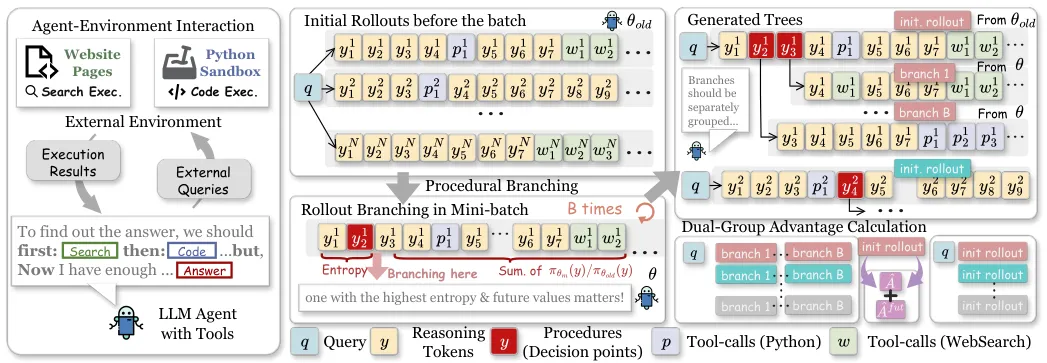
Prior agentic RL methods such as ARPO branch rollouts at heuristic units, usually tool-call boundaries. APPO’s Figure 1 analysis argues this anchors exploration in the wrong place: high-entropy tokens do not cluster at tool calls, and entropy alone is a poor significance signal anyway, because some peaks are just lexically rare words. APPO instead scores every token with a product of two z-score-normalized signals: token entropy, and a discounted accumulated importance-sampling ratio that estimates how much the continuation shifts if that token changes. A token is worth branching at only when it is both uncertain and consequential.
The training loop builds a tree from that score, and the second half reshapes credit: initial rollouts and branched continuations go into separate advantage groups, and a future-aware advantage term built from the same likelihood ratio multiplies the base advantage, so tokens with more downstream influence absorb more of the reward.
The results are recipe-level gains over an already RL-tuned agent, not base-model jumps. On Qwen2.5-7B-Instruct, the 13-benchmark average rises from 58.3 (ARPO) to 62.2, with AIME24 climbing from 30.0 to 36.7. On Llama3.1-8B the average gain is +2.1. On deep search, GAIA improves from 38.8 to 42.7 on Qwen3-8B and from 43.7 to 46.6 on Qwen3-14B. The ablations say where the value lives: removing the future-aware advantage costs 3.4 points, dropping dual-group grouping costs 2.1, and reducing the branching score to entropy-only costs 1.8.
LongTraceRL: harder distractors plus a rubric that cannot be farmed
LongTraceRL targets long-context reasoning rather than tool use, and it fixes two weak points of the standard RLVR setup at once. The distractor documents are too easy, because padding a context with random passages teaches a model to ignore obviously unrelated text rather than to discriminate. And an outcome-only reward happily reinforces a model that guesses the right final answer while skipping the intermediate reasoning.
Both fixes come from the trajectories of a search agent solving multi-hop questions. Documents the agent opened and read but did not cite become Tier-1 distractors, topically adjacent and entity-overlapping enough to fool a capable reader; documents it never opened become easy Tier-2 padding. The entities the agent had to chain through become a process reward: the fraction of gold entities that appear in the response. Critically, the rubric bonus is applied positive-only, granted only when the final answer is already correct, so a model cannot farm reward by spraying gold entities into a wrong answer.
On Qwen3-4B-Thinking-2507 the five-benchmark average rises from 53.3 to 59.0. The gains track the bottleneck: MRCR jumps 36.2 to 45.8 (+9.6) and AA-LCR 33.2 to 41.8 (+8.6), both retrieval-heavy tasks where the needle hides among confusable distractors, while FRAMES (+2.8) and LongBench v2 (+2.4) move less because the baseline was already strong there. The rubric ablation isolates its own contribution: GRPO with tiered distractors but no rubric lands at 53.7 versus 59.0 with it. Scaling is not restricted to 4B: Qwen3-30B-A3B improves 60.5 to 63.7, though DeepSeek-R1-0528-Qwen3-8B gains only +1.1, a hint the recipe is tuned to the Qwen3-Thinking family.
SDAR: dense signal from a teacher the same size as the student
SDAR attacks sparsity directly. In multi-turn tasks such as ALFWorld, Search-QA, and WebShop, GRPO gives gradient only on the end-of-episode bit, so the method adds an auxiliary on-policy self-distillation loss on top of GRPO. The teacher is not a bigger model; it is the same policy given retrieved skills as privileged context that the student does not see at inference. Because teacher and student differ only by context, the distillation target is cheap and on-policy.
The engineering contribution is a per-token sigmoid gate over the teacher-student log-prob gap. The motivation is empirical: in the multi-turn setting more than half of tokens show a negative gap, meaning the skill-augmented teacher is actually worse there, because skill retrieval is imperfect. Ungated distillation would copy those errors; the gate amplifies distillation where the teacher is genuinely better and attenuates it elsewhere. A random-retrieval ablation makes the point cleanly: even with noise as skills, ALFWorld still gains +1.9, so the gate is salvaging a weak signal rather than depending on a strong one.
The gains over plain GRPO are consistent across three Qwen model sizes. On Qwen2.5-3B-Instruct: ALFWorld 75.0% to 84.4% (+9.4), Search-QA 36.4% to 43.4% (+7.0), WebShop accuracy 63.3% to 68.0% (+4.7). On Qwen2.5-7B-Instruct: WebShop 72.6% to 82.8% (+10.2), with ALFWorld +4.7 and Search-QA +7.0. The largest single number, +20.3 on WebShop, belongs to Qwen3-1.7B where the baseline was weakest at 38.3%, which is the honest caveat: the method helps most where there is the most room.
SCOPE: self-play when there is no verifier and no data
Math and code support self-play because answers are rule-checkable. Open-ended tasks such as deep research, scholarly QA, planning, and creative writing have no such oracle, so prior work either curated datasets or rented a frontier-model judge. SCOPE removes both. One base model is split into three roles: a Challenger that writes document-grounded questions pitched in the hard-but-solvable band, a Solver that answers through multi-turn retrieval, and a Judge that is a frozen snapshot of the starting model, grading the Solver against a rubric derived from the source document rather than from its own parametric knowledge. Challenger and Solver are trained against each other in alternation.
The frozen judge is a deliberate constraint. A co-evolving judge could collude with the Solver on a shared shortcut; a frozen one keeps the target stationary, at the price of a reward ceiling no higher than the day-zero model’s grounded judgment.
Across eight open-ended benchmarks averaged over three base models, SCOPE lifts scores by up to +10.4 points. On Qwen2.5-7B it goes 24.4 to 34.8 after three iterations, ahead of GRPO_data at 33.4, a baseline trained on roughly 9K curated prompts that SCOPE never sees. On Qwen3-8B it reaches 43.1 versus 41.5 for the curated baseline. OLMo-3-7B is the exception: SCOPE’s 38.5 trails GRPO_data’s 39.0, so “no curated prompts needed” is an average-case claim, not a law. The result worth weighting most is transfer: on held-out short-form QA, gains reach +13.8 points across seven benchmarks, suggesting the models learn to retrieve and ground rather than to write long, rubric-friendly padding.
Key numbers
| Method | Lever it pulls | Head-to-head baseline | Headline gain | Setting |
|---|---|---|---|---|
| APPO | Branching and credit placement | ARPO (agentic RL) | 62.2 vs 58.3, +3.9 avg over 13 benchmarks; AIME24 30.0 → 36.7 | Qwen2.5-7B-Instruct, same checkpoints fine-tuned |
| APPO | Deep search transfer | ARPO | GAIA 42.7 vs 38.8; 46.6 vs 43.7 | Qwen3-8B / Qwen3-14B |
| LongTraceRL | Training-data difficulty + process reward | GRPO with standard padding | 59.0 vs 53.3, +5.7 avg over five long-context benchmarks | Qwen3-4B-Thinking-2507 |
| LongTraceRL | Rubric contribution (ablation) | Tiered distractors without rubric | 59.0 vs 53.7 | Same model, same mixing setup |
| SDAR | Dense auxiliary signal | GRPO alone | WebShop-Acc 82.8% vs 72.6% (+10.2); ALFWorld +9.4, Search-QA +7.0 | Qwen2.5-7B / 3B-Instruct |
| SDAR | Gate vs no gate evidence | Random retrieval ablation | +1.9 on ALFWorld even with noise skills | Qwen2.5-3B |
| SCOPE | Data-free, judge-free training | GRPO_data (~9K curated prompts) | 34.8 vs 33.4 on Qwen2.5-7B; 43.1 vs 41.5 on Qwen3-8B | Eight open-ended benchmarks, 3 iterations |
| SCOPE | Curated data still wins | GRPO_data on OLMo-3-7B | 38.5 vs 39.0, the one base where SCOPE trails | Same benchmark suite |
Read this table for what it does not contain. No pair of rows shares a model, a task set, and a harness, so the columns tell you what each lever buys over its own matched baseline, not which method wins. APPO’s +3.9 and LongTraceRL’s +5.7 are not comparable numbers; they are comparable evidence that the lever works.
What the numbers do not prove
Every gain here is a training-recipe improvement measured against an RL baseline on the same checkpoints, not a capability jump over the base model. APPO’s Pass@K curves widen as k grows, which suggests it reshapes the distribution of candidate trajectories more than it makes the first sample reliably better, so single-sample deployments may see less than the averages imply. LongTraceRL’s supervision signal is defined by one particular search agent’s reading behavior, which makes the method somewhat self-referential: a weaker agent produces easier distractors and a noisier rubric. SDAR’s teacher is the same model with extra context, so it cannot teach what the model fundamentally does not know, and whether it beats simply distilling from a genuinely bigger model is left open. SCOPE caps its own reward at the frozen judge’s quality, which its authors name as the bottleneck.
When to use which
- You already run agentic RL with tool calls and want the cheapest upgrade: start with APPO’s branching score. The criterion is a drop-in replacement for tool-call-boundary branching, and the ablations show the future-aware advantage term is where most of the 3.4-point ablation value sits.
- Your bottleneck is long context full of plausible-but-wrong passages: LongTraceRL. Tier-1 distractors plus a positive-only rubric directly target the needle-among-lookalikes failure mode, and the gains are largest exactly there (MRCR +9.6).
- Rewards are sparse, you have retrieval infrastructure, and you cannot afford a bigger teacher: SDAR. The teacher is free because it is the same model, nothing changes at inference time, and the gate keeps imperfect retrieval from poisoning training.
- No verifier, no curated data, no budget for a frontier judge: SCOPE is the only option of the four that manufactures both the tasks and the reward internally. Accept the reward ceiling, and prefer it for document-grounded skills rather than open-ended creativity.
- Your task already has a checker (math, code, structured extraction): none of this is necessary. Plain GRPO with the verifier is simpler and likely stronger; SCOPE’s own authors say so.
Limits and open questions
The four papers do not compose in any measured sense. APPO’s branching tree plus LongTraceRL’s distractors plus SDAR’s gate is an attractive stack, but no paper stacks them, and the interaction between a denser reward and a denser signal is exactly where double-counting credit could silently hurt. Compute accounting is thin across the board: APPO reports only “comparable” tool-call counts without a hard budget number, and SDAR’s gating overhead per step is not priced in throughput terms. Scale is also mostly untested; SCOPE stops at 8B and SDAR at 7B, so whether the mechanisms survive contact with 70B agents and real product trajectories is an open question, not a settled one.
FAQ
What is agentic RL?
Agentic RL is reinforcement learning for models that act over multiple turns (searching, browsing, using tools) rather than producing one answer. The defining difficulty is credit assignment: the environment returns one outcome signal per episode, and the method must decide which of the hundreds of intermediate tokens and steps earned it. GRPO handles this poorly out of the box because it spreads one advantage uniformly across the trajectory.
How is agentic RL different from RLHF?
RLHF, the PPO-or-DPO loop used to align chat models, trains against a learned preference reward on single responses. Agentic RL trains multi-turn trajectories, usually against verifiable outcomes (task success, correct answer), and the research frontier is credit assignment: branching rollouts where decisions happen, adding process rewards, distilling dense per-token signal, or generating the training data itself through self-play.
Which agentic RL method has the biggest gains?
Against its own baseline, SDAR posts the largest single number (+20.3 on WebShop for Qwen3-1.7B), but the baseline there was weak (38.3%). The most evenly supported gains are APPO’s +3.9 over ARPO across 13 benchmarks and LongTraceRL’s +5.7 across five long-context benchmarks, both on models that were already RL-tuned. Cross-paper comparisons are not meaningful because no shared harness exists.
Do these methods need a bigger teacher model?
Only SDAR uses a teacher, and it is deliberately the same model given privileged context, so no external or larger model is required. SCOPE goes further and uses a frozen copy of the starting model as judge. APPO and LongTraceRL use no teacher at all; they change rollout structure and reward design respectively.
Can these methods be combined?
Nothing in the papers forbids it, and the layers are mostly orthogonal: APPO changes where rollouts branch, LongTraceRL changes the data and reward, SDAR adds an auxiliary loss, and SCOPE replaces the data source. But no published result stacks them, and dense-reward-plus-dense-signal combinations risk double-counting credit, so treat stacking as a research direction rather than a recipe.
One line: GRPO gives an agent one scalar per episode; APPO decides where decisions are, LongTraceRL makes the training problem harder and the reward denser, SDAR adds a gated same-sized teacher, and SCOPE deletes the data and the judge. Read the linked papers for the full numbers and limits.