
Vision Foundation Models · Self-Supervised Learning · Multimodal Models
CLIP vs DINOv2: Language-Aligned or Frozen Self-Supervised Features?
CLIP learns from 400M image-text pairs and classifies zero-shot via text prompts; DINOv2 uses no labels on 142M curated images and ships frozen features that beat OpenCLIP on most benchmarks.
The two-line version
CLIP and DINOv2 are the two most reused visual feature extractors of the foundation-model era, and they are built on opposite bets. CLIP, from OpenAI, learns from 400 million internet image-text pairs so that images and text live in one shared embedding space; the payoff is zero-shot classification by writing prompts, no retraining. DINOv2, from Meta AI, uses no text and no labels at all: it self-supervises a 1-billion-parameter ViT on a curated 142-million-image dataset and ships frozen features that, per its paper, match or beat OpenCLIP on most benchmarks at both the image level and the pixel level. The question “CLIP or DINOv2?” is really “does my task have a language side, and is it image-level or pixel-level?”
Key numbers
Every number in this table comes from the two papers’ own pages; the categorical rows are the papers’ stated design goals.
| Dimension | CLIP | DINOv2 |
|---|---|---|
| Supervision signal | 400M internet image-text pairs (contrastive) | None: self-supervised, no labels, no text |
| Training data | 400 million (image, text) pairs scraped from the web | LVD-142M: 142M images, automatically curated and deduplicated |
| Headline model | Paired image and text encoders | 1B-parameter ViT teacher, distilled into smaller students |
| Intended usage | Zero-shot: encode label sentences, pick the closest | Frozen backbone + lightweight probe (e.g. a linear classifier) |
| Language interface | Native: one shared embedding space for text and images | None: no text encoder, no prompt mechanism |
| Headline result | Zero-shot matches the original ResNet-50 on ImageNet without any of its 1.28M labeled training images | Distilled students surpass OpenCLIP, the best all-purpose features at the time, on most image-level and pixel-level benchmarks |
| Task breadth claimed | Non-trivial transfer across 30+ vision datasets: OCR, video action recognition, geo-localization, fine-grained classification | All-purpose features across image distributions and tasks, with pixel-level tasks (segmentation, depth) called out as the hard case |
| Failure mode flagged by the authors | Reflects the biases and noise of uncurated web data; accuracy is sensitive to prompt wording | Wins are “most benchmarks, not all”; distant domains (medical, scientific, satellite) still need their own evaluation |
The asymmetry to notice: CLIP’s headline number is a single-task equivalence (ResNet-50 on ImageNet), while DINOv2’s headline number is a breadth claim (most benchmarks, two task levels). That is not an accident. CLIP’s paper is a proof of concept that language supervision works at all; DINOv2’s paper is an engineering claim that self-supervised features are now the default backbone, full stop.
What CLIP gives you that DINOv2 does not
A language interface to vision. CLIP’s shared text-image space means you steer the model by writing sentences. Classification is a photo of a {label}, retrieval is a query string, and a safety filter or a text-to-image model can sit on the same embeddings. DINOv2 has no text encoder at all; there is nothing to prompt.
Zero-shot deployment. CLIP adapts to a new task by changing text, not weights: encode the candidate labels, score the image against them, done. The paper’s demonstration is deliberately stark: zero-shot CLIP matches the accuracy of the original ResNet-50 on ImageNet while using none of that dataset’s 1.28 million labeled training images. For a product team that ships new categories weekly, that property is worth more than a point of accuracy.
Messy-data robustness in a different sense. CLIP’s supervision is whatever caption accompanied an image on the web: noisy, biased, but effectively infinite in vocabulary. The paper is candid that the model inherits the web’s distributions, and that zero-shot accuracy moves with prompt phrasing (writing a photo of a {label} instead of the bare label word changes results). That prompt sensitivity is a real operational cost: zero-shot CLIP recognizes textual associations as much as it grounds concepts, and it is weak on systematic tasks like counting.
What DINOv2 gives you that CLIP does not
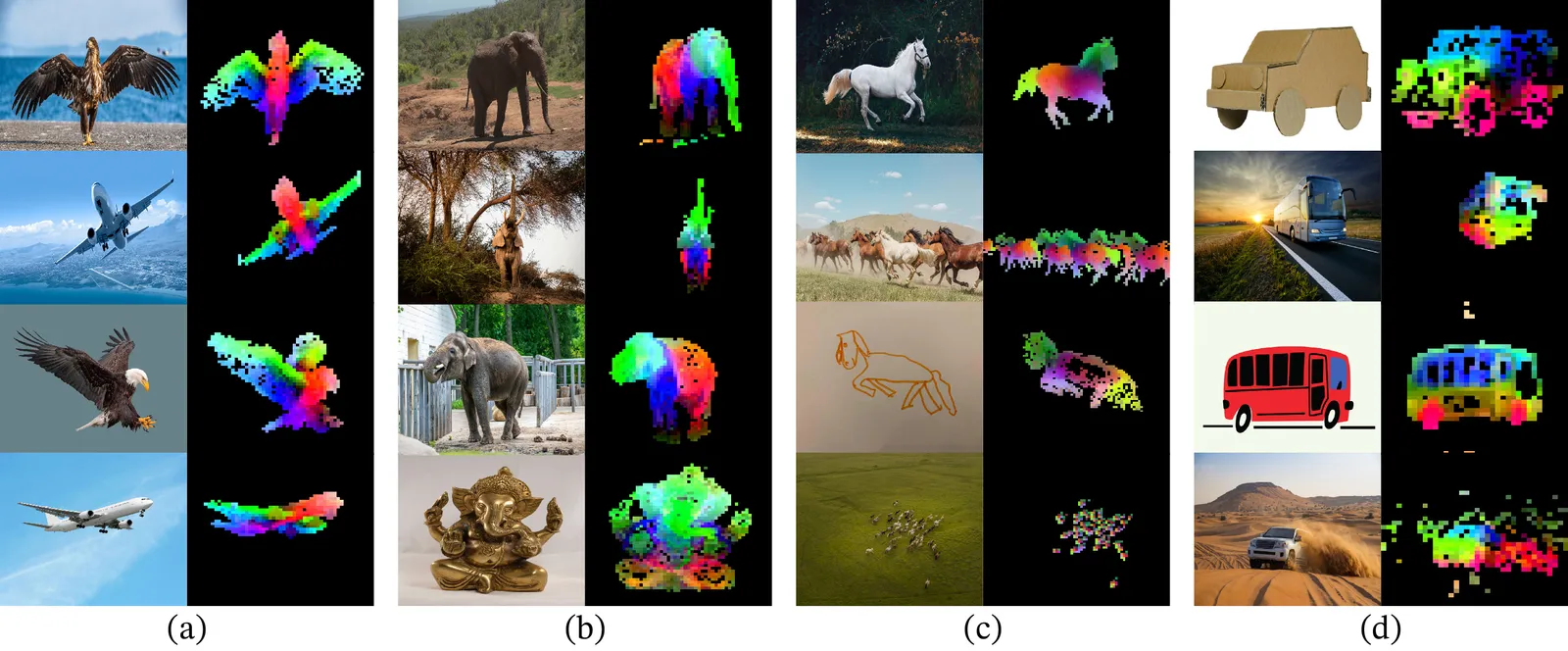
Frozen features that survive dense tasks. DINOv2’s design goal is the opposite of finetuning: keep the backbone frozen, train only a lightweight probe on top. The result that made it a default backbone is pixel-level: the paper reports frozen features good enough for segmentation and depth, dense tasks that normally demand finetuned task-specific networks, with the distilled students surpassing OpenCLIP on most benchmarks at both the image level and the pixel level. CLIP’s embeddings are pooled, image-level descriptors; pixel-level work is not what they are for.
Label-free operation end to end. No labels at training, no labels downstream, no prompts to tune. For domains where text captions barely exist (microscopy, industrial inspection, satellite scenes) CLIP’s supervision signal is thin or mismatched, while DINOv2 only asks for images. The catch, flagged on the DINOv2 paper page itself: distant domains still need their own evaluation, because self-supervised features carry no guarantee about blind spots inherited from what the curated set excludes.
A portable data lesson. DINOv2’s most reusable idea is not architectural: it is the claim that curation, not raw scale, drives transferability, implemented as an automatic filtering and deduplication pipeline that assembles LVD-142M from raw sources with no task labels involved. CLIP is the opposite lesson from the same era: at web scale, messiness washes out. Both lessons generalize; they just point at different parts of the pipeline.
When to use which
- Zero-shot classification, image-text search, content moderation, or any task where categories arrive as words: CLIP. Prompt engineering is cheaper than any training run.
- Segmentation, depth estimation, correspondence, or any pixel-level task: DINOv2. This is the paper’s headline strength and CLIP’s structural weakness.
- A frozen feature extractor you will reuse across many tasks without labels: DINOv2, specifically a distilled student rather than the 1B teacher; the paper’s own guidance is that the students already surpass prior all-purpose features.
- A visual backbone you plan to fine-tune, with a language component in the product: CLIP-family backbones keep the text pathway open; DINOv2 gives you the visual side.
- Domain imagery far from the web (medical, scientific, satellite): trust neither until evaluated. DINOv2’s page says this explicitly; CLIP inherits web bias by construction. Budget an eval set before committing.
- Both, in practice: retrieval and reranking stacks routinely encode images with both feature types, because CLIP similarity answers “does this match the query” while DINOv2 features answer “is this visually the same thing.”
Limits and open questions
The two papers do not share an evaluation harness, and their headline numbers are not directly comparable: CLIP’s ResNet-50-equivalence claim is a single benchmark equivalence, while DINOv2’s “most benchmarks” claim deliberately spans dozens. Neither paper’s page gives a same-harness table where CLIP and DINOv2 features are scored on identical tasks with identical probes, so any precise numeric ranking of “which is better” would be manufactured, not measured. CLIP’s prompt sensitivity means its zero-shot scores move by prompt design, not just by model quality. DINOv2’s “most benchmarks” phrasing leaves real gaps, and its 1B teacher is expensive enough that almost everyone consumes the distilled students. And both are 2021-2023 lineage: for a new deployment, treat this page as the reference for the feature-extraction trade-off, then verify against current-generation backbones trained with both supervision types.
FAQ
Is DINOv2 better than CLIP?
They optimize different things, so “better” needs a task attached. For pixel-level tasks (segmentation, depth) and frozen, label-free feature extraction, DINOv2 is the clear pick: its paper reports distilled models that surpass OpenCLIP on most image- and pixel-level benchmarks. For zero-shot classification and anything with a text interface, CLIP is the only one of the two that can do it at all.
What is the biggest difference between CLIP and DINOv2?
Supervision. CLIP learns from 400 million image-text pairs, so its features are aligned with language and it can classify zero-shot by comparing against text prompts. DINOv2 uses no text and no labels, trains on 142 million curated images (LVD-142M), and produces frozen features meant to be reused behind a lightweight probe. CLIP’s output is queryable by language; DINOv2’s is not.
Can DINOv2 do zero-shot classification like CLIP?
Not in CLIP’s sense. DINOv2 has no text encoder, so there are no prompts to encode labels with. Its usage pattern is the opposite: freeze the backbone, train a small probe (often just a linear classifier) on your labeled data, and let the pretrained features do the heavy lifting. With no probe and no labels, you get features, not predictions.
Which is better for segmentation, CLIP or DINOv2?
DINOv2, per its paper’s own claims. The headline result on the DINOv2 page is that frozen features work at the pixel level (segmentation and depth), which is precisely the task type that normally requires finetuned task-specific heads. CLIP’s architecture produces pooled image-level embeddings aligned to text, not dense per-pixel features.
Do I need the 1B-parameter DINOv2 model?
Usually not. The 1B ViT is the teacher; it is distilled into smaller students that the paper reports already surpass prior all-purpose features. For most applications a distilled student delivers the quality without the training or serving cost of the teacher.