
Language Models · LLM Reasoning
GPT-4 vs GPT-3: What Changed When Frontier Labs Stopped Publishing Recipes
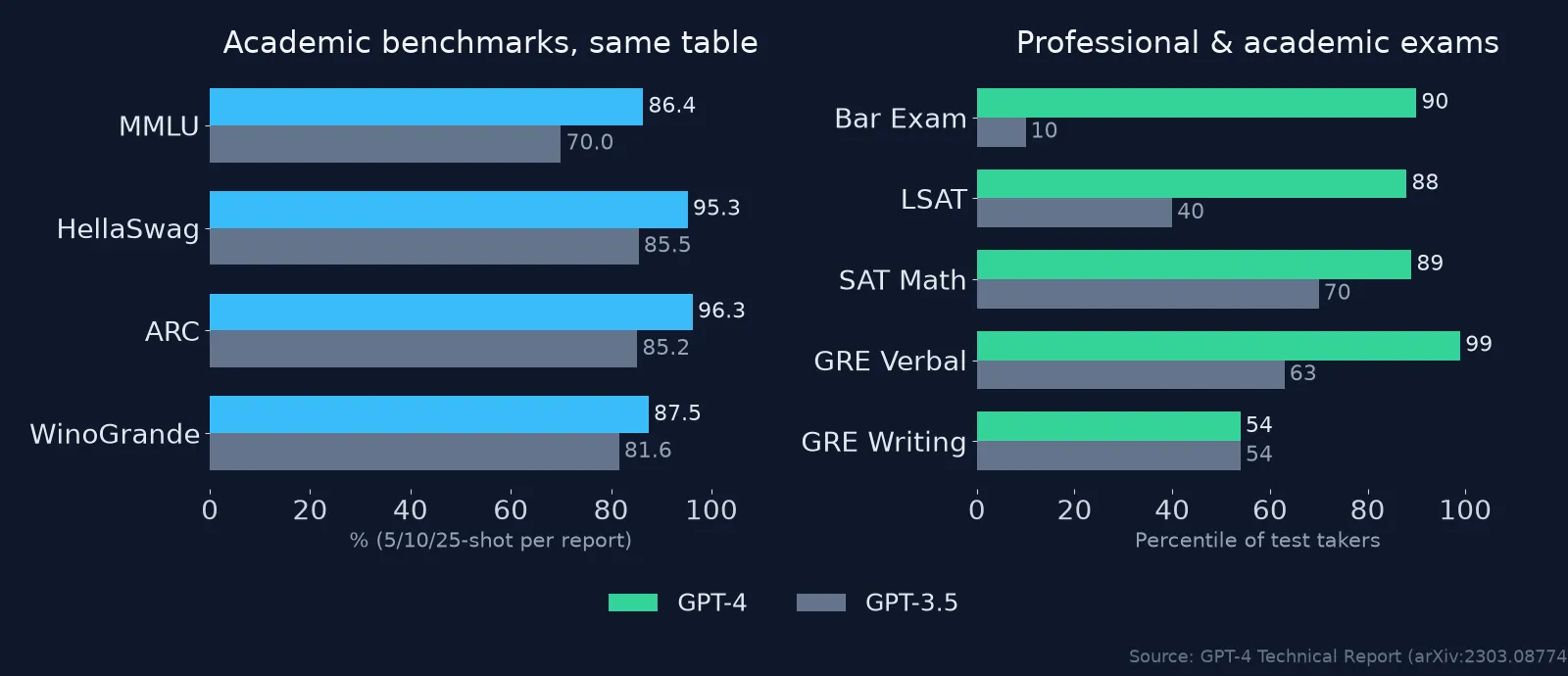
GPT-3 (2020) shipped a buildable recipe: 175B parameters, few-shot prompting. GPT-4 (2023) shipped mostly numbers: MMLU 86.4 vs 70.0, bar exam ~90th vs ~10th percentile. The honest comparison is interface vs evaluation.
Two papers, two opposite contracts with the reader
Three years separate these two papers, and they are not the same kind of document. GPT-3 (2020) is a buildable account: same decoder-only Transformer recipe as GPT-2, scaled to 175 billion parameters, trained on a web corpus the paper describes, evaluated with a method (zero/one/few-shot prompting) anyone could rerun. GPT-4 (2023) inverts that contract. OpenAI states that, given the competitive landscape and the safety implications, it discloses no architecture, parameter count, training data, or hardware. What remains is one sentence of method, a next-token Transformer plus a post-training alignment stage, and roughly a hundred pages of evaluation.
So “GPT-4 vs GPT-3” is partly a category error that this page resolves honestly: you can compare the two papers’ philosophies, interfaces, and claims, but the same-harness benchmark numbers only exist against GPT-3.5, OpenAI’s intermediate model family, not against the 175B GPT-3 of the 2020 paper.
Key numbers
| Measurement | GPT-3 (2020 paper) | GPT-4 (2023 report) | Setting and source | Same harness? |
|---|---|---|---|---|
| Parameters | 175B, disclosed | deliberately withheld | Both papers | n/a |
| Training tokens | ~300B (Chinchilla’s accounting of the corpus) | withheld | GPT-3 paper; Chinchilla paper | Different eras, both undisclosed for GPT-4 |
| Tokens per parameter | ~1.7, later flagged as undertrained | not disclosed | Arithmetic; Chinchilla paper | n/a |
| Training compute | not stated | not stated; predictable-scaling infra claimed to forecast results from models trained with ≤1/1000th the compute | GPT-4 report | n/a |
| MMLU | not reported, GPT-3 predates the eval habit | 86.4% (5-shot); GPT-3.5 scores 70.0% | GPT-4 report | Yes, one table, but the baseline is GPT-3.5 |
| HellaSwag | not reported | 95.3% (10-shot); GPT-3.5 85.5% | GPT-4 report | Yes, same table |
| ARC | not reported | 96.3% (25-shot); GPT-3.5 85.2% | GPT-4 report | Yes, same table |
| WinoGrande | not reported | 87.5% (5-shot); GPT-3.5 81.6% | GPT-4 report | Yes, same table |
| Uniform Bar Exam | not taken | 298/400, ~90th percentile; GPT-3.5 213/400, ~10th percentile | GPT-4 report, simulated exam | Yes, same exam |
| LSAT | not taken | 163 (~88th); GPT-3.5 149 (~40th) | GPT-4 report | Yes |
| SAT Math | not taken | 700/800 (~89th); GPT-3.5 590/800 (~70th) | GPT-4 report | Yes |
| GRE Quant | not taken | 163 (~80th); GPT-3.5 147 (~25th) | GPT-4 report | Yes |
| GRE Verbal | not taken | 169 (~99th); GPT-3.5 154 (~63rd) | GPT-4 report | Yes |
| GRE Writing | not taken | 4/6 (~54th), identical to GPT-3.5’s 4/6 | GPT-4 report | Yes |
| Headline capability | few-shot in-context learning: LAMBADA ~86%, TriviaQA ~71%, weights frozen | human-level exam breadth; multimodal input, text+image in, text out | Respective papers | Different questions |
Read the table for its gaps. The entire same-harness block compares GPT-4 to GPT-3.5, the RLHF-era sibling of GPT-3, not to the 175B 2020 model, which never sat these exams. And the GRE Writing row is the quietest evidence in the report: two models a full MMLU generation apart both land at 4/6, a reminder that exam percentiles reward some skills and not others.
What GPT-3’s 175 billion actually bought
The GPT-3 paper’s claim was never a leaderboard position. It is that scale turns the prompt into a task interface: put the instruction and a few worked examples into the context, leave the weights frozen, and the model performs. The paper tests zero-shot, one-shot, and few-shot (typically 10 to 100 examples) on every task, and the finding that mattered is the interaction: small models barely benefit from in-context examples, GPT-3 benefits a lot.
The concrete numbers on the GPT-3 page: roughly 86% on the LAMBADA cloze task few-shot, well above prior zero-shot state of the art; around 71% on open-domain TriviaQA, competitive with fine-tuned systems that saw far more supervision; and synthetic on-the-fly tasks like letter unscrambling, using a newly defined word in a sentence, and 3-digit arithmetic, which earlier language models could not do from a prompt at all. Human evaluators performed near chance at telling GPT-3-generated short news articles from human-written ones. The legacy is the interface shift: task adaptation moved out of the optimizer and into the context window.
The GPT-3 page is also candid about the fragility: few-shot numbers swing with prompt wording, example order, and example choice, and later work, notably the Chinchilla paper, calculated that GPT-3’s ~1.7 tokens per parameter left it badly undertrained for its size.
The bridge InstructGPT built
Between the two papers sits the result that made GPT-4’s release format possible. InstructGPT aligned GPT-3 with a three-step RLHF recipe: supervised fine-tuning on human demonstrations, a reward model trained on human rankings, and PPO optimization against that reward with a KL penalty. The headline number inverts the scaling assumption of the GPT-3 paper: on OpenAI’s own prompt distribution, evaluators preferred outputs from the 1.3B-parameter InstructGPT over the 175B GPT-3, a 100x parameter gap lost on the metric users actually feel.
The catch, documented on the InstructGPT page, is the alignment tax: RLHF regressed some public NLP benchmarks, only partially recovered by mixing pretraining gradients back into PPO. But the recipe stuck, and it is the reason the GPT-4 report compares against GPT-3.5 rather than raw GPT-3. GPT-4’s “post-training alignment stage” is, in one sentence, InstructGPT’s pipeline at frontier scale, which is also why the honest same-harness baseline for GPT-4’s table is the aligned intermediate model, not the 2020 few-shot paper model.
What GPT-4’s report actually documents
Everything substantive in the GPT-4 report is measurement, not construction. The strongest and most quoted results: the simulated Uniform Bar Exam at 298/400, around the 90th percentile of test takers, against GPT-3.5’s 213/400 near the 10th; GRE Verbal at 169 (~99th) against 154 (~63rd); MMLU at 86.4% against 70.0%, all from one evaluation table in the report. The multimodal claim is real but narrow: GPT-4 accepts interleaved image and text input and reasons over charts, diagrams, and exam figures, while outputting text only.
The technically most interesting disclosure is predictable scaling: OpenAI claims infrastructure and optimization methods that behave consistently across scales, accurate enough to forecast aspects of GPT-4’s performance from models trained with no more than 1/1,000th of its compute. For a frontier run that is a single enormously expensive bet, that turns training from a lottery into something closer to engineering, and it is precisely the part a competitor would want and least receive.
The report is equally direct about what did not change. GPT-4 still hallucinates, still has a fixed knowledge cutoff, still does not learn from experience, and remains, in OpenAI’s own words, less capable than humans in many real-world scenarios. Post-training alignment improved measured factuality and behavior over the base model, the same direction InstructGPT demonstrated at 1/100th the drama.
Reading the head-to-head honestly
Three caveats before quoting any row. First, the exam percentiles are the report’s strongest marketing and its weakest evidence: standardized tests reward exactly what a next-token model trained on web text does well, recall and pattern-matching on problems with clean answers, and the GRE Writing tie shows the ceiling. Second, every same-harness number is GPT-4 against GPT-3.5; the 175B GPT-3 of the 2020 paper predates MMLU, the bar-exam simulation, and RLHF, so “how much better is GPT-4 than GPT-3” has no controlled measurement anywhere, only philosophy-to-philosophy comparison. Third, reproduction is impossible by design, so no external party can audit the training data for contamination or rerun the evals; the numbers are taken partly on trust.
When to use which
- You want to understand the modern LLM interface: read GPT-3. Few-shot in-context learning, with its sensitivity to wording and example order, is the behavior every prompt-engineering practice still manipulates.
- You want a recipe you can actually reproduce: GPT-3 is one of the last frontier-scale papers that tells you the architecture, size, and data. GPT-4 tells you nothing buildable, and says so on purpose.
- You are building on top of a frontier API: GPT-4 is the paper that defined your constraints. Benchmark opacity, a system card, and withheld construction are the permanent conditions you design around, not a temporary state.
- You are comparing models for procurement or research: use the GPT-4 report’s own table format, demand same-harness numbers against a named baseline, and treat any “GPT-4 vs GPT-3” claim without a named GPT-3 variant as marketing. GPT-3, GPT-3.5, and the instruct-tuned derivatives are different models, and the report’s baseline is explicitly GPT-3.5.
- You study how the field got here: the three-paper arc, scale buys an interface, alignment beats size for helpfulness, evaluation replaces disclosure, is the cleanest narrative of 2020 to 2023 frontier AI that the primary sources themselves tell.
Limits and open questions
The comparison this page cannot make is the one people most want: GPT-4 and GPT-3 under one harness, one era of evals. GPT-3’s page predates MMLU and was never run on the bar exam; GPT-4’s report never ran the LAMBADA and TriviaQA few-shot suite. Even parameter count, the simplest axis, is unknown for GPT-4. The predictable-scaling claim is stated but its method is not disclosed, so it cannot be checked. And both papers’ exam-style evidence says little about reliability on open-ended, multi-step real work, the gap that GPT-4’s own report concedes. What survives all caveats is narrower and more durable: GPT-3 proved a huge frozen model can carry a task in its context; InstructGPT proved behavior is trained, not scaled into; GPT-4 proved that frontier capability can be exhaustively evaluated in public while its construction stays private. Three separate facts, three separate papers.
FAQ
Is GPT-4 bigger than GPT-3?
Unknown. GPT-3’s 175 billion parameters are disclosed in its paper; OpenAI deliberately withheld GPT-4’s parameter count, training data, and compute, citing competitive and safety concerns. Any specific GPT-4 size you have seen quoted is a guess, not a paper number.
What is the GPT-4 vs GPT-3 MMLU score?
There isn’t one. GPT-3’s 2020 paper predates MMLU and never reports it. The GPT-4 report’s table shows GPT-4 at 86.4% (5-shot) against GPT-3.5 at 70.0% on the same benchmark, and GPT-3.5 is a later, aligned model family, not the 175B GPT-3 paper model.
How much better is GPT-4 than GPT-3.5 on exams?
From the GPT-4 report’s own table: Uniform Bar Exam 298/400 (~90th percentile) vs 213/400 (~10th); LSAT 163 (~88th) vs 149 (~40th); SAT Math 700 (~89th) vs 590 (~70th); GRE Verbal 169 (~99th) vs 154 (~63rd); GRE Writing 4/6 vs 4/6, a tie. The exam gaps are large everywhere except writing.
What did GPT-3 do that GPT-4 didn’t?
Publish a buildable recipe. GPT-3 disclosed its architecture, parameter count, and data sources, and introduced few-shot prompting as the task interface. GPT-4’s report documents capability and deployment behavior but no construction details, the moment frontier releases split into “evaluated in public, built in private.”
Why is there no controlled GPT-4 vs GPT-3 benchmark?
The two papers are three years and a whole alignment era apart. GPT-3 was evaluated on few-shot LAMBADA (~86%) and TriviaQA (~71%); GPT-4 was evaluated on MMLU, professional exams, and multimodal inputs, with GPT-3.5 as its baseline. Nobody has run both models across both suites under one harness, so cross-paper comparisons rest on philosophy and claims, not shared measurements.