
Open Models · Language Models · Efficient AI
Qwen2.5 vs Gemma: same-harness 91.6 vs 76.7, and the license split
In the Qwen2.5 report's own table, Qwen2.5-7B-Instruct beats Gemma2-9B-It 91.6 to 76.7 on GSM8K; Gemma 1's own-paper numbers use a different harness, and only half of the Qwen2.5 ladder is Apache 2.0.
The two-line version
Qwen2.5 is Alibaba’s open-weight ladder from 0.5B to 72B, pretrained on 18 trillion tokens, whose 7B instruct model beats Google’s Gemma2-9B-It across all eight benchmarks in Qwen’s own evaluation table. Gemma is Google DeepMind’s earlier open release, 2B and 7B distilled from Gemini research, which won 11 of 18 text tasks against its contemporaries and shipped with a responsible-release framing that became a template. The comparison looks like a clean win for Qwen2.5 on paper, and mostly is, but three caveats do real work: the clean table is first-party, the on-site Gemma paper is Gemma 1 while the table uses its successor Gemma 2, and the license story splits both families in half.
Key numbers
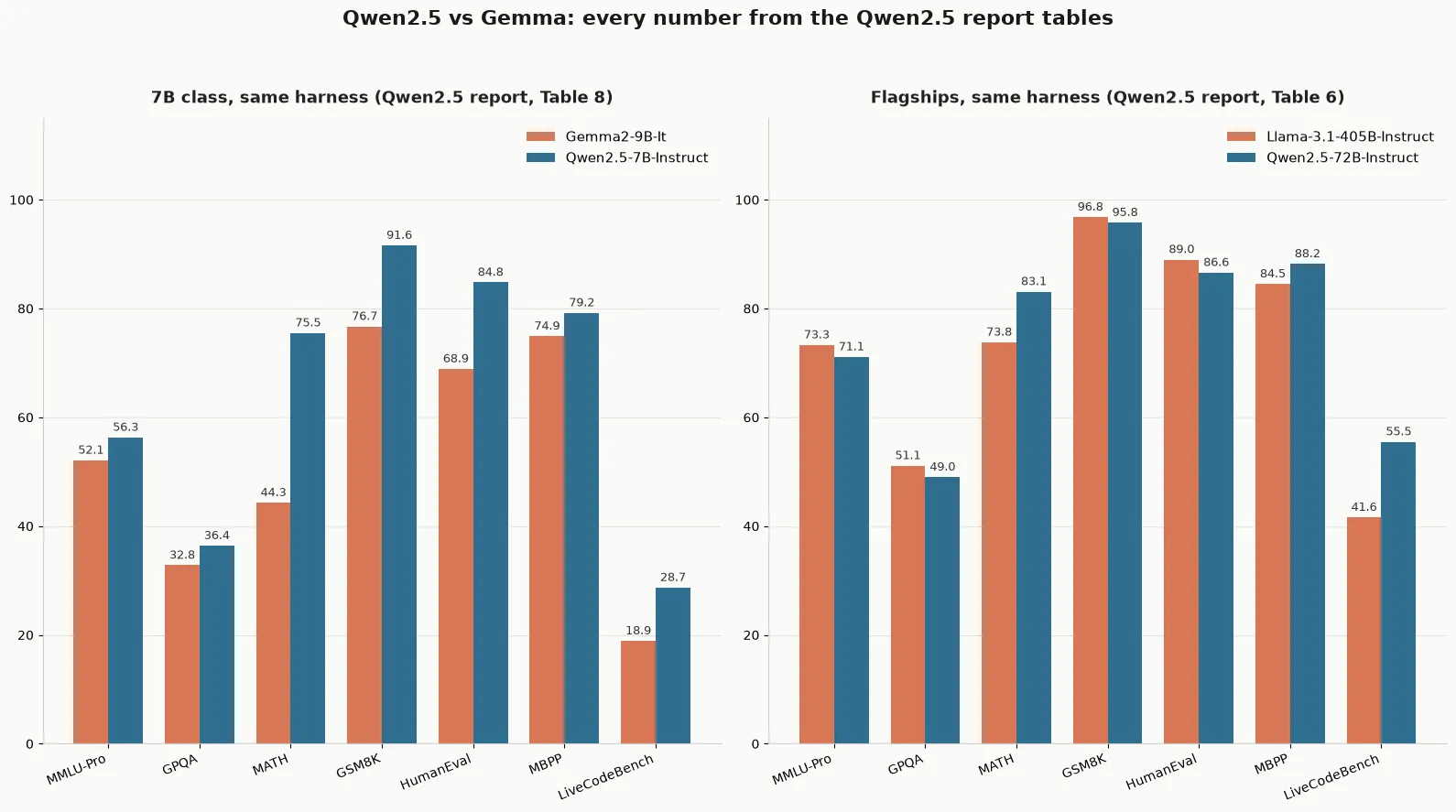
The single best cross-family table is Table 8 of the Qwen2.5 technical report, where the Qwen team ran Qwen2.5-7B-Instruct against Gemma2-9B-It, Llama-3.1-8B-Instruct and Qwen2-7B through one evaluation pipeline. All eight numbers below come from that one table, same harness.
| Benchmark | Gemma2-9B-It | Qwen2.5-7B-Instruct | Gap |
|---|---|---|---|
| MMLU-Pro | 52.1 | 56.3 | +4.2 |
| MMLU-redux | 72.8 | 75.4 | +2.6 |
| GPQA | 32.8 | 36.4 | +3.6 |
| MATH | 44.3 | 75.5 | +31.2 |
| GSM8K | 76.7 | 91.6 | +14.9 |
| HumanEval | 68.9 | 84.8 | +15.9 |
| MBPP | 74.9 | 79.2 | +4.3 |
| LiveCodeBench | 18.9 | 28.7 | +9.8 |
Two patterns matter more than the sweep. First, the blowouts are exactly where post-training math and code ability concentrates: MATH +31.2, HumanEval +15.9, GSM8K +14.9. Qwen2.5’s post-training stack (over 1 million curated SFT samples plus multistage preference RL) was aimed at these skills, and the table shows it. Second, on broad knowledge the margin collapses to single digits: MMLU-Pro +4.2, GPQA +3.6. Knowledge is parameter- and data-bound, and a 7B model stays a 7B model.
One framing note before treating this as settled: Table 8 is Qwen’s own harness on Qwen’s own paper. The direction of every gap is consistent across all eight rows, which is more trustworthy than any single number, but the absolute values would move a point or two under a neutral harness.
Which Gemma, exactly?
This is the part most “Qwen2.5 vs Gemma” posts blur. The on-site Gemma paper covers Gemma 1, released in February 2024 in 2B and 7B sizes. The model Qwen’s table actually ran is Gemma2-9B-It, the successor from June 2024, one size class up from Qwen2.5-7B. So the honest comparison structure is two layers:
| Measurement | Gemma 7B (Gemma paper) | Qwen2.5-7B (Qwen2.5 report) | Same harness? |
|---|---|---|---|
| MMLU (5-shot, base) | 64.3 | 74.2 | No |
| GSM8K (7B instruct) | 46.4 | 91.6 | No |
| MATH | 32.3 | 75.5 | No |
| HumanEval (pass@1) | ~32 | 84.8 | No |
| HellaSwag | 81.2 | not reported | n/a |
Read this table as “not directly comparable” in every row: different papers, different harnesses, and the Gemma side is first-generation. What survives the caveat is the shape: Qwen2.5-7B’s numbers sit far above Gemma 1 7B on math and code, and even further above what the 10-month-older release could have reached on long-context use, because Gemma 1’s context is 8,192 tokens against Qwen2.5-7B’s 128K. For the record, Gemma 1’s own-paper claim still stands on its own terms: it beat similarly sized open models on 11 of 18 text tasks, in its own comparison set, at release time.
What Qwen2.5 adds that Gemma never had
A size ladder. Qwen2.5 ships base and instruct checkpoints at 0.5B, 1.5B, 3B, 7B, 14B, 32B and 72B, plus quantized builds. For a team picking a model to fit specific hardware, that spread is the feature: phone-scale 0.5B to server-scale 72B from one lineage, one tokenizer, one chat template. Gemma 1 stops at 2B and 7B.
Pretraining scale. Qwen2.5’s 18 trillion tokens are 2.6x the 7 trillion of Qwen2 and three times Gemma 1’s 6 trillion. The report credits this jump, plus data curation, for the broad base-model gains across understanding, reasoning, math and code.
A real long context. Both 7B and 72B instruct models carry 128K context with 8K maximum generation, and the hosted Qwen2.5-Turbo variant extends to 1 million tokens. Gemma 1’s 8K context was standard for early 2024 but is a different product class for document and repository work.
A foundation lineage. Alibaba built Qwen2.5-Math, Qwen2.5-Coder, the QwQ reasoning model and multimodal variants on this base, so its quality propagated through the open ecosystem well beyond the flagship. Gemma seeded Gemma 2 and later families, but the on-site paper’s contribution is the release strategy itself, not a new method: the architecture is deliberately standard (multi-query attention on 2B, multi-head on 7B, rotary embeddings, GeGLU, RMSNorm), and the engineering signature is a 256K-entry SentencePiece tokenizer that carries more information per token at the cost of a fat embedding table.
A flagship efficiency claim. Table 6 of the same report puts Qwen2.5-72B-Instruct within reach of Llama-3.1-405B-Instruct, a model 5.6x larger, on the same eight-benchmark style table: MMLU-Pro 71.1 versus 73.3, MATH 83.1 versus 73.8 (where Qwen leads), GSM8K 95.8 versus 96.8, LiveCodeBench 55.5 versus 41.6 (a wide Qwen lead). Same first-party caveat as Table 8 applies.
The license trade neither side advertises
“Open” splits differently for each family, and the split is by size.
| Size | Qwen2.5 license | Gemma 1 license |
|---|---|---|
| Small (≤3B) | Apache 2.0 at 0.5B/1.5B; 3B is Qwen Research (non-commercial) | Gemma Terms of Use (commercial allowed, prohibited-use policy) |
| Mid (7B–14B–32B) | Apache 2.0 | n/a |
| Flagship | 72B under the Qwen license (commercial use with a 100M-MAU ceiling) | n/a |
So the most-used Qwen2.5 sizes, 7B and 14B, are Apache 2.0 with essentially no strings, which is friendlier than the Gemma custom terms for standard commercial deployment. But Qwen2.5’s flagship sits under a custom license with a user ceiling, and its 3B research-only slot is a trap for anyone assuming the whole ladder is permissive. Gemma’s terms are uniform across the family: commercial use allowed, with a use-restriction policy attached. Neither family is “open source” in the OSI sense; both are open-weight with conditions.
When to use which
- A 7B-class instruct model for math- or code-heavy workloads, self-hosted: Qwen2.5-7B-Instruct, decisively on the evidence above: GSM8K 91.6 vs 76.7, HumanEval 84.8 vs 68.9, MATH 75.5 vs 44.3, plus 128K context, all under Apache 2.0.
- Smallest possible footprint, 2B scale: Gemma’s 2B tier has no Qwen2.5-era equivalent in this comparison; Qwen2.5 starts at 0.5B but the Gemma 2B was tuned for exactly that slot. Benchmark them on your task before deciding, because first-party tables do not cover this size.
- Maximum open quality from this generation: Qwen2.5-72B-Instruct, with the Qwen license attached. It stays within 2.2 points of a 5.6x-larger Llama-3.1-405B on MMLU-Pro in the report’s own table.
- Strictly permissive licensing on a flagship: neither. Qwen2.5-72B has a 100M-MAU ceiling and Gemma carries use restrictions. This is the one requirement where both families lose.
- A new deployment in 2026: treat both as lineage. Pick a current-generation open model and apply the same discipline this page uses: same-harness tables first, first-party tables flagged, license read per size.
Limits and open questions
Every same-harness number here is first-party, from the Qwen2.5 report, which has an interest in the outcome; the consistent eight-row sweep is reassuring but not a substitute for an independent rerun. The Gemma side of the comparison is generational muddled by design of what was published where: the on-site Gemma paper documents Gemma 1, while the only same-harness Gemma column available to us is Gemma2-9B-It, a successor model one size class larger. Neither paper releases training data, so the math and code gaps cannot be cleanly decomposed into pretraining scale versus post-training recipe. The 11-of-18 Gemma claim and the 5x-flagship Qwen claim both use the vendor’s own comparison set. LiveCodeBench in particular is version-sensitive, and the report’s 28.7 for a 7B model should be read with the benchmark version attached. And as with every evergreen comparison on this site, both papers are from 2024; use the page to learn the evaluation discipline, not to choose today’s deployment.
FAQ
Is Qwen2.5 better than Gemma?
On the numbers both teams published, yes for the 7B instruct class. In Table 8 of the Qwen2.5 report, Qwen2.5-7B-Instruct beats Gemma2-9B-It on all eight benchmarks, with the biggest gaps on MATH (75.5 vs 44.3), HumanEval (84.8 vs 68.9) and GSM8K (91.6 vs 76.7). Caveats: the table is Qwen’s own harness, and Gemma2-9B is one size class larger and a generation newer than the 7B Gemma 1 covered by the on-site paper.
What is the difference between Qwen2.5 and Gemma licenses?
Qwen2.5 is split by size: 0.5B, 1.5B, 7B, 14B and 32B are Apache 2.0; the 3B is research-only; the 72B flagship uses the Qwen license with commercial use allowed below 100 million monthly active users. Gemma uses one custom license for the family, the Gemma Terms of Use: commercial use is allowed but carries a prohibited-use policy. For a standard commercial deployment at 7B, Qwen2.5’s Apache 2.0 is the simpler legal path; for a restricted-use flagship, neither family is fully permissive.
How do Qwen2.5 and Gemma compare on context length?
Qwen2.5-7B-Instruct supports 128K context tokens with 8K maximum generation; Qwen2.5-72B matches it, and the hosted Qwen2.5-Turbo extends to 1M tokens. Gemma 1’s context is 8,192 tokens for both the 2B and 7B models. For long-document, repository-level or multi-turn agent workloads, that is a 16x difference in stated context.
Is Qwen2.5-72B really competitive with Llama-3.1-405B?
In the Qwen2.5 report’s Table 6, yes, with the first-party caveat attached. Qwen2.5-72B-Instruct scores 71.1 on MMLU-Pro versus 73.3 for Llama-3.1-405B-Instruct, leads on MATH 83.1 to 73.8, and leads LiveCodeBench 55.5 to 41.6, while trailing slightly on GSM8K (95.8 vs 96.8). Against a model 5.6x its size, that is the report’s central efficiency claim; independent reruns should be checked before treating the margins as exact.
Does the Gemma 11-of-18 claim still hold against Qwen2.5?
No. That claim was measured against early-2024 contemporaries (Mistral 7B, Llama 2 13B, and similar) on the Gemma team’s own 18-task set. Qwen2.5 arrived ten months later with 3x the pretraining tokens and a math-and-code-focused post-training stack, and the same-harness table shows it ahead on every shared benchmark. The 11-of-18 result is historically accurate and was a real achievement at release; it is not a statement about Qwen2.5.