
Multimodal Models · AI Agents · LLM Reasoning
IPT vs SpatialWorld: Can VLMs Reason About Space?
IPT improves static spatial tasks by rendering imagined views (+3.4% on multiview counting), while SpatialWorld finds the strongest agents solve only 17.4% of its 760 interactive spatial tasks.
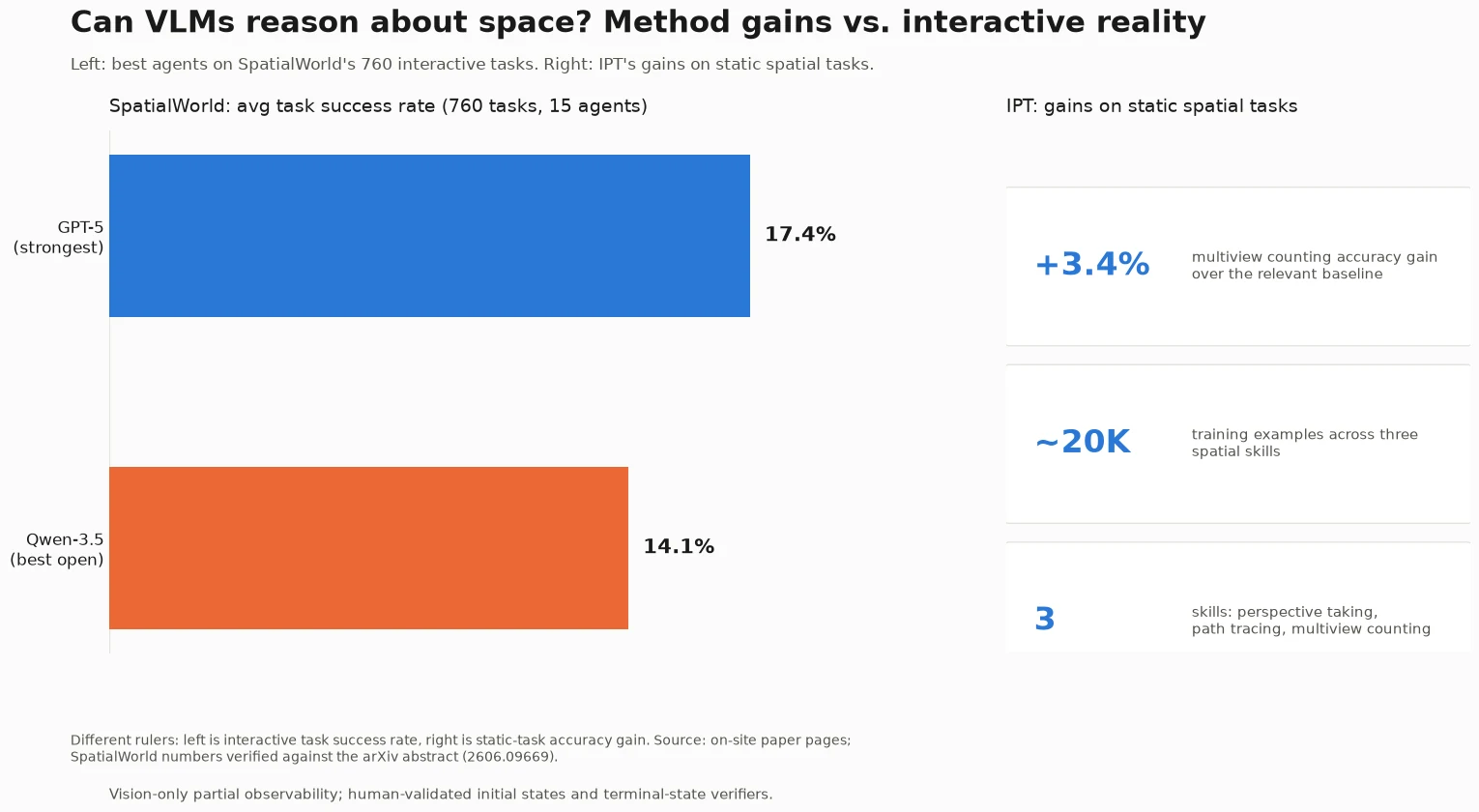
Two 2026 papers attack the same weakness, vision-language models and space, from opposite sides. Imaginative Perception Tokens (IPT) is a training method: it asks whether a VLM gets better at spatial questions when it renders an imagined viewpoint instead of narrating its reasoning in text. SpatialWorld is a benchmark: it asks how well today’s best agents actually perform when spatial reasoning happens inside an interactive task, under partial observability, with the agent responsible for gathering its own visual evidence.
Read together they give a sharper picture than either gives alone. IPT reports genuine, measured gains on static spatial questions. SpatialWorld reports that, measured interactively, the strongest agent evaluated still fails more than four out of five tasks. This guide puts the two sets of numbers side by side, explains why they do not contradict each other, and tells you which one to reach for depending on what you are building.
Key numbers
| Dimension | IPT (method paper) | SpatialWorld (benchmark paper) |
|---|---|---|
| What it is | Training method: emit tokens that decode into an imagined view, then reason over that render | Benchmark: interactive spatial tasks scored by terminal-state verifiers |
| Evaluated population | One BAGEL-based open system against baselines and closed models | 15 agents across 8 heterogeneous simulation backends |
| Headline number | +3.4% multiview counting accuracy over the relevant baseline | GPT-5 17.4% average task success rate, the strongest of the 15 agents |
| Best open-model result | Open BAGEL-based system competitive with closed models on path tracing | Qwen-3.5 14.1% average TSR, the leading open-source model |
| Text chain-of-thought | Sometimes degrades spatial accuracy; narrating geometry is a modality mismatch | Named bottleneck alongside active exploration and long-horizon planning |
| Scale | 3 skills, about 20K training examples | 760 human-annotated tasks, human-validated initial states and reference trajectories |
| Observability | Static images in, one answer out | Vision-only partial observability; the agent must actively gather egocentric evidence |
Three of these rows deserve a closer look.
The 17.4% figure is an average across the whole benchmark. GPT-5 is the strongest of 15 evaluated agents on SpatialWorld, and it finishes 17.4% of the 760 tasks on average. Qwen-3.5, the leading open-source model, sits at 14.1%. That is a 3.3 point gap between the best closed and best open systems, and it is small compared to the gap between either of them and a solved benchmark. The abstract also reports a clear mismatch between task success and execution efficiency, meaning agents that do finish often take wasteful routes, and substantial domain-specific variation across the task families.
The +3.4% figure is a gain, not a level. IPT lifts multiview counting accuracy by 3.4 points over the relevant baseline on its three-task setup. The paper does not claim its system solves spatial reasoning; it claims that imagined-view supervision teaches something answer labels alone do not, and that the two signals stack. One honest caveat: the published page does not give the absolute counting accuracy, so the 3.4 points cannot be converted into a success rate and should not be compared with SpatialWorld’s 17.4% as if they were the same kind of number.
Both papers indict text as a spatial medium, for different reasons. IPT finds that text chain-of-thought training sometimes lowers spatial accuracy, because forcing rotation and re-identification through prose loses geometric information. SpatialWorld finds that failures concentrate in active exploration and long-horizon planning, skills that a single-turn text answer never exercises. A related line of work, cross-view revisiting, reports that letting a model re-reason across views also beats one-shot answers, which points the same direction: spatial competence grows when the model is allowed to look again rather than talk longer.
When to use which
Reach for IPT when you are training or fine-tuning a vision-language model on spatial tasks and your inputs are static: multiple views of a scene, a route to trace, a viewpoint to take. Its contribution is a supervision signal (render the imagined view and check it against the true one) that you can graft onto a unified understand-and-generate backbone such as BAGEL. If your bottleneck is a model that describes space fluently but counts or traces paths wrongly, IPT gives you a concrete, checkable intermediate target.
Reach for SpatialWorld when you need to know whether an agent, your own or a frontier API you are considering, can actually operate in space: navigate, search an environment, manipulate layout, recover after a wrong turn. Its 760 tasks across 8 simulation backends, scored by terminal-state verifiers rather than judge models, are designed so that a score means something checkable. If you are choosing between models for an embodied or computer-use product, its GPT-5 17.4% versus Qwen-3.5 14.1% split is a more decision-relevant data point than any static-image leaderboard.
Use both together the way the field will likely have to: train spatial competence with methods like IPT, then validate it interactively with benchmarks like SpatialWorld. The current evidence says the first step measurably works and the second step is nowhere near passing. Treating a static-task gain as evidence of interactive readiness is exactly the over-reading these two papers, placed side by side, warn against.
Limits and open questions
The two papers cannot be merged into one league table, and this guide has deliberately not done so. IPT’s numbers come from three hand-picked skills on about 20K training examples, with gains reported as deltas over baselines; SpatialWorld’s numbers come from 760 interactive tasks averaged into a success rate. Different rulers, different units, different claims.
IPT’s own page flags the open risks: the gains are modest, the evaluation is narrow, and rendering an intermediate image per query costs more than emitting text. Worse, a hallucinated imagined view is not a neutral intermediate; the model ends up reasoning over a confidently wrong picture, inheriting whatever the BAGEL generator gets wrong.
SpatialWorld’s page and abstract flag different ones: 15 agents and 8 backends is broad for one benchmark but still a slice; the tasks emphasize household, travel, and collaboration scenarios; and a terminal-state verifier can confirm that a task finished without confirming that the agent finished it efficiently, which is why the success-efficiency mismatch matters. Both papers evaluate known model families, and neither tests the other’s setting: IPT does not run interactive tasks, and SpatialWorld does not test whether imagined-view training would raise its numbers.
The genuinely open question the pair leaves behind: does pixel-native spatial supervision transfer to interactive agents? Nobody has published that result yet. Until someone does, the honest claim is narrow on both sides.
FAQ
Does IPT’s +3.4% gain mean models can solve SpatialWorld’s tasks?
No, and the two numbers are not comparable. +3.4% is an accuracy gain on multiview counting within IPT’s own three-task setup, while 17.4% is GPT-5’s average task success rate across SpatialWorld’s 760 interactive tasks. Different metrics, different harnesses, different task types. What you can say is that static-task methods are improving while interactive success stays low; whether the first causes movement in the second is untested.
What benchmark numbers should I quote for SpatialWorld?
Quote these: 760 human-annotated tasks, 8 heterogeneous simulation backends, 15 agents evaluated, GPT-5 at 17.4% average task success as the strongest model, Qwen-3.5 at 14.1% as the best open-source model, and a reported mismatch between task success and execution efficiency. Every task ships a human-validated initial state, a reference trajectory, and a terminal-state verifier.
When does text chain-of-thought help IPT-style spatial reasoning?
Rarely, according to the IPT paper. Training with text chain-of-thought sometimes degraded spatial accuracy, because narrating geometry in prose is a modality mismatch; rotation, occlusion, and object re-identification are visual operations. The paper’s alternative is to let the model render its spatial guess as an image and train that render to match the true view, which is where the +3.4% multiview counting gain comes from.
How does each paper verify that its results are real?
IPT supervises the imagined view directly: the rendered prediction is trained to match the true alternative view, so the intermediate artifact is checkable rather than free-form prose. SpatialWorld verifies outcomes mechanically: each task has a human-validated initial state, a reference trajectory, and a terminal-state verifier, and agents act through a unified text-based action interface under vision-only partial observability. Neither relies on a judge model for its headline numbers.
One line: IPT makes spatial reasoning a little better in pixels; SpatialWorld shows how much worse it still is in motion. Read the IPT paper page and the SpatialWorld paper page.