
LLM Reasoning · Open Models · Reinforcement Learning
DeepSeek-R1 vs SU-01: Two Open Recipes for Reasoning Models
DeepSeek-R1 proved RL alone can teach reasoning; SU-01 shows 338K short SFT traces plus 200 RL steps take a 30B open model to gold-level olympiad scores. What each recipe costs and when to pick which.
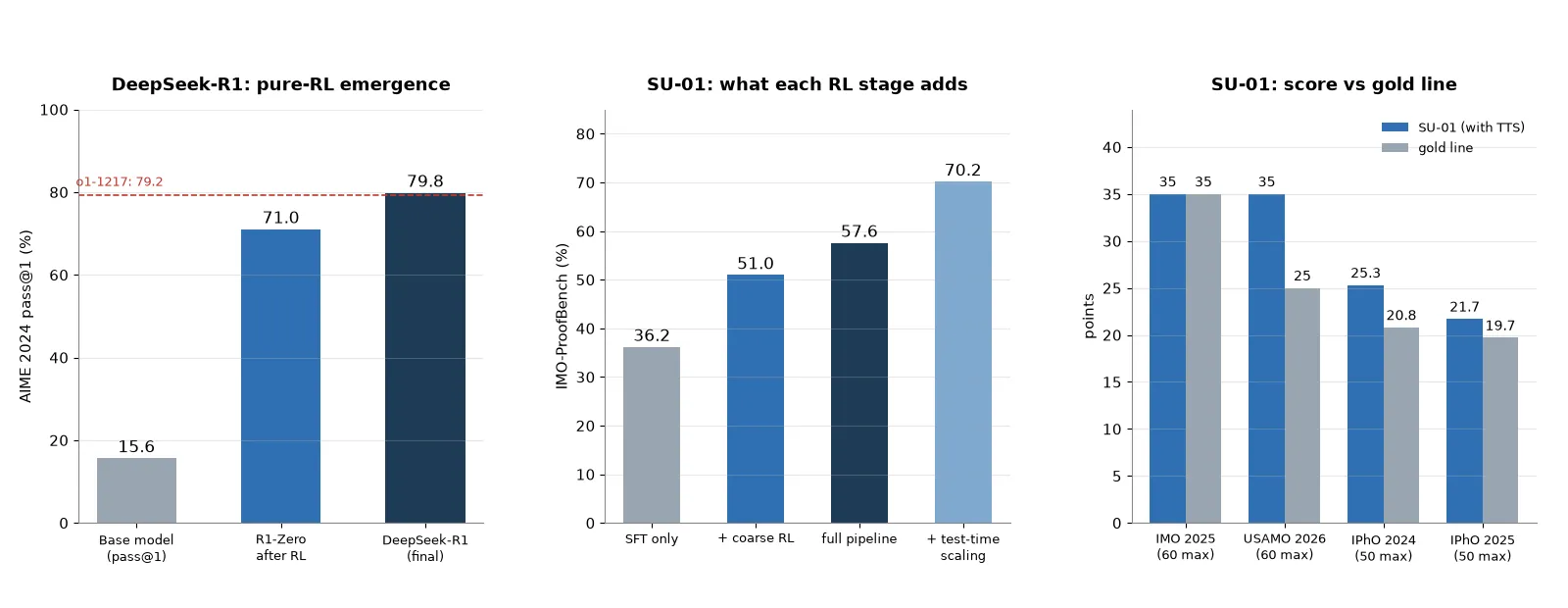
Two recipes, one question
Both papers answer the same question from opposite ends: how much supervised data does a reasoning model actually need? DeepSeek-R1 (January 2025) pushed the answer toward zero on the reasoning stage: skip human reasoning traces, reward only the final answer, and let reinforcement learning grow the thinking. SU-01 (May 2026) pushed the answer toward discipline: a modest, carefully composed SFT set of about 338K short trajectories, then a deliberately short RL run of just 200 steps, is enough for a 30B open model to hit gold-medal scores at the International Mathematical Olympiad and the International Physics Olympiad.
The two models are not rivals on a leaderboard. R1 is a general reasoning model built on a frontier-scale base; SU-01 is a competition specialist built to prove that training discipline, not scale, is the binding constraint. Comparing them is useful anyway, because anyone choosing an open reasoning recipe in 2026 is really choosing between these two philosophies: emergent reasoning from RL, or compact reasoning engineered through data design. Both use GRPO from DeepSeekMath as the RL algorithm, and both released open weights, which is what makes the comparison concrete instead of theoretical.
Key numbers
Every number below is reported by the source paper itself. Almost none of them come from the same harness, and the table says so explicitly rather than lining up unlike numbers.
| Measurement | DeepSeek-R1 | SU-01 | Setting and source | Same harness? |
|---|---|---|---|---|
| AIME pass@1 | 79.8% on AIME 2024 | 94.6% on AIME 2025, 93.3% on AIME 2026 | R1 paper; SU-01 paper | No: different years and problem sets |
| MATH-500 | 97.3% | not reported | R1 paper | No SU-01 number |
| IMO 2025 | not reported | 35 points, exactly the gold line | SU-01 paper | No R1 number |
| USAMO 2026 | not reported | 35 points, 10 above the gold line | SU-01 paper | No R1 number |
| IPhO, with test-time scaling | not reported | 25.3 vs 20.8 gold line (2024); 21.7 vs 19.7 (2025) | SU-01 paper | No R1 number |
| IMO-ProofBench ablation | not reported | 36.2 SFT only, 51.0 with coarse RL, 57.6 full, 70.2 with test-time scaling | SU-01 ablation table | n/a |
| AIME through RL alone | 15.6% to 71.0% pass@1; 86.7% with majority voting (R1-Zero) | not reported | R1-Zero, no human reasoning data | n/a |
| SFT data | a few thousand long chain-of-thought cold-start examples | about 338K trajectories under 8K tokens, 54.3% direct and 45.7% self-improvement | both papers | n/a |
| RL budget | steps not disclosed | 200 steps total, 96 coarse plus 104 refined | SU-01 paper | n/a |
| Base model | DeepSeek-V3-Base, frontier scale | P1-30B-A3B, a 30B open model | R1 built on DeepSeek-V3 | n/a |
| License | MIT, plus six distilled models down to 1.5B | open weights, 30B-A3B | both papers | n/a |
The one number people want to compare first, AIME, is also the least honest comparison: R1’s 79.8% is on AIME 2024 while SU-01’s 94.6% is on AIME 2025, a different contest with a different difficulty profile. Treat that cell as orientation, not evidence.
What each recipe actually is
The R1 recipe: emergence first. R1-Zero takes a base model and runs GRPO with rule-based rewards: a math answer is checked for correctness, code is run against tests, and a small format reward keeps the thinking inside tags. There is no neural reward model and no supervised reasoning data at all. The famous result is the trajectory: AIME pass@1 climbs from 15.6% to 71.0% through RL alone, and to 86.7% with majority voting. The product version, DeepSeek-R1, adds a few thousand “cold-start” long chain-of-thought examples to fix readability, then large-scale RL, then rejection sampling to build fresh SFT data, then a final alignment stage. The expensive part underneath all of this is the base model itself; the viral “few million dollars” figure refers to training DeepSeek-V3, not the R1 reasoning stage.
The SU-01 recipe: data design first. SU-01 accepts that SFT is necessary and asks what the smallest, best-composed SFT set looks like. Every one of its roughly 338K trajectories is under 8K tokens, split 54.3% direct generation and 45.7% self-improvement traces built from self-verify and self-refine loops. The design bet is that SFT should teach compact reasoning plus self-correction, and let RL grow the length. The RL stage is startlingly short by frontier standards: 200 total steps, 96 coarse and 104 refined. The ablation is the paper’s real argument: SFT alone scores 36.2% on IMO-ProofBench, adding coarse RL jumps it to 51.0%, and the full pipeline reaches 57.6%, or 70.2% once test-time scaling pushes trajectories past 100K tokens.
The shared skeleton. Both recipes are GRPO against verifiable rewards on top of open weights. The difference is what each treats as the scarce resource: R1 treats human reasoning data as radioactive and proves you can go far without it, given a strong enough base; SU-01 treats data curation as the main lever and proves a small, clean dataset plus a short RL run beats a sprawling imitation set.
When to use which
Pick the R1 recipe when you need one general-purpose reasoning model across math, code, and STEM, and you can afford a frontier-scale base plus a full multi-stage RL pipeline. R1’s scores are broad: 97.3% on MATH-500, a Codeforces rating near 2029, and distilled variants (the 7B distill hits 55.5% on AIME 2024) that make the behavior accessible on ordinary hardware. Its recipe is also the one with a mature ecosystem: MIT-licensed weights, published distills, and two years of community reproductions.
Pick the SU-01 recipe when your target is competition-level math and physics on a training budget you can actually reproduce. About 338K short trajectories and 200 RL steps is a pipeline a well-funded lab or even a determined academic group can rerun, and the olympiad numbers (35 points at IMO 2025, plus IPhO gold lines with test-time scaling) are exactly the profile that matters for competition-style evaluation. The catch is on the serving side: the headline physics scores require test-time scaling with trajectories above 100K tokens, so inference is expensive even though training was cheap.
A practical note: these compose rather than compete. SU-01’s data-composition findings (short traces, self-improvement data, length grown in RL) apply to anyone tuning an R1-style pipeline, and R1’s distillation playbook applies to anyone who wants SU-01-class reasoning below 30B.
Limits and open questions
- No shared benchmark cells. There is no task in the table where both papers report a number under the same conditions, so any aggregate ranking between them is fabricated precision. The honest comparison is recipe versus recipe, not score versus score.
- SU-01’s gold margins are thin. IPhO 2025 clears the gold line only with test-time scaling, by 21.7 to 19.7, and the number of competition problems is small enough that variance is a real concern. Automated proof scoring on IMO-ProofBench is itself a contested methodology.
- R1’s cost story is easy to misread. The cheap part is the reasoning stage; the base model it stands on is a frontier-scale training run. Reproducing R1 end to end is not a budget exercise.
- Both depend on verifiable rewards. Math answers and physics scores can be checked; open-ended reasoning cannot. Neither paper answers how far these recipes travel beyond checkable domains.
- Test-time scaling hides in SU-01’s best numbers. Several headline results (both IPhO golds, the 70.2% IMO-ProofBench number) come from the test-time-scaled configuration, which is a different cost regime from direct generation.
FAQ
Is SU-01 better than DeepSeek-R1 because 94.6 beats 79.8 on AIME?
No. SU-01’s 94.6% is on AIME 2025 and DeepSeek-R1’s 79.8% is on AIME 2024; they are different contests, and neither paper reports the other year’s set. What can be said: SU-01 clears gold lines at IMO 2025 (35 points) and both IPhO years with test-time scaling, while R1’s published strengths are MATH-500 (97.3%), AIME 2024 (79.8%), and a Codeforces rating near 2029.
How much RL does SU-01 use compared to DeepSeek-R1?
SU-01 discloses a precise budget: 200 GRPO steps in total, split into 96 coarse and 104 refined, and its ablation shows what each stage adds on IMO-ProofBench (36.2% SFT only, 51.0% with coarse RL, 57.6% full). DeepSeek-R1 does not disclose its step count; its RL evidence is the R1-Zero trajectory, where AIME pass@1 rises from 15.6% to 71.0% with no supervised reasoning data at all.
Does DeepSeek-R1 use more SFT data than SU-01?
No, almost certainly less. R1’s cold-start stage uses a few thousand long chain-of-thought examples, and its later SFT stage is generated by rejection sampling from the RL model itself. SU-01’s initial SFT set is about 338K trajectories, though each is under 8K tokens by design, so token counts are closer than trajectory counts suggest.
Which recipe should a small team reproduce: DeepSeek-R1 or SU-01?
SU-01’s pipeline is the reproducible one on paper: 338K short trajectories and 200 RL steps on a 30B open base. R1’s reasoning stage is conceptually simpler, but it stands on a frontier-scale base model, which is where most of the cost lives. Either way, budget for inference: SU-01’s best numbers need trajectories past 100K tokens, and R1’s distillation step exists precisely because serving the full model is heavy.
Are SU-01’s IMO and IPhO gold claims solid, and does DeepSeek-R1 have comparable ones?
They are paper-reported competition scores, which deserve more skepticism than benchmark averages. SU-01’s IMO 2025 score is exactly 35, the gold line, and its IPhO 2025 margin over the gold line is 21.7 to 19.7 with test-time scaling only. Small problem counts mean high variance, and the paper itself relies on automated proof grading for IMO-ProofBench, a methodology that remains contested.