
Reinforcement Learning · LLM Reasoning · Fine-Tuning & Adaptation
Trust Region Methods for LLM RL: CPPO vs TrOPD vs TRB
CPPO tightens early-token clipping in RL (+5.56 AIME over DPPO), TrOPD gates per-token teacher trust in distillation (+3.06 to +3.52), and TRB blends teacher rollouts inside a KL trust region during warmup.
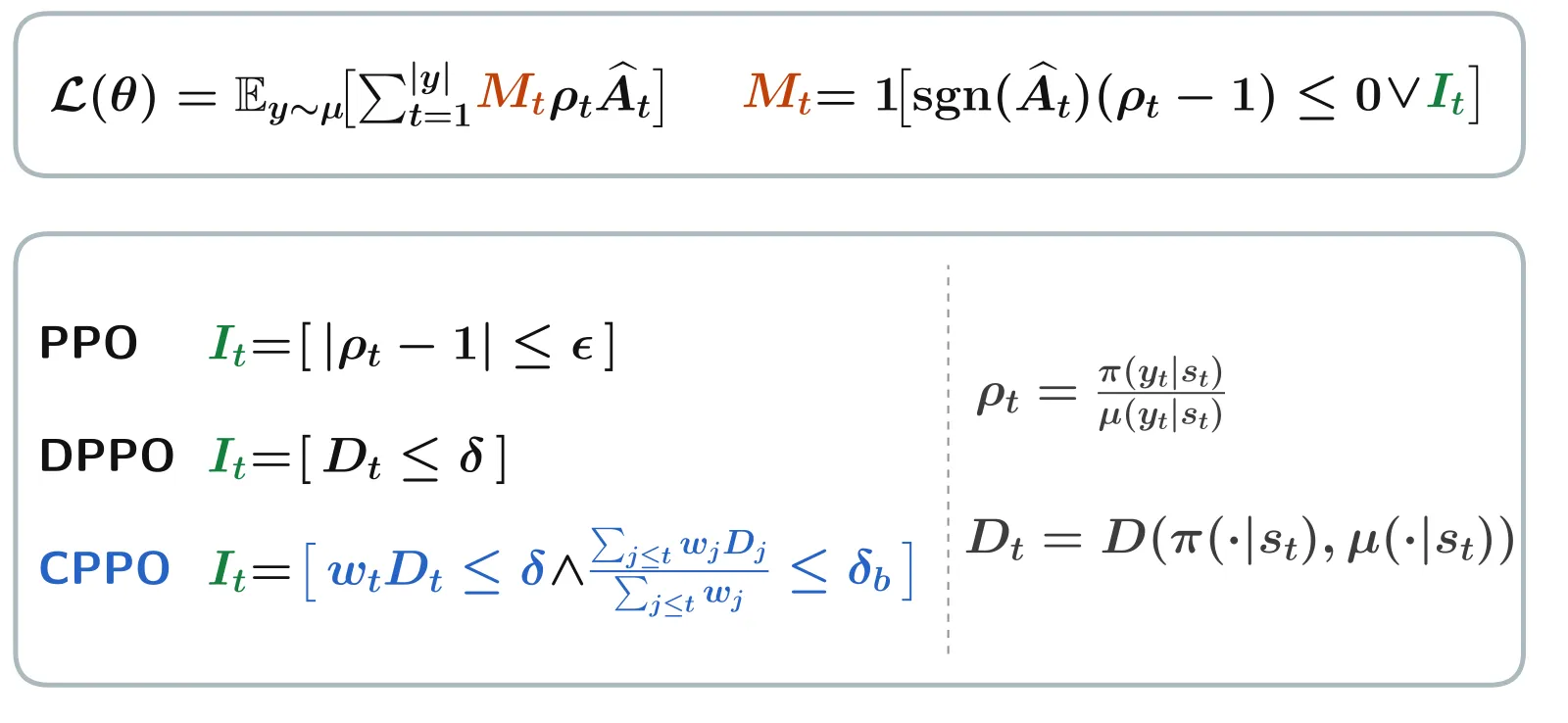
The one idea, moved to three different failure points
PPO’s clip is a trust region: a hard bound on how far each update can move the policy, so a bad gradient can’t knock training off a cliff. For years that bound was applied uniformly and without memory. Three papers from mid-2026 argue the uniform trust region is right in spirit and wrong in three different places at once, and each fixes a different one:
- CPPO (Cumulative Prefix-divergence Policy Optimization) fixes the clip rule in RL: early tokens in an autoregressive chain do more damage per unit deviation, so they deserve a tighter threshold, and a token arriving after an already-drifted prefix deserves less allowance than one arriving after a clean prefix.
- TrOPD (Trust Region On-Policy Distillation) fixes credit assignment in distillation: the teacher is only a reliable supervisor on the tokens where it assigns at least as much probability as the student, so the trust region should decide per token whether the teacher’s gradient is allowed to drive the update.
- TRB (Trust-Region Behavior Blending) fixes the rollout source during warmup: early student rollouts are so weak that the teacher wastes supervision correcting prefixes the student would never produce, so warmup rollouts should come from the closest-to-teacher policy that still sits inside a student-centered KL trust region.
Same mathematical instinct, three non-overlapping interventions. None of the three papers evaluates the other two, so this comparison is a synthesis of three separate evidence bases, not a head-to-head.
CPPO: the trust region should remember the prefix
PPO-style reasoning RL (GRPO, DAPO, DPPO and friends) applies one clip threshold to every token in every sequence. CPPO’s diagnosis, backed by its Figure 2 measurements, is that this ignores how autoregressive generation actually fails: a wrong token at position 5 re-conditions everything after it, measured policy deviation is larger and heavier-tailed at early positions, and a per-token-only threshold has no memory of how far the prefix already wandered. CPPO names the two blind spots autoregressive asymmetry and cumulative prefix drift.
The fix has two knobs. A linear position weight decays from 1.0 at the first token to w_min = 0.8 at the last, so the effective threshold δ/w_t is tightest early. A cumulative prefix budget keeps a weighted running sum of prefix divergence S_t; a token is masked once pushing it would exceed δ + δ_b·W_{t-1} − S_{t-1}. So a token gets killed either for deviating too much on its own or for arriving after a prefix that already overspent. The objective, reward, and data are untouched; only the clip rule changes.
The ablations are the most informative part of the paper. Removing either knob still beats DPPO, so neither is dead weight. And the shuffle test is the cleanest evidence that ordering matters: randomizing the position weights while keeping the same threshold values underperforms the ordered schedule, which rules out “it’s just a tighter average clip” as the explanation.
For the bigger picture of why the clip rule is where recent reasoning-RL gains come from, see GRPO vs PPO.
TrOPD: the trust region should decide where the teacher is trustworthy
On-policy distillation (OPD) trains a student on its own samples against a stronger teacher. Its known failure mode is the outlier token: when the student generates something the teacher considers very unlikely, reverse-KL produces a large noisy gradient that pushes the student off a cliff instead of correcting it. The instability is worst exactly on the hard, exploratory tokens that reasoning depends on.
TrOPD’s move is a per-token trust ratio P_trust(x) = min(teacher prob / student prob, 1). Inside the trust region, standard on-policy distillation applies. On outlier tokens, the unstable reverse-KL gradient is replaced by a forward-KL objective over the teacher’s top-k vocabulary, recovering usable signal instead of either trusting a bad gradient or masking to zero. A light off-policy term (beta = 0.001, annealed to zero) lets the student imitate teacher-written prefixes early, before its own rollouts are worth learning from.
The design is credit assignment, not a new loss family: decide token by token whether the teacher has earned the right to drive the gradient. Everything is bolted onto existing OPD, which is what makes it cheap to try.
TRB: the trust region belongs on the rollouts, not the loss
TRB targets a different OPD problem than TrOPD. Even when OPD is stable, its warmup phase is wasteful: the student is weak, so its self-generated prefixes are low quality, and the teacher spends its supervision teaching the student to continue prefixes a competent student would never write. On math reasoning, where one bad early token derails a chain, this is actively harmful.
TRB changes only where warmup prefixes come from, not the loss. The behavior policy is the closest-to-teacher policy that still sits within a bounded KL of the student, so early prefixes are competent but on-distribution enough to learn from. The KL budget then anneals to zero, handing control back to pure student rollouts; the standard per-prefix reverse-KL distillation objective is never modified. The paper frames the result modestly: the strongest average among the compared methods across two math-reasoning distillation settings, a training-recipe refinement rather than a capability claim. Unlike the other two papers, the exact benchmark numbers are not available from the abstract-level record, so treat the magnitude as unverified here.
Key numbers
The three papers run on different setups, so no cell in this table is a head-to-head; each row is a same-harness comparison from a single paper.
| Measurement | Best trust-region method | Main baseline | Setting and source | Same harness? |
|---|---|---|---|---|
| AIME24/25/26 Avg@16 | CPPO 54.79 | DPPO 49.23 (+5.56), GRPO 38.19 (+16.6), MinPRO 48.12 | Qwen3-30B-A3B-Base, CPPO | Yes, within CPPO paper |
| AIME family, smaller scales | CPPO wins all four columns | Second-best margins 3.06, 0.91, 1.39, 5.56 | Qwen3-1.7B 31.88, 1.7B-Base 12.78, 8B-Base 31.11 | Yes |
| Math single-domain average | TrOPD 49.85 | OPD 46.79 (+3.06), REOPOLD 47.86 | AIME24 38.54 vs 35.83, AIME25 32.50 vs 29.16, AMC23 78.51 vs 75.39; TrOPD Table 1 | Yes |
| Multi-domain average, 1.5B student | TrOPD 40.63 | OPD 37.11 (+3.52) | DeepSeek-Qwen2.5-1.5B, math + code + STEM; GPQA 36.24 vs 28.03 the largest single move | Yes |
| Multi-domain average, 1.7B student | TrOPD 51.73 | OPD 48.29 (+3.44) | Qwen3-SFT-1.7B across math, STEM, instruction following, code | Yes |
| Math distillation, two settings | TRB strongest average | Compared OPD methods | No public point numbers; magnitude unverified from the abstract record | Within TRB paper |
| Late-training behavior | TRB = standard OPD | By construction | KL budget anneals to zero after warmup | Yes, by design |
Read the table row by row and one fact dominates: CPPO’s and TrOPD’s margins are consistent rather than spectacular. CPPO’s largest margin (+5.56) sits on the one MoE setting with a non-default threshold (δ 0.2 vs 0.15), and its small-model margins drop below 1.5 points. TrOPD’s margin is almost eerily stable at +3.06, +3.52 and +3.44 across three setups, which is what a training-stability claim should look like. TRB’s row is honest about its limits: best-on-average, no quotable numbers.
What the three share, and what they don’t
All three are rollout- or gradient-side interventions that leave the underlying objective alone. CPPO changes the clip mask inside the PPO-family loss; TrOPD changes which tokens get the OPD gradient and which get a forward-KL substitute; TRB changes who writes the warmup prefixes while keeping the reverse-KL loss intact. All three also add hyperparameters on top of an already-tuned recipe: CPPO adds δ_b and w_min, TrOPD adds the trust-ratio gate and the beta = 0.001 off-policy weight, TRB adds the initial KL budget and the annealing schedule.
The differences matter for adoption. CPPO is an RL method evaluated on RL training of base models; it needs a reward and verifiable answers. TrOPD is a distillation method; it needs a teacher better than the student and distillation infrastructure, and everything is validated at 1.5B-1.7B students with 4B-7B teachers. TRB is a warmup patch for an existing OPD run; it needs nothing but an annealing schedule, but its evidence base is the thinnest of the three, two math settings with no published point numbers. And the adjacent Flow-DPPO shows the same trust-region instinct ported to flow-matching generation, which suggests the idea family generalizes even though no single method’s numbers do.
When to use which
Match the method to the failure you actually observe. If you run GRPO or DPPO on long-chain reasoning and see instability, reward spikes that revert, or a stubborn ceiling, CPPO is the pick: it is a clip-rule swap with a published +5.56 over DPPO and +16.6 over GRPO on the flagship setting, and its ablations tell you what to expect even if you only adopt the early-token weighting intuition. If you run on-policy distillation and the failure mode is exploding gradients on hard tokens, TrOPD is the pick, with a consistent ~3-point margin across three setups and the largest single gain on GPQA, exactly the out-of-distribution tokens where OPD was weakest. If your OPD runs are already stable but you suspect the first training phase is wasted, TRB is the cheapest experiment of the three, since it self-disables via annealing and needs no extra data. If you are not sure which failure you have, instrument first: log per-token deviation by position (CPPO’s Figure 2 recipe) before choosing.
Limits and open questions
The headline caveat is that nothing here has been reproduced across papers. CPPO is math-only, all on Qwen3 models, with the largest margin on the least standard configuration. TrOPD is post-training only, at small student scale, with no ablation isolating the trust mask from the outlier forward-KL from the off-policy warmup, so the ~3 points could be any mix of the three. TRB has the thinnest evidence: two math settings, no public point numbers, and added hyperparameters whose sensitivity is unmeasured. None of the three reports coding, agentic, or open-ended results. The mechanism-level claim, that trust regions should be structured rather than uniform, is well supported; the claim that any specific structure wins broadly is not. For the broader context of on-policy distillation as a practice, see the on-policy distillation explainer.
FAQ
What is a trust region in LLM reinforcement learning?
A bound on how far a single update can move the policy, typically implemented as clipping the ratio between new and old token probabilities. PPO introduced it; GRPO kept the clip and dropped the value model. The 2026 papers on this page keep the idea but reject the assumption that every token deserves the same bound.
How much does CPPO beat GRPO and DPPO on AIME?
On Qwen3-30B-A3B-Base, AIME24/25/26 Avg@16, CPPO scores 54.79 versus 49.23 for DPPO (+5.56) and 38.19 for GRPO (+16.6), with MinPRO at 48.12. CPPO also wins all four model settings tested, though margins at smaller scales drop to 0.91 and 1.39 points over the second-best method.
How much better is TrOPD than standard on-policy distillation?
TrOPD improves the average by +3.06 points on single-domain math (49.85 vs 46.79), +3.52 on multi-domain distillation of a DeepSeek-Qwen-1.5B student (40.63 vs 37.11), and +3.44 with a Qwen3-SFT-1.7B student (51.73 vs 48.29). The largest single-benchmark move is GPQA at 36.24 versus 28.03.
Is TRB a new loss function for distillation?
No. TRB keeps the standard per-prefix reverse-KL on-policy distillation loss untouched. It only changes where warmup rollouts come from, sampling from the closest-to-teacher policy inside a student-centered KL trust region, and anneals that KL budget to zero so training returns to pure student rollouts.
Which trust region method should I try first?
It depends on the failure. Unstable or plateaued RL on verifiable long-chain tasks: CPPO, a clip-rule swap inside your existing loss. On-policy distillation that destabilizes on hard tokens: TrOPD’s per-token trust gate. Stable OPD runs where early supervision looks wasted: TRB’s self-disabling warmup. All three are cheap to pilot relative to a full training run, and none is proven outside its own benchmark family.
One line: the uniform trust region was the default; 2026’s lesson is to structure it — tighter early in the sequence, gated by teacher reliability per token, or placed on the rollout source instead of the loss. Read the originals: CPPO, TrOPD, TRB.