
Qwen-Image-Flash: Beyond Objective Design in Few-Step Distillation
Qwen-Image-Flash distills Qwen-Image-2.0 to 4 sampling steps for both text-to-image and editing. The Alibaba Qwen team shows the training recipe — data, teachers, task mix — matters as much as the distillation objective.
Quick answer
Qwen-Image-Flash is a 4-step (4-NFE) distilled version of Alibaba’s Qwen-Image-2.0 that handles both text-to-image generation and instruction-guided image editing in one model. The paper’s argument is that most few-step distillation work obsesses over the distillation objective, but the training recipe — what data you distill on, which teachers you use, and how you mix tasks — shapes student quality just as much. Using Distribution Matching Distillation (DMD) on a flow-matching backbone, the team reports three non-obvious findings and turns them into a recipe that, at 4 NFEs, matches or beats its 80-NFE-style teacher on their internal benchmarks.
The problem: recipe, not just objective
Few-step distillation compresses a diffusion or flow model that normally needs dozens of sampling steps into one that produces a comparable image in a handful. Prior work mostly innovates on the loss — better consistency targets, better matching objectives. This paper holds the objective fixed (DMD over flow matching) and asks what else moves the needle. The answer the authors land on: an intuitive, conventional recipe often falls short, so the objective is only part of the story. They study three levers — data composition, teacher guidance, and task mixture — on Qwen-Image-2.0.
Finding 1: data diversity can hurt
T2I distillation is sharply sensitive to what data you distill on, and more diversity is not better. On their T2I-Bench (1,800 cases across landscape, portrait, and text-centric splits, scored by Gemini 3.1 Pro and GPT 5.5 as preference judges), a student distilled on 20,000 portrait-only images ranked first overall (GPT 5.5 average 4.15). A mixed-category set of 60,000 images ranked fourth (3.62), and even on text-centric prompts the mixed set scored worse than the coherent single-category sets. The takeaway: coherent single-category data can support broad transfer, while naively scaling diversity — the usual pretraining instinct — can degrade the distilled student.
Finding 2: blend teachers step-wise, do not swap them
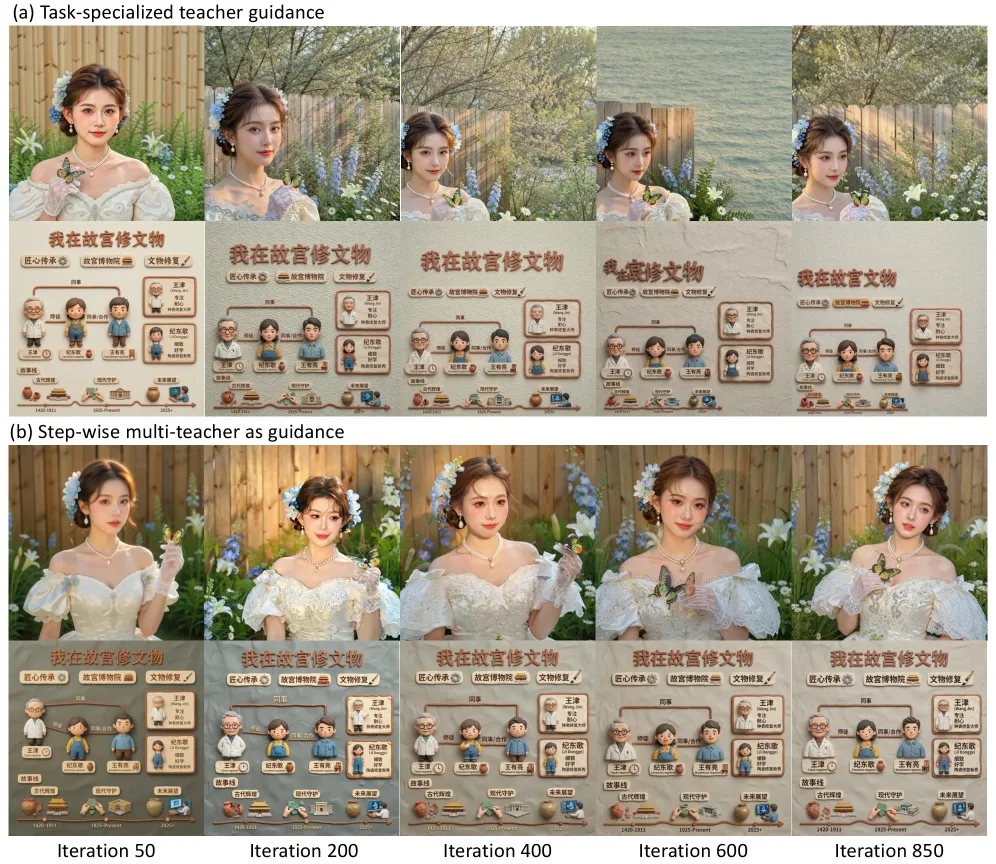
A second teacher with stronger downstream skills sounds like free quality. The paper shows that directly guiding distillation with a task-specialized teacher destabilizes training, even though that teacher is stronger on its own. Their fix is step-wise multi-teacher guidance: keep the pretrained base teacher as a stable distributional anchor and selectively fold in the specialized teacher’s guidance during the sampling trajectory. This preserves training stability while still transferring the specialized teacher’s complementary strengths. They note one trade-off: first-step supervision toward the stable teacher constrains the student toward more reliable structure but can mildly limit the specialized teacher’s distributional guidance.
Finding 3: balance generation and editing
When jointly distilling T2I and editing into one student, the task ratio is decisive. The team varied the T2I-to-editing ratio with a fixed training budget. A T2I-only student loses editing ability — it cannot be recovered for free. On their Editing-Bench, a balanced 5:5 mixture ranked first (Gemini 3.1 Pro average 2.97, GPT 5.5 average 3.41), ahead of a 7:3 mixture (2.87 / 3.36). The surprise runs the other way too: adding editing supervision improved T2I generation rather than just preserving it, raising the T2I average from 2.77 to 2.97 under Gemini 3.1 Pro and 3.28 to 3.41 under GPT 5.5 versus a T2I-only student.
Key results
- 4 NFEs (sampling steps) for the final Qwen-Image-Flash student, doing both T2I and instruction-guided editing in one model.
- Portrait-only (20k) distillation ranked #1 on T2I-Bench (GPT 5.5 avg 4.15); mixed-category (60k) ranked #4 (3.62) — more data and more diversity did not win.
- Balanced 5:5 T2I-to-editing mixture ranked #1 on Editing-Bench (Gemini 2.97 / GPT 3.41) over 7:3 (2.87 / 3.36).
- Adding editing data lifted T2I scores from 2.77 to 2.97 (Gemini) and 3.28 to 3.41 (GPT), surpassing the teacher on the Gemini metric and staying competitive on GPT.
- Method stack: Distribution Matching Distillation over a flow-matching backbone, plus step-wise multi-teacher guidance.
Limits and open questions
The few-step student still struggles with highly detailed text rendering — tiny text and complex poster-style compositions with dense typography and precise layout remain hard. After folding editing data into joint distillation, the authors observe slight residual noise in some T2I outputs, suggesting the denoising trajectory is not fully completed under so few steps, and the effect is most visible on clean backgrounds. The scores come from preference-based VLM judges (Gemini 3.1 Pro, GPT 5.5) on the authors’ own T2I-Bench and Editing-Bench, not from third-party leaderboards, so cross-paper comparison is limited. Whether the single-category data finding generalizes beyond Qwen-Image-2.0 is untested here.
FAQ
What is Qwen-Image-Flash?
Qwen-Image-Flash is a few-step distilled model from the Alibaba Qwen team that generates images from text and edits images from instructions in 4 sampling steps, distilled from Qwen-Image-2.0.
How many steps does Qwen-Image-Flash use?
Qwen-Image-Flash runs in 4 NFEs (number of function evaluations, i.e. sampling steps), versus the many-step sampling its teacher Qwen-Image-2.0 normally uses.
What is the main point of the Qwen-Image-Flash paper?
The Qwen-Image-Flash paper argues that few-step distillation quality is shaped not only by the distillation objective but by the training recipe — data composition, teacher guidance, and task mixture — and backs this with three counterintuitive findings.
Does Qwen-Image-Flash do image editing?
Yes. Qwen-Image-Flash is jointly distilled for both text-to-image generation and instruction-guided editing, and the paper finds a balanced 5:5 task mixture works best.
What can Qwen-Image-Flash not do well?
Qwen-Image-Flash still struggles with tiny, dense text rendering and complex poster layouts, and can show slight residual noise on clean backgrounds because the denoising trajectory is not fully completed at so few steps.