
World Models · Robotics · Video Generation
AnchorWorld vs ABot-Earth: Interactive Worlds or a 3D Earth?
Both papers generate worlds from opposite ends: AnchorWorld makes egocentric video react to full-body motion and text-prompted scene evolution; ABot-Earth 0.5 turns satellite imagery into a streaming 3D earth.
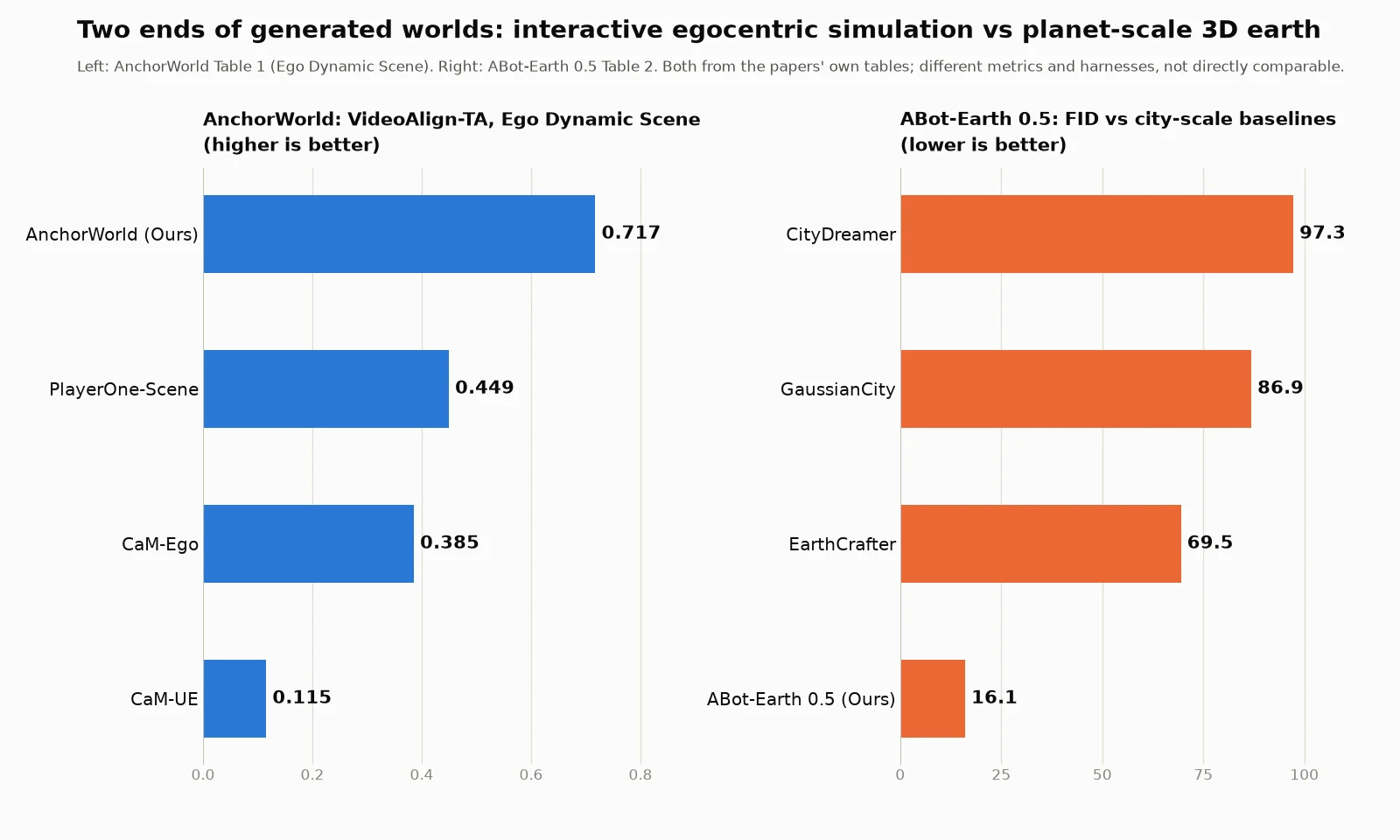
Both AnchorWorld and ABot-Earth 0.5 answer the same broad question, “can a model generate a world?”, and they answer it in ways that almost do not overlap. AnchorWorld cares about interaction integrity: you wear the camera, you move your whole body, and the world around you must react correctly and stay geometrically consistent. ABot-Earth 0.5 cares about scale and accessibility: you point it at ordinary satellite imagery and it produces a seamless, explorable 3D earth that streams in a web browser. One paper measures whether the world survives contact with a moving human; the other measures whether the world survives contact with the entire planet.
This comparison matters because both papers target the same downstream buyer, embodied AI. Robots and drones need cheap, controllable environments for training and evaluation, and the two papers attack the cost problem from opposite directions. AnchorWorld tries to make a small, closed-loop, first-person world faithful enough to trust. ABot-Earth tries to make a huge, open, static world cheap enough to deploy anywhere on Earth.
Two opposite designs
AnchorWorld generates egocentric video conditioned on 3D human motion and an initial first-person frame. Its core problem is that an egocentric camera sees your hands and forearms but not your full body, so the model has to infer what the rest of you is doing in the scene. The authors add auxiliary training supervision from exogenous viewpoints that are decoupled from the agent’s own sensorium, so the model learns where the full body sits relative to the environment even when the first-person view truncates it. Their second mechanism is world customization: you define anchor views in a shared world coordinate system and attach text descriptions that dictate how local scenes should evolve over time. The model is trained in four progressive stages (third-person motion, egocentric motion, static scenes, dynamic scenes), with stage data of 200K+101K, 100K, 25K and 25K+10K clips respectively.
ABot-Earth 0.5 is a generative 3D framework built directly on the 3D Gaussian Splatting representation. It is trained on real urban reconstructions produced by the authors’ own ABot-3DGS pipeline from eight open-source datasets, among them UrbanScene3D (128K images covering 55 km2) and UrbanBIS (113K images, 10.78 km2). At inference it needs only satellite imagery and generates novel 3D scenes tile by tile, using 200 m x 200 m training tiles and a hierarchical level-of-detail structure. Close views stream high-precision tiles at map zoom 17 to 19 while distant views stream coarse tiles at zoom 14 to 15, exported through the OGC 3D Tiles specification so standard web map engines can render them. The authors report roughly 312,500 production tiles covering more than 300 cities across over 190 countries.
A useful third point on this spectrum is OmniDreams, a closed-loop driving world model: it sits between the two, interactive like AnchorWorld but engineered for real-time vehicle simulation rather than human-embodied control.
Key numbers
The two papers never evaluate on a shared benchmark, so treat every row below as a different ruler. Within each paper’s own tables the numbers are same-harness; across papers they are not directly comparable.
| Dimension | AnchorWorld | ABot-Earth 0.5 | Same harness? |
|---|---|---|---|
| Output modality | Egocentric video reacting to 3D human motion | Static 3DGS earth from satellite imagery | Not directly comparable |
| Headline metric | VideoAlign-TA 0.717 (Ego Dynamic Scene, Table 1) | FID 16.1 (Table 2) | Different metrics, not comparable |
| Best baseline in the same table | PlayerOne-Scene 0.449 VideoAlign-TA | EarthCrafter 69.5 FID | Each vs its own baselines only |
| Dynamic scene fidelity | PSNR 16.37 / SSIM 0.555 / LPIPS 0.486 vs CaM-Ego 14.57 / 0.501 / 0.574 | Not reported on a video metric | AnchorWorld internal only |
| Training cost | 1,406 GPU hours total across 4 stages on 16 GPUs at 80G (Table 3) | About 25 min per tile inference on a 1,000-GPU cluster | Different units, not comparable |
| Serving scale | Not reported | 312,500 tiles, 300+ cities, 190+ countries, under 10 min per km2 | ABot-Earth only |
| Customization | Anchor views plus text evolution prompts; scene consistency rises from 4,074.94 to 4,233.59 Mat. Pix. with 1 to 3 anchors (Table 5) | None; generation is conditioned on satellite imagery alone | Not directly comparable |
Three readings of this table deserve emphasis. First, AnchorWorld’s 0.717 VideoAlign-TA on the Ego Dynamic Scene beats every baseline in its own table by a wide margin, and the same table shows its advantage is not an artefact of one metric: PSNR, SSIM, LPIPS and trajectory error (ATE 0.048 vs 0.067 to 0.083 for baselines) all move together. Second, ABot-Earth’s FID 16.1 is dramatically lower than the city-scale generation baselines, but the paper’s own caption warns that baseline FID and KID were computed against different ground-truth sets with different poses and viewpoints, so the gap flatters the comparison. Third, the cost rows use units so different (GPU hours per training stage versus minutes per tile on a production cluster) that any “which is cheaper” claim would be invented rather than measured.
When to use which
Choose AnchorWorld when your bottleneck is interaction fidelity in a small space. If you are training or evaluating an embodied agent that must understand how the world reacts to its own body, you need exactly what this paper optimizes: full-body motion control, out-of-sight consistency, and a mechanism for dictating how scenes evolve between visits. The customization scheme is the differentiator, since it lets you script world state changes through anchor views and text rather than re-capturing data.
Choose ABot-Earth 0.5 when your bottleneck is coverage. If you need a navigable 3D environment for a drone route, a digital-twin prototype, or a geography-scale simulation sandbox, a system that generates under 10 minutes per km2 from free satellite imagery removes the reconstruction bottleneck entirely. Its openness matters too: where Google Earth offers API-only access to a sparsely scanned reconstruction, ABot-Earth positions itself as an open generation platform with effectively unlimited coverage.
Do not choose either if you need the other property today. AnchorWorld does not generate explorable square kilometres, and ABot-Earth does not close the loop on human motion. A pipeline that conditions ABot-Earth-style terrain generation on AnchorWorld-style egocentric interaction is the obvious research gap, and neither paper claims to have built it.
Limits and open questions
AnchorWorld. The evaluation is internal: every baseline number comes from the authors’ own tables on their own scene splits, and the paper does not report a closed-loop downstream task where an agent trained or evaluated inside the simulation transfers to the real world. The training cost, about 1,406 GPU hours on 16 GPUs at 80G across four stages, is also non-trivial for a system whose output is video rather than a persistent 3D asset. Finally, the anchor-view customization is demonstrated qualitatively for scene evolution; the quantitative tables measure static and motion fidelity, not whether the scripted evolution itself is faithful over long horizons.
ABot-Earth 0.5. The headline FID comparison carries the authors’ own caveat about different ground-truth sets and viewpoints, so the 16.1 versus 69.5 gap should be read as suggestive, not conclusive. The downstream embodied AI claims (closed-loop UAV navigation, obstacle avoidance, control) are argued from the sim-to-real motivation and qualitative landmark integration, but the paper’s text reports no navigation success-rate benchmark. The system is also versioned 0.5 for a reason: coverage of 300+ cities sounds planetary, but the authors note performance is validated mainly on metropolitan areas and selected non-urban terrain, and geometry quality depends on the quality of the input satellite imagery and the upstream ABot-3DGS reconstructions.
Cross-paper honesty. Any number from the left column of the table above and any number from the right column answer different questions. AnchorWorld’s metrics ask “does the world react correctly to a human”; ABot-Earth’s metrics ask “does the generated earth look like the real one”. Ranking the two papers against each other is meaningless, and this guide deliberately does not do it.
FAQ
How does AnchorWorld control the world?
AnchorWorld conditions egocentric video generation on 3D human motion plus an initial first-person frame. For world customization it lets a user define anchor views in a shared world coordinate system and attach text descriptions that dictate how local scenes evolve, achieving control without retraining per scene.
How fast does ABot-Earth 0.5 generate one square kilometre?
The paper reports a scalable generation rate of under 10 minutes per square kilometre from satellite imagery, with single-tile inference taking about 25 minutes on a 1,000-GPU cluster. The deployed system comprises roughly 312,500 tiles across more than 300 cities in over 190 countries.
Can AnchorWorld and ABot-Earth numbers be compared directly?
No. AnchorWorld’s VideoAlign-TA, PSNR, SSIM and LPIPS measure dynamic egocentric fidelity on the paper’s own scene splits, while ABot-Earth’s FID and KID measure image realism of generated 3D earth tiles with a ground-truth caveat stated in the paper itself. The metrics, datasets and harnesses differ completely.
Which one helps embodied AI evaluation more?
They address different failure modes. AnchorWorld supplies interactive, first-person worlds for testing how agents handle dynamic scenes and their own embodiment, while ABot-Earth supplies geography-scale static environments for navigation-oriented tasks such as UAV route simulation. Neither paper reports a full closed-loop transfer benchmark for its own side.