
World Models · Video Generation · Diffusion Models
Stream-R1 vs Stream-T1 vs WorldCraft: Where to Spend Your Video Budget
Stream-R1 reweights the distillation loss, Stream-T1 searches at inference, WorldCraft adds drag-and-drop object control: three budgets for the same streaming video stack, compared with numbers.
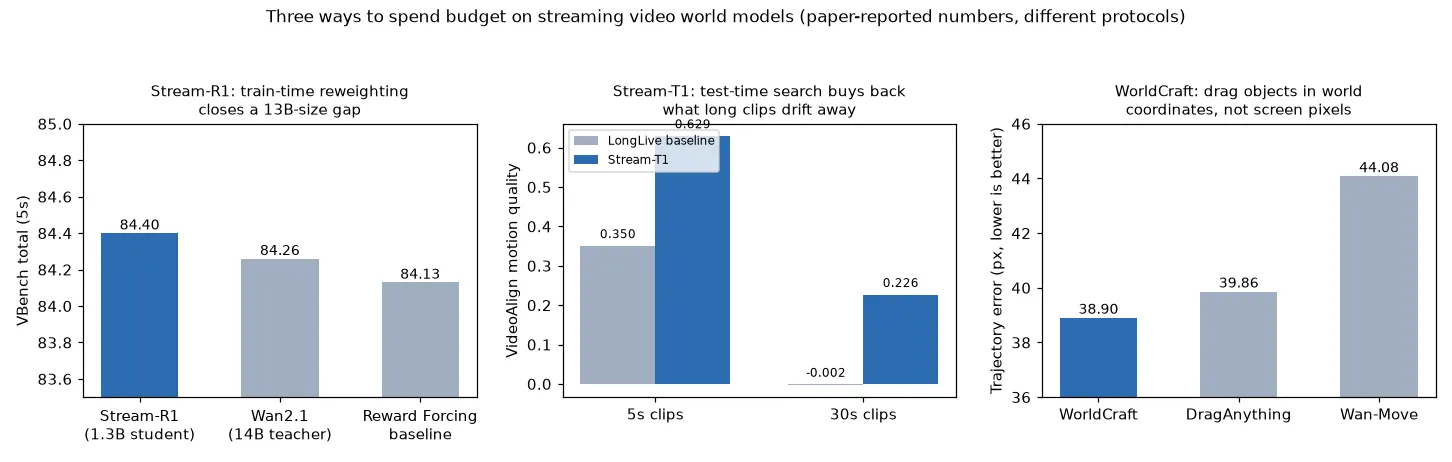
Three papers, one machine, three places to spend
All three papers start from the same kind of system: an autoregressive video model that generates footage chunk by chunk through a KV cache, fast enough to stream. That design buys real-time generation and, in principle, unlimited length. It also creates three distinct problems, and each paper attacks one of them with a different budget.
Stream-R1 fixes the training signal. A few-step streaming student distilled via distribution matching distillation wastes gradient on rollouts and pixel regions that have nothing left to teach, so Stream-R1 reweights the loss by rollout reliability and per-region perplexity. Everything happens at training time; the deployed model is untouched.
Stream-T1 assumes the opposite constraint: the model is frozen and you may only spend compute at inference. It wraps the generator in a chunk-level search with three parts, noise propagation between chunks, reward pruning over a sliding window of ten chunks, and memory sinking for evicted KV-cache entries.
WorldCraft attacks a different axis entirely. Camera-controlled video world models let you fly through a scene but not touch anything in it. WorldCraft adds click-and-drag object manipulation on top of a frozen camera backbone, using world-space trajectories and a small adapter.
The useful question is rarely “which is best.” It is “which budget do I actually have.”
Key numbers
Each column reports what its own paper measured. The protocols differ, so read rows, not the table as a whole.
| What was measured | Stream-R1 | Stream-T1 | WorldCraft | Context |
|---|---|---|---|---|
| VBench total, 5s clip | 84.40 | not reported | n/a | Student is 1.3B; teacher Wan2.1-14B scores 84.26, Reward Forcing baseline 84.13 |
| VideoAlign motion quality, 5s | n/a | 0.629 | n/a | LongLive frozen baseline scores 0.350 |
| VideoAlign motion quality, 30s | n/a | 0.226 | n/a | Baseline collapses to -0.002; the long clip is where drift wins |
| Inference speed | 23.1 FPS at 832x480 | search multiplies per-chunk compute | n/a | Stream-R1 speed is identical to a plain DMD student |
| Training cost | 1,000 steps, 8 A100s, about 56 hours | none | 27,027 clips plus a roughly 50M-parameter LoRA | WorldCraft freezes the camera backbone |
| Trajectory error, static camera | n/a | n/a | 38.90 px | DragAnything 39.86, Wan-Move 44.08 |
| Camera RPE rotation | n/a | n/a | 0.131 at 61 frames, 0.123 at 253 frames | Full fine-tuning instead of the LoRA degrades RPE to 0.237 |
Three observations fall out of the table.
First, Stream-R1’s headline is a size inversion: a 1.3B few-step student reaching 84.40 VBench against its own 14B multi-step teacher at 84.26. The margin is thin, and the paper’s own evidence for it is weakest on short clips. The stronger part of its case is that the gains survive a 60-second rollout (Qwen3-VL judge scores of 4.92 visual quality, 4.04 motion dynamics, 4.11 text alignment) and a 50-video human preference study where it wins 57.0% overall against the baseline. If you only cite 84.40 vs 84.26, you are quoting the noisiest cell in the paper.
Second, Stream-T1’s numbers move the most exactly where the baseline is failing. On 5-second clips its VBench consistency metrics barely budge (motion smoothness 99.12 to 99.15, subject consistency 97.00 to 97.25) because LongLive was already near the ceiling there; the VideoAlign reward-model metrics, which track perceived quality, jump from 0.350 to 0.629. At 30 seconds the pattern flips into view: baseline motion quality sits at -0.002 and Stream-T1 lifts it to 0.226. Read the VBench rows as “does not break what works” and the VideoAlign rows as the real win.
Third, WorldCraft’s numbers look modest (38.90 vs 39.86 trajectory error is not a blowout) until you notice what is being preserved. Adding object control through the roughly 50M-parameter Spatial-Pathway LoRA keeps camera RPE rotation at 0.131, while the ablation shows that full fine-tuning for the same capability degrades it to 0.237. And at 253 frames, a horizon where autoregressive rollouts usually fall apart, its combined RPE of 0.0233 actually beats the WorldPlay camera baseline. The ablation that isolates the core idea is also worth quoting: world-space trajectories with iterative depth refinement reach 30.82 trajectory error on small rotations versus 35.82 for the pixel-space variant, which is the paper’s argument that control has to live in world coordinates, not on the screen.
Why you cannot rank them from this table
The three papers measure different things on different harnesses, and pretending otherwise produces fake conclusions. Stream-R1’s VBench total and Stream-T1’s VideoAlign motion quality are not two readings of one scale; VBench consistency sub-metrics saturate near 97 to 99 on strong baselines while VideoAlign keeps moving. WorldCraft’s trajectory error is a control-accuracy metric measured on a static camera, and its camera RPE numbers come from camera-only evaluation, meaning they prove the camera controller survived the adapter, not that dragging an object is visually free. No shared backbone, resolution, prompt set, or judge appears across all three. The comparison that is actually informative is about cost structure and failure modes, and that is what the rest of this guide does.
When to use which
- You operate your own distillation pipeline and can retrain: Stream-R1 is close to a free upgrade. Both its signals reweight the existing DMD loss, so there is no architecture change and no inference cost, and the recipe is modest (1,000 steps on 8 A100s, about 56 hours). The catch is that everything was shown on one backbone pair, Wan2.1 1.3B student and 14B teacher, at one resolution.
- The model is frozen, or retraining is not yours to do: Stream-T1 is the only option of the three, by construction. It treats the generator as a black box and searches at the chunk level. The bill arrives at inference: expanding and scoring several candidate continuations per chunk multiplies compute, which sits in tension with the real-time streaming goal. If your deployment has latency headroom or offline generation, that trade is attractive; if every millisecond is spoken for, it is not.
- You are building an interactive world, not a clip generator: WorldCraft. Its contribution is capability, not quality: click-and-drag object manipulation that survives camera motion. Because it goes through a LoRA on a frozen backbone, it should in principle stack on top of either quality method, though no paper in this set demonstrates that combination.
- You need long clips from a frozen model and care about perceived quality: Stream-T1 again, specifically for the 30-second regime where its relative gains are largest (motion quality from -0.002 to 0.226). Note that Stream-R1’s 60-second evidence comes from its own retrained student, so it answers a different question.
Failure modes worth pricing in
All three methods trust a learned scorer, which is the shared quiet assumption. Stream-R1’s inter-reliability weighting amplifies whatever bias its pretrained video reward model carries. Stream-T1’s pruning optimizes VideoAlign, and pushing hard on any reward metric drifts toward what the scorer likes rather than what looks right. WorldCraft inherits the failure modes of its monocular depth estimator, which is exactly the component its world-coordinate re-projection depends on, and its control granularity is one latent token, roughly 16x16 pixels, so small objects cannot be addressed precisely.
Each paper also has a scope limit that matters for adoption. Stream-R1 shows one backbone pair at 832x480 and reports no evidence the two-level weighting transfers to other distillation recipes. Stream-T1 is evaluated against a single baseline (LongLive) on two benchmarks, 946 VBench prompts at 5 seconds and 128 MovieGen prompts at 30 seconds, and several of its knobs (the noise interpolation factor, the dynamic reward threshold, EMA decay) look like per-model tuning work. WorldCraft reports no user study, so “controllable” rests on trajectory error and visual metrics rather than on whether people can steer it to intent, and its off-camera persistence keeps state only for objects you explicitly moved.
Limits and open questions
The obvious experiment nobody in this set ran is the composition: a Stream-R1-reweighted student wrapped in Stream-T1 search, with WorldCraft’s adapter on top. If the three budget choices are additive, that stack is the interesting system; if they fight (search amplifying reward-hacked modes from reweighted distillation, say), that is worth knowing too. A second gap is a controlled quality comparison on one backbone with one judge: Stream-R1 and Stream-T1 both claim to lift streaming quality, but their numbers cannot be lined up, so a buyer today has to run both to learn which fits. Third, none of these papers reports throughput-adjusted quality: what you get per GPU-hour at serving time, which is the number an actual deployment would budget against.
FAQ
Is Stream-R1 better than Stream-T1?
They solve different constraint problems, and their numbers cannot be compared directly. Stream-R1 requires retraining (1,000 steps on 8 A100s, about 56 hours) and buys quality that costs nothing at inference, reaching 84.40 VBench with a 1.3B student against its 14B teacher’s 84.26. Stream-T1 requires no retraining but spends extra compute per generated chunk, lifting VideoAlign motion quality from 0.350 to 0.629 on 5-second clips. If you own the training pipeline, Stream-R1’s gains are cheaper to keep; if the model is frozen, Stream-T1 is the only door.
Does Stream-T1 need to retrain the video model?
No. Stream-T1 is training-free by design. It treats the streaming generator as frozen and applies three chunk-level techniques at inference: noise propagation between chunks, reward pruning over a sliding window of ten chunks, and memory sinking for KV-cache entries evicted from the window of nine chunks plus three sink tokens. The cost is additional inference compute, not gradient steps.
How much compute does Stream-R1 training cost?
The paper reports 1,000 optimizer steps on 8 A100 GPUs, an effective batch size of 64, and about 56 hours total, for a Wan2.1-T2V-1.3B student distilled from the 14B teacher at 832x480. Inference is unchanged at 23.1 FPS, since both the reliability and perplexity signals only modify loss weights during training.
Can WorldCraft move objects while the camera is moving?
Yes, and that is its central claim. The drag path is lifted from screen pixels into camera-invariant world coordinates using monocular depth, then re-projected per frame from the current camera pose, so the object follows the intended world path even as the viewpoint rotates. The ablation quantifies this: world-space trajectories with iterative depth refinement reach 30.82 trajectory error on small rotations versus 35.82 for a pixel-space variant.
Why are the benchmark numbers not comparable across the three papers?
Different metrics, harnesses, and goals. Stream-R1 optimizes VBench total for short-clip quality with a retrained student. Stream-T1 reports VideoAlign reward-model metrics against a frozen LongLive baseline, where its VBench consistency rows barely move because they were already saturated near 97 to 99. WorldCraft reports trajectory error in pixels and camera RPE, which are control and tracking metrics, not generative quality scores. Any ranking built by lining these numbers up in one column would be manufactured.
One line: Stream-R1 spends training compute, Stream-T1 spends inference compute, WorldCraft spends a 50M adapter, and the right choice is whichever budget you actually have. Read the Stream-R1 paper, the Stream-T1 paper, and the WorldCraft paper for the full tables.