
AI Agents · AI for Science · LLM Reasoning
Autonomous Research Agents Compared: AutoResearchClaw vs EurekAgent vs ARIS
Four 2026 systems attack the same problem from different layers: workflow (0.648 vs 0.419), environment (85.71% any-medal on MLE-Bench Lite), adversarial assurance, and measurement.
The problem all four are solving
An autonomous research agent is asked to do what a junior researcher does: pick a question, write code, run experiments, analyze results, write a paper. The demos look great. The failure literature is consistent, and AutoResearchClaw names the two recurring ones precisely: agents hallucinate results that were never actually computed, and one bad early decision (a broken data split, a wrong metric) silently poisons everything downstream. ARIS adds a third failure mode it calls “plausible unsupported success”: the run completes, the paper looks finished, and the conclusions were never verified. Nothing crashes, so nothing looks wrong.
The four systems in this comparison attack that problem from four different layers. They are not direct competitors, and that is exactly why comparing them is useful: the layer you choose to fix determines what evidence you will get and what risks remain.
Four answers to the same problem
- Fix the workflow. AutoResearchClaw decomposes ML research into a fixed 23-stage pipeline across three phases (ideation, experimentation, reporting), with panels of K=3 agents debating hypotheses and results, a dedicated verification stage tying every reported number back to executed code, and a human able to step in at any stage. Its thesis: structure plus a reachable human, not a smarter single agent.
- Engineer the environment. EurekAgent leaves the agent off-the-shelf and instead designs everything around it: permissions that keep hidden evaluators and authoritative score files outside the editable workspace, filesystem and Git artifacts that act as a lab notebook, explicit time and API budgets, and human monitoring interfaces. Its thesis: for metric-driven discovery, the environment matters as much as the prompt.
- Add an assurance layer. ARIS is an open-source harness that pairs a Claude-family executor with a reviewer from a different model family (GPT, Gemini, GLM, MiniMax, Kimi, or DeepSeek) whose job is to attack intermediate outputs. On top of that sit 65+ Markdown-defined skills, five workflows, and a three-stage evidence-to-claim audit. Its thesis: the dangerous failure is the quiet one, so make finishing-without-evidence expensive.
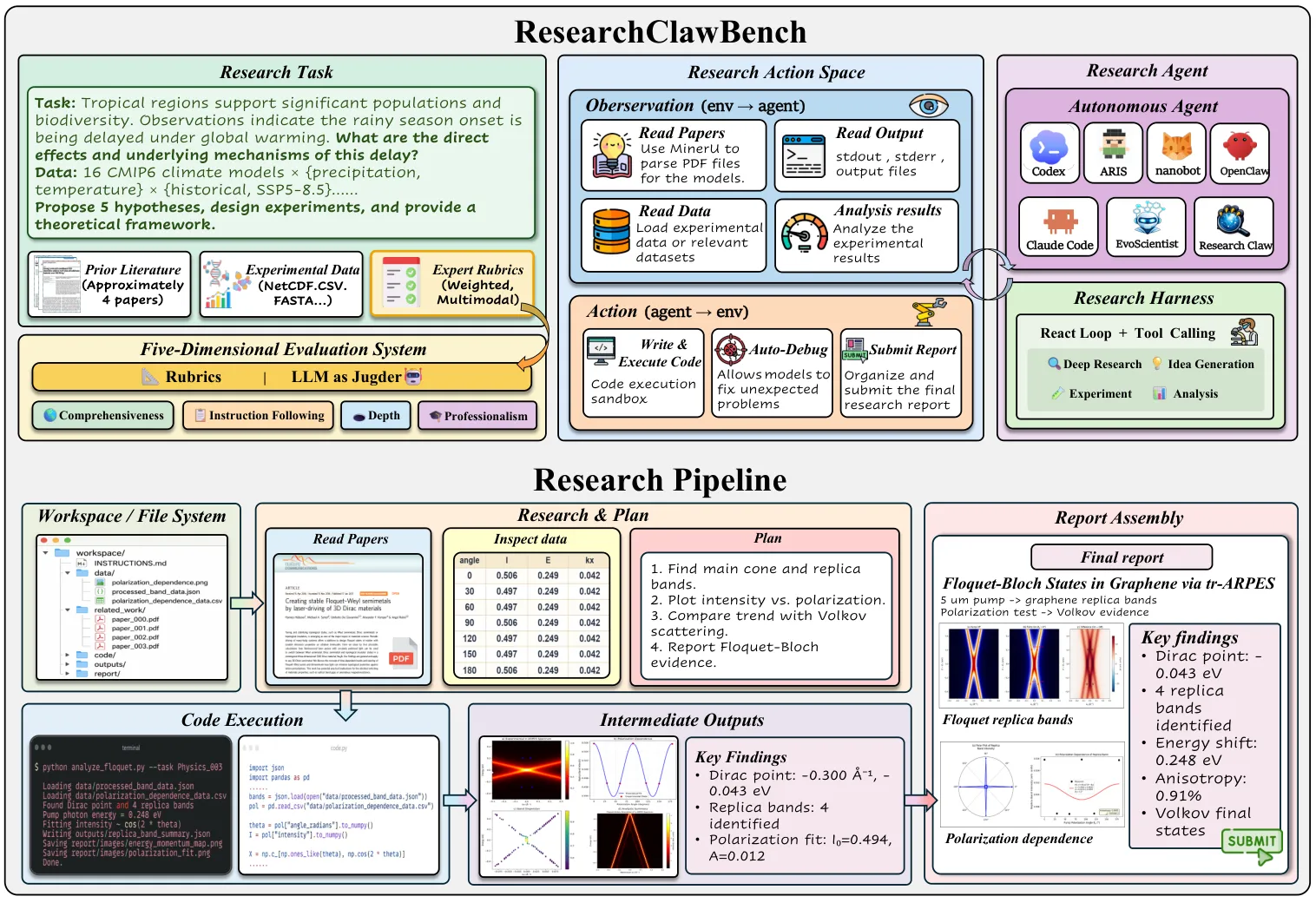
- Measure first. ResearchClawBench is not a system but a 40-task benchmark that turns end-to-end autonomous research into a checkable test with concrete failure signals. Its thesis: without a sharper failure surface than a leaderboard score, every claim above is unfalsifiable.
Key numbers
| System | What it fixes | Headline number | Benchmark / setting | Same harness as rivals? |
|---|---|---|---|---|
| AutoResearchClaw | Workflow structure + human-in-the-loop | 0.648 overall strict vs 0.419 AI Scientist v2 vs 0.511 AIDE-ML | ARC-Bench, 25 ML topics | Yes, its own ARC-Bench, external baselines |
| AutoResearchClaw | Result analysis quality | 0.523 vs 0.261, a 100.4% relative improvement | ARC-Bench dimension score | Yes, vs AI Scientist v2 |
| AutoResearchClaw | Fully autonomous vs CoPilot | 4.03/10, 25.0% accept (6→0 interventions) vs 7.27/10, 87.5% accept (6 interventions) | 10 topics, Table 3 | Step-by-Step: 5.19/10, 50.0%, 23 interventions |
| AutoResearchClaw | Cross-domain breadth | 0.489 physics, 0.912 biology, 0.898 statistics | 20 scientific tasks (10 HEP, 7 bio, 3 stats) | No rival arm |
| EurekAgent | Environment engineering | 2005.03 µs median vs 2247.78 (TTT-Discover) vs 2096.04 (regraded leaderboard best) | TriMul kernel engineering | Local regrading, not a universal leaderboard |
| EurekAgent | Mathematics discovery | 2.635999 on 26-circle packing; 0.380870 Erdős minimum overlap | Open-conjecture tasks | New best, no like-for-like rival run |
| EurekAgent | ML engineering | 85.71% any-medal, 71.43% gold, 100% above median | MLE-Bench Lite, 7-task subset | Subset, not full MLE-Bench |
| ARIS | Assurance / adversarial review | Reviewer score 5.0 → 7.5/10 over 4 review-revision rounds, 20+ GPU experiments | One illustrative overnight run | No: scored by its own reviewer model |
| ResearchClawBench | Evaluation | 40 checkable tasks with concrete failure signals | End-to-end autonomous research | n/a (it is the benchmark) |
Read the table for what it does not contain. There is no shared harness across systems: AutoResearchClaw’s 0.648, EurekAgent’s 85.71%, and ARIS’s 5.0→7.5 measure three different things under three different protocols. The only head-to-head rows are AutoResearchClaw’s, because it built ARC-Bench and ran AI Scientist v2 and AIDE-ML on it. EurekAgent’s TriMul comparison is a local regrading against a leaderboard best, and its MLE-Bench result is a 7-task subset. ARIS’s headline is a single anecdotal run graded by the system’s own reviewer, which its own paper page flags as circular. None of these are fake, but none of them transfer.
The number that matters most is a human-in-the-loop number
Strip away the architectures and the most decision-relevant row in the table is the third one. AutoResearchClaw in fully autonomous mode produces output that human judges accept 25.0% of the time at 4.03/10 mean quality. Its CoPilot mode, with a human intervening only six times across a run, reaches 7.27/10 and 87.5%. A naive Step-by-Step mode that interrupts at every one of the 23 stages needed 23 interventions and still scored worse (5.19/10, 50.0%). Two lessons fall out of this: a human reviewer is currently load-bearing, and where the human intervenes matters more than how often.
This reframes the whole comparison. EurekAgent’s budget warnings and web monitors, ARIS’s terminal inspection, and AutoResearchClaw’s CoPilot mode are all the same bet expressed in different engineering: autonomous research today is a human-supervised process, and the product question is how cheap and how early the supervision happens. ARIS names the reason crisply: an agent that fabricates a clean result is worse than one that fails loudly, because a human downstream will trust the polished artifact.
When to use which
- You have a metric-driven optimization task (kernels, packing, Kaggle-style ML problems): EurekAgent’s environment engineering is the most transferable piece. The evaluator boundary (the agent can explore freely but cannot edit the hidden grader or authoritative score files) is a design pattern you can copy regardless of which agent you run.
- You want an ML-research assistant for your own team: AutoResearchClaw’s evidence is the most decision-ready, because it is the only one with external baselines (0.648 vs 0.419). Plan around CoPilot mode, not Full-Auto.
- You are building your own autonomous-research pipeline: ARIS’s assurance layer is reusable on its own: the three-stage evidence-to-claim audit and cross-family reviewer pattern apply to any harness. But treat its quality numbers as demos, not proof.
- You need to decide whether any of these claims apply to your setting: that is what ResearchClawBench is for. Use its 40-task failure surface as a diagnostic before trusting a leaderboard number.
What none of them solve
The common blind spot is evidence that does not reduce to a scalar. EurekAgent’s page states this directly: the environment-engineering thesis is demonstrated on tasks with executable evaluators, and large parts of science where evidence is slow, noisy, or not reducible to a score are out of scope. AutoResearchClaw’s cross-domain claim rests on as few as three statistics tasks. ARIS’s authors are explicit that it “cannot guarantee that any output is correct, novel, or scientifically sound.” And every verification stage in every system is itself an LLM judgment at some point, so a sufficiently confident model can still pass a check it should fail. Cost is the unmeasured dimension across the board: multi-agent debate, cross-family review, and 23-stage pipelines all multiply token spend, and none of the papers makes that accounting central.
Limits and open questions
The field lacks the one experiment that would settle the layer question: the same research tasks run through a structured-workflow harness, an engineered environment, and an assurance layer, with cost and human-intervention hours reported for all three. Until then, “which layer matters most” is an argument from four papers’ different successes, not a measurement. It is also worth repeating that three of the four headline numbers come from the authors’ own protocols (ARC-Bench, a local regrading, and a self-graded run), which is normal for a young field but should discount confidence accordingly.
FAQ
Which autonomous research agent is best?
There is no shared benchmark that ranks them, so there is no defensible overall winner. AutoResearchClaw has the only head-to-head numbers (0.648 vs 0.419 for AI Scientist v2 on ARC-Bench), EurekAgent posts the strongest task results (85.71% any-medal on a 7-task MLE-Bench Lite subset), and ARIS is a reusable assurance harness rather than a benchmark entry. Choose by which layer you need.
Can AI agents do scientific research fully autonomously?
Not yet at an acceptable quality bar. AutoResearchClaw’s own fully-autonomous mode scores 4.03/10 mean output quality with a 25.0% human accept rate; with a human intervening just six times per run (CoPilot mode) the same system reaches 7.27/10 and 87.5%.
How does AutoResearchClaw compare to AI Scientist v2?
On AutoResearchClaw’s 25-topic ARC-Bench, it scores 0.648 overall strict versus 0.419 for AI Scientist v2 (a 54.7% relative improvement) and 0.511 for AIDE-ML. The largest gain is on result analysis: 0.523 vs 0.261, a 100.4% relative improvement, which the paper attributes to its debate-plus-verification design.
What is “plausible unsupported success” in ARIS?
ARIS’s term for the failure where an autonomous run completes and produces a polished artifact whose claims were never verified. Nothing crashes, so the failure is invisible without an audit layer. ARIS counters it with a cross-model-family reviewer and a three-stage evidence-to-claim audit.
What does EurekAgent’s environment engineering actually mean?
Shaping everything around an off-the-shelf CLI agent: permissions that wall off hidden evaluators and authoritative score files, filesystem and Git artifacts that preserve previous attempts, explicit time and API budgets, and human monitoring interfaces. The agent can explore freely, but it cannot edit the grader that scores it.
One line: the 2026 crop of AI-scientist systems agrees on the diagnosis (agents finish without being right) and disagrees on the cure (workflow, environment, assurance, or measurement), and every honest number still has a human in it. Start with our pages on AutoResearchClaw, EurekAgent, ARIS, and ResearchClawBench.