
Diffusion Models · Text-to-Image · Vision Foundation Models
DDPM vs ControlNet: The Generation Engine and the Steering Wheel
DDPM trains a generator from scratch by reversing Gaussian noise and beat the GANs of 2020; ControlNet freezes a pretrained generator and trains only a zero-connected copy to steer it. Same stack, different problems.
Why these two papers in one page
DDPM and ControlNet are not rivals, and this page is not going to pretend they are. DDPM (Ho, Jain and Abbeel, 2020) answers one question: how do you train a high-quality image generator from scratch without adversarial training? ControlNet (Zhang, Rao and Agrawala, 2023) answers a different one: given a generator you cannot afford to retrain, how do you make it obey a sketch, a depth map, or a pose? Nearly every image-generation system in production today runs DDPM’s idea inside ControlNet’s wrapper. Comparing them side by side clarifies what each layer of the stack actually costs and what each one buys you, which is the question a builder landing here really has.
What DDPM established
The DDPM paper took an old idea, gradual Gaussian noising, and made it train well. The forward process adds a small amount of noise over T = 1000 steps until the image becomes pure noise; this part is fixed and has no parameters. The reverse process is a learned network that undoes one noising step at a time, and chaining 1000 of those steps from pure noise produces a sample. Two decisions did the heavy lifting. First, because each forward step is Gaussian, you can jump to any noise level in closed form, so training only needs a random t per example. Second, instead of the full variational bound with its per-step weights, the network predicts the noise that was added and the paper trains it with plain mean-squared error, the L_simple objective. That objective is equivalent to denoising score matching across noise scales, which is why this paper also connected diffusion models to the score-based line of work.
The payoff was sample quality. On unconditional CIFAR-10, DDPM reaches an Inception score of 9.46 and a then state-of-the-art FID of 3.17, beating the strong GANs of its day, and on 256x256 LSUN it matches ProgressiveGAN. The honest weaknesses are in the same paper: sampling needs the full sequential chain of 1000 network evaluations per image, orders of magnitude slower than a GAN’s single pass, and the model’s log-likelihoods trail dedicated density models, so it is a better sampler than compressor. Conditioning, guidance, and fast sampling all came later. DDPM gives you the engine, burning one fuel: a big pile of clean images and many sequential denoising calls.
What ControlNet added
By 2023 the engine existed as Stable Diffusion, pretrained on web-scale image-text pairs, and the new pain was control. Text prompts are good at content and bad at layout: you cannot reliably say “this pose, this horizon, this building outline” in words. The obvious fix, fine-tuning the whole model on paired (condition, image) data, fails because those paired datasets are small and full fine-tuning of a billion-parameter model on a small set degrades the prior you were trying to keep.
ControlNet’s solution is structural. Freeze the production Stable Diffusion weights. Clone the encoding blocks into a trainable copy. Connect the two with 1x1 convolutions initialized to exactly zero, before and after the copy. At step zero the control branch contributes nothing, so the combined model is byte-for-byte the original and training cannot start by corrupting it; as gradients flow, the zero layers grow away from zero and the conditioning signal fades in. Because the base is frozen, no gradients flow through it, and training a usable control adapter becomes cheap enough for a single GPU.
Key numbers
These papers were published three years apart and answer different questions, so most rows are different rulers, not head-to-head results. The last column says when two numbers were measured under the same harness and can be compared directly.
| Measurement | DDPM (2020) | ControlNet (2023) | Setting and source | Same harness? |
|---|---|---|---|---|
| What it contributes | From-scratch unconditional generator | Spatial control adapter on a frozen generator | Design, both papers | n/a |
| Headline sample quality | CIFAR-10 FID 3.17, Inception 9.46 | Fill50k AUR quality 4.22, fidelity 4.28 (1-5, higher is better) | DDPM Table; ControlNet Table 1, human ranking | No, different tasks and metrics |
| Sampling / inference cost | 1000 sequential network passes per image | One denoising run as usual, plus a condition preprocessor | DDPM Sec. 3; ControlNet design | No |
| Training data regime | Class-level sets (CIFAR-10, LSUN rooms) | Stable under 50k paired images, scales past 1M | DDPM experiments; ControlNet abstract | No |
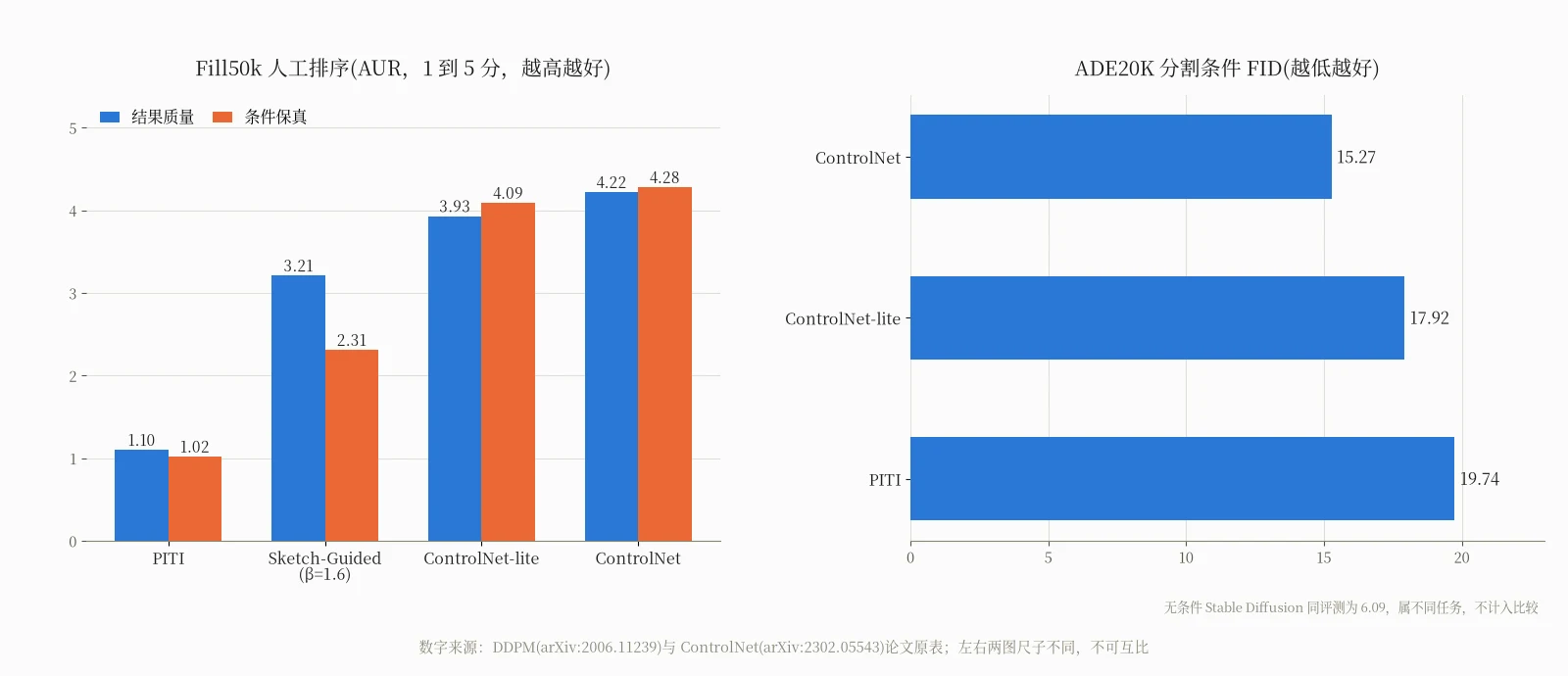
| Human preference vs prior sketch methods | No such comparison | AUR quality/fidelity: ControlNet 4.22/4.28, ControlNet-lite 3.93/4.09, Sketch-Guided (beta=1.6) 3.21/2.31, PITI 1.10/1.02 | ControlNet Table 1, Fill50k, users rank 1-5 | Yes, all rows same Fill50k protocol |
| Segmentation-conditioned FID | Not applicable | ControlNet 15.27, ControlNet-lite 17.92, PITI 19.74 (lower is better) | ControlNet Table 3, ADE20K segmentations, 512x512 sets | Yes, conditioned methods same eval; unconditioned Stable Diffusion’s 6.09 is a different task and not a ControlNet loss |
| Extra training cost of the adapter | n/a, no adapter | About 23% more GPU memory and 34% more time per training iteration than plain Stable Diffusion optimization | ControlNet Sec. 4.1, single NVIDIA A100 40GB | Yes, same-hardware comparison |
| Matching an industrial depth model | n/a | Depth ControlNet: 200k samples, one RTX 3090Ti, 5 days, vs SDv2-D2I trained with a large A100 cluster and over 12M images | ControlNet Sec. 4.1 comparison to industrial models | No, cost accounting differs |
| Can humans tell it from the industrial model | n/a | Average user discrimination precision 0.52 +/- 0.17, chance level | ControlNet Sec. 4.1, 12 users trained on 100 examples, then 200 test images | Yes, within that user study |
Read the table for what it cannot give you. There is no benchmark where DDPM and ControlNet compete, because they operate on different layers of the stack. DDPM’s 3.17 FID is a sample-quality claim about a generator trained from nothing; ControlNet’s 15.27 FID is a distribution claim about images steered by segmentation maps, and the paper itself shows that unconditioned Stable Diffusion scores 6.09 on that evaluation simply because free generation is an easier distribution to match. Those numbers must never be read as DDPM winning or losing against ControlNet.
What each one is actually buying you
DDPM buys a training recipe. Its contribution is that a simple noise-prediction objective over a fixed noising schedule produces a generator that beats adversarial training on sample quality, with no discriminator and no mode-collapse failures. What you pay is inference: the sampler is the model run 1000 times in sequence, and every downstream acceleration trick (fewer steps, distillation, latent spaces) exists because of this line item.
ControlNet buys prior preservation. Its contribution is a way to add a capability to a model you cannot regenerate: the frozen branch keeps everything web-scale pretraining taught it, and the trainable copy only learns to read the new condition. The zero-initialized convolutions are the load-bearing detail, and the paper’s ablations show that swapping them for standard initialization degrades results. What you pay is a per-condition tax: each condition type (edges, depth, pose, segmentation, scribbles) needs its own trained ControlNet and its own off-the-shelf preprocessor, and the ceiling of your control is the quality of that preprocessor.
Seen this way the two papers are complementary budgets. DDPM decides what the engine is; ControlNet decides how little you must touch it. The systems that followed, from DALL-E 2 onward, stack both: a DDPM-style diffusion engine inside a larger pipeline, with conditioning machinery around it.
When to use which
- You are studying or building the generator itself: start with the DDPM recipe. The forward noising process, the closed-form jump to any noise level, and the L_simple noise-prediction objective are still the mental model every diffusion system assumes you have.
- You have a pretrained text-to-image model and need layout control: use ControlNet’s pattern. Freeze the base, train a copy with zero-initialized connections, and budget one adapter per condition type.
- Your paired condition dataset is small, tens of thousands of images: that is exactly the regime ControlNet was built for; full fine-tuning of the base model is the option that loses there.
- You need many sequential denoising steps to be cheap at serving time: that problem belongs to the DDPM layer (fewer-step samplers, distillation), and no control adapter fixes it, because ControlNet spends its budget during training, not per sample.
- You need semantics, not structure: ControlNet steers geometry. If the problem is “wrong object, wrong style,” that is a prompting or fine-tuning problem of the base model, not something an edge map will fix.
Limits and open questions
The comparison itself has a structural gap: the two papers were measured on different tasks, different metrics, and different hardware regimes, so every row in the table above is marked as same-harness or not, and only the ControlNet-internal rows (user rankings, segmentation FID, per-iteration overhead) support direct comparison. DDPM’s numbers are also 2020 numbers: FID 3.17 on CIFAR-10 says nothing about modern text-to-image quality, and its 1000-step sampling has since been cut to dozens of steps by samplers DDPM did not have. ControlNet’s small-data stability claim assumes the frozen base exists, so it transfers none of the upstream pretraining cost; and its per-condition adapters inherit every bias of the base model rather than fixing any. The open question neither paper answers is when the adapter should be a ControlNet-style structural copy versus a lighter parameter-efficient method; that choice depends on how far your condition departs from what the base already understands.
FAQ
What is the difference between DDPM and ControlNet?
DDPM is a method for training an image generator from scratch by reversing a gradual Gaussian noising process; ControlNet is a method for adding spatial control to an already-trained diffusion model without retraining it. One builds the engine, the other steers it.
How does ControlNet’s zero convolution method work?
A zero convolution is a 1x1 convolution whose weights and bias start at exactly zero, placed around a trainable copy of the frozen model’s encoding blocks. At initialization it outputs nothing, so the network behaves as the unmodified pretrained model, and it learns to let the conditioning signal in gradually as training proceeds.
What results does each paper report?
DDPM reports FID 3.17 and an Inception score of 9.46 on unconditional CIFAR-10, plus LSUN 256x256 quality comparable to ProgressiveGAN. ControlNet reports a Fill50k user ranking of 4.22 for quality and 4.28 for condition fidelity, an ADE20K segmentation FID of 15.27, and training overhead of roughly 23% more GPU memory and 34% more time per iteration on a single A100.
Does ControlNet need a large training dataset?
No. The paper shows stable training with under 50k paired images and also shows the approach scaling past 1M. The zero-initialized connection layers are what keep small-dataset training from degrading the frozen base model.
Why is DDPM sampling slow, and does ControlNet make it slower?
DDPM generates by running the network once per noising step, 1000 sequential passes in the original paper. ControlNet does not change inference cost much at all; it adds a preprocessing step (edge detector, depth network, pose estimator) and conditions each denoising call, so its budget is spent at training time.
Can I use ControlNet with a model other than Stable Diffusion?
The architecture is generic: lock the encoding blocks of any large diffusion model, clone them, and connect with zero convolutions. The paper implements it on Stable Diffusion, and the same pattern has since been applied to other diffusion backbones and to conditioning beyond images.