
Video Generation · Diffusion Models
OmniDirector vs SCAIL-2 vs Lip Forcing: Controlled Video Compared
OmniDirector, SCAIL-2, and Lip Forcing control camera, body, and lips in video diffusion, each escaping its axis's wall: paired data, pose skeletons, or bidirectional latency.
The two walls that define this problem
Text-to-video models generate beautiful footage from a prompt, but production work rarely wants “a beautiful video.” It wants this camera move, that person’s motion, those lips matching this audio. Getting that control into a video diffusion model runs into one of two walls.
The first is a data wall. The natural way to teach a model camera control is cross-paired data: two videos with identical camera trajectories but different content. Almost nobody can film that at scale. The natural way to teach character animation is paired (reference image, driving video) tuples with clean motion labels, which is why pose-driven methods first crush the driving video into a skeleton, destroying exactly the detail (hand-object contact, clothing physics, two-character interaction) that makes motion look real.
The second is a latency wall. The strongest audio-driven methods process the whole clip bidirectionally before emitting a single frame. That yields great lip-audio alignment and unusable latency: in Lip Forcing’s own table, the 14B OmniAvatar-LS baseline runs at 0.38 FPS with a 213.72ms time-to-first-frame. No live avatar can be built on that.
The three papers in this comparison (OmniDirector, SCAIL-2, and Lip Forcing) each attack one axis (camera, body, lips) and each gets around its wall by replacing a hand-designed intermediate with something the model can learn from directly. That shared move is the real subject of this guide.
Key numbers: the three control axes at a glance
| OmniDirector | SCAIL-2 | Lip Forcing | |
|---|---|---|---|
| Control axis | Camera path and shot transitions | Character body motion, identity binding | Lip-audio synchronization |
| Conditioning signal | Camera path rendered as a 3D grid video | Raw driving video tokens concatenated in-context | Audio + already-generated frames, chunked |
| Backbone | Multi-modal diffusion transformer (token concat) | Full fine-tune of Wan2.1-14B-I2V | 1.3B / 14B causal students distilled from a 14B bidirectional teacher |
| Data wall workaround | Grid computed from the video itself: every clip is its own training pair | Synthetic MotionPair-60K built by an agentic loop | Distribution Matching Distillation; no new data needed |
| Latency workaround | n/a (offline generation) | n/a (offline generation) | Two denoising steps per chunk, no inference-time CFG |
| Headline number | Rotation error 2.64° vs 4.11 (CamCloneMaster) | FVD 287.11 vs 305.31 (Wan-Animate) on Studio-Bench | 31.58 FPS vs 3.23 (LatentSync) at Sync-C 6.88 vs 8.10 |
| Boundary | 480p, short clips; long-sequence consistency unproven | Ceiling set by synthetic data generators; lip-sync not handled | 33-clip HDTF eval; fastest checkpoint is not the highest-fidelity one |
None of these three numbers come from the same benchmark, and none should be read as a ranking of the three methods against each other. They answer different questions. What is comparable is the pattern: each headline metric is measured against the previous best method on its own axis, and each gap is large where the new conditioning signal removes a bottleneck, incremental elsewhere.
OmniDirector: camera control without cross-paired data
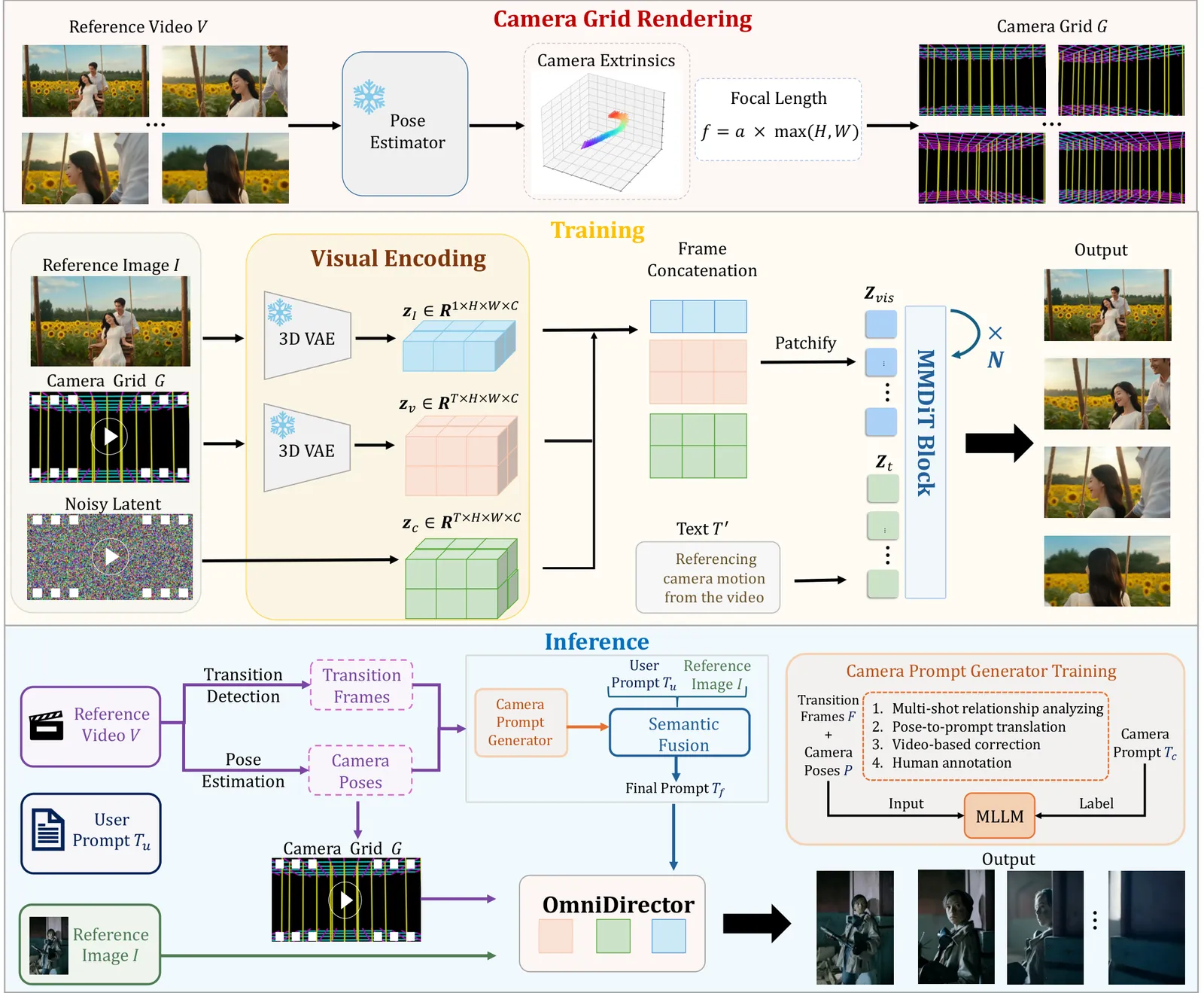
OmniDirector’s problem is the purest form of the data wall. Camera cloning needs two videos with the same camera move and different scenes; that dataset essentially does not exist, and synthetic versions carry a domain gap. The paper’s move is to change the representation of the camera: instead of pose matrices or text descriptions, it renders the trajectory as a camera grid: an empty 3D room with colored lines for floor, ceiling, and walls, plus a tube tracing the path, computed from estimated camera parameters. Because the grid derives from the same single video, every clip in the wild becomes its own training pair. The authors train on 1.8 million ordinary internet videos filtered with TransNet-V2, with 30% self-reconstruction samples that force the model to actually read the geometry.
The single-shot gains are real but incremental: rotation error (RRE) of 2.64 degrees vs CamCloneMaster’s 4.11 on a 1,094-sample web evaluation set, translation precision 72.74% vs 52.21%. The decisive number is multi-shot. Prior cloning methods cannot reproduce a cut and its new camera setup; CamCloneMaster’s temporal precision on shot transitions is 2.20%, LTX-LoRA’s is 38.94%, while OmniDirector reaches 96.52% by rendering transition frames as pure white and generating separate inter-shot and intra-shot camera prompts. Content leakage drops to 0.51% frame / 3.38% shot vs 1.60% / 11.59%. A schedule detail matters too: injecting the grid only during high-noise steps and other signals during low-noise steps is worth 83.18% vs 74.55% rotation precision when ablated.
The boundary the paper states itself: token concatenation “struggles to maintain long-term memory and temporal consistency when scaling to significantly longer video sequences,” and everything is measured at 480p. Also note the evaluation pipeline uses DPA-V3 for camera extrinsics for both training labels and scoring, so the metrics can inherit that estimator’s systematic biases. Read the full breakdown in the OmniDirector paper page.
SCAIL-2: character animation without the pose skeleton
SCAIL-2 attacks a different intermediate: the pose skeleton. Pose-driven animators like Wan-Animate convert the driving video into a skeleton before generation, so anything the skeleton cannot encode (hand-object contact, fine clothing, physical interaction between two characters) is discarded before the model ever sees it. SCAIL-2 (from Zhipu AI and Tsinghua) removes the intermediate entirely: the I2V backbone receives the concatenation of reference tokens, noisy video tokens, and raw driving video tokens, spatially offset so they stay detached from the output frames.
Raw conditioning alone does not tell the model whose motion to copy or which background to keep, so SCAIL-2 adds an in-context mask with 28 extra channels: one environment-switch channel (reference background for animation, driving background for replacement) and six binding-slot channels that tie motion to specific characters, enabling zero-shot multi-character scenes. The data problem is solved synthetically: an agentic loop (Candidate Selector, Prompt Weaver, Quality Checker) builds MotionPair-60K: about 31,895 SCAIL animation pairs, 13,847 from Wan-Animate, 13,634 replacement pairs from MoCha, and roughly 100,000 pose-extraction pairs. A 400-step Bias-Aware DPO pass targets the artifacts synthetic data leaves in fine regions.
On Studio-Bench pose-driven evaluation, SCAIL-2 with a SAM3D-Body mesh hits SSIM 0.6453 / FVD 287.11 against Wan-Animate’s 0.6340 / 305.31, VACE at 0.5942 / 387.52, and UniAnimate-DiT at 0.6367 / 480.15. Two details to carry into any decision. First, the mesh matters: swapping the NLF-Pose skeleton for a SAM3D-Body mesh lifts SSIM from 0.6370 to 0.6453 zero-shot, and as a pure skeleton-driven generator the model is described as mediocre, so part of the win rides on a richer driving representation, not the architecture alone. Second, the ablations show the design pieces are load-bearing: Video-Bench imaging quality drops from 4.63 to 4.47 without binding slots and to 3.90 without the replacement task. The cost is a full fine-tune of a 14B model on 64 H100s for about a week, plus the synthetic-pair pipeline. More in the SCAIL-2 paper page.
Lip Forcing: lip-sync control without waiting for the whole clip
Lip Forcing (KAIST AI with AIPARK) hits the latency wall head-on. Strong lip-sync diffusion models like LatentSync process clips bidirectionally: Sync-C 8.10, but 3.23 FPS. Lip Forcing turns a 14B bidirectional teacher into causal students with Distribution Matching Distillation (the same few-step family that powers Causal Forcing for text-to-video), so each new chunk conditions on already-generated frames and the audio, and streams.
Three pieces make the two-step schedule hold up. Students denoise at exactly two ODE indices (0, 30), with the landing point derived from an Euler-step analysis balancing identity survival against audio tracking; a naive one-step student visibly underperforms. Sync-Window DMD gates classifier-free guidance by denoising step instead of treating it as a global dial: CFG 4.5 only inside steps 20-40, where the trajectory is most responsive to audio, because no fixed scale wins on both sync and fidelity. A SyncNet reward with weight w = exp(2·R) scales the DMD gradient by how well each sample’s mouth matches the audio.
The numbers, all on the 33-clip HDTF set (ground truth: Sync-C 7.95, Sync-D 6.92): the 1.3B student runs at 31.58 FPS with a 0.32ms time-to-first-frame, Sync-C 6.88, FVD 118.86, FID 6.76, which is 17.6x faster than its same-scale bidirectional counterpart. The 14B student hits 15.11 FPS with Sync-C 7.59, closing most of the gap to ground truth while running 39.8x faster than its teacher and 4.7x faster than LatentSync at a comparable FID (7.01 vs 6.90). The trade is explicit: the fastest checkpoint is the weakest on sync, and Wav2Lip still wins the raw sync metric (8.56) while looking far worse (FID 24.15). The pitch is photorealism at streaming speed, not maximum Sync-C. Full detail in the Lip Forcing paper page.
The pattern underneath: kill the intermediate
Put side by side, the three methods make one argument three times. Each axis of video control had a canonical intermediate representation (pose matrices or text for camera, pose skeletons for body motion, full-clip bidirectional decoding for audio), and each intermediate existed to make supervision or inference tractable. Each paper shows the intermediate is doing more damage than the tractability is worth, and replaces it with a signal computed from the data itself: a camera grid rendered from estimated parameters, raw driving pixels plus a learned mask, a distilled causal trajectory. Two of the three also share a second move, self-supervision on unlabeled video (1.8M internet videos for OmniDirector, synthetic pairs reverse-engineered from real human-centric data for SCAIL-2), to avoid paired-data collection, while Lip Forcing inherits supervision from the teacher instead of new data.
The differences are just as instructive. OmniDirector’s bottleneck is temporal (long sequences at 480p), SCAIL-2’s is data quality (fidelity capped by its generators; lip-sync explicitly out of scope), and Lip Forcing’s is the fidelity-speed frontier (you pick your checkpoint). None of the three numbers-tables above is a controlled comparison, because the benchmarks, backbones, and eval sets differ; the guide’s verdict box is built from the per-axis numbers, not a cross-axis ranking.
Limits and open questions: what the numbers do not prove
Three cautions apply to all three papers. First, evaluation pipelines can flatter themselves: OmniDirector trains and scores with the same DPA-V3 camera estimator; Lip Forcing’s Sync-C is a SyncNet-based metric that older GAN methods game (Wav2Lip’s 8.56); SCAIL-2’s strongest numbers need an external mesh extractor in the loop. Second, the headline metric is not the deployment metric: 96.52% temporal precision measures cut timing within 3 frames, not cinematic coherence across shots; 31.58 FPS belongs to the lowest-sync checkpoint; the FVD win depends on the mesh pairing. Third, none of the three releases a fully reproducible stack yet: OmniDirector’s dataset and weights are unconfirmed, SCAIL-2 promises a subset, and Lip Forcing’s two-step schedule is tied to its specific teacher and dataset.
When to use which
- You need a specific camera move, especially multi-shot edits with cuts: OmniDirector. The 2.64° vs 4.11° rotation error is good; the 96.52% vs 2.20% multi-shot temporal precision is the reason to adopt it. Wait if you need minute-long, high-resolution sequences.
- You run pose-driven animation and lose detail at the skeleton step: SCAIL-2’s reproducible idea (raw driving tokens plus an in-context mask) fits an existing Wan2.1-14B I2V backbone, but budget for the 64-H100-week fine-tune and the synthetic-pair pipeline before any of it works.
- You need a live, streaming talking head: Lip Forcing, at the checkpoint that matches your trade: 1.3B for 31.58 FPS, 14B for Sync-C 7.59 at 15.11 FPS. If raw sync score is all you need, Wav2Lip is still cheaper.
- You need all three axes in one product: none of these papers unifies them. SCAIL-2 explicitly leaves lip-sync to future work, so camera-plus-body-plus-lips control in a single model remains open.
FAQ
Which controlled video generation method is best?
There is no cross-axis ranking: OmniDirector (camera), SCAIL-2 (character animation), and Lip Forcing (lip sync) are evaluated on different benchmarks against different baselines. On their own axes, each beats the previous best clearly: OmniDirector 2.64° vs 4.11° rotation error, SCAIL-2 FVD 287.11 vs 305.31, Lip Forcing 31.58 FPS vs 3.23.
Do any of these methods need paired training data?
OmniDirector needs no cross-paired camera data because it renders each video’s camera path as a grid, making every clip its own training pair. SCAIL-2 does need paired (reference, driving) data and synthesizes it via an agentic pipeline (MotionPair-60K). Lip Forcing needs no new data; it distills an existing 14B bidirectional teacher.
What is the real-time lip sync speed tradeoff?
On the 33-clip HDTF set, Lip Forcing’s 1.3B student streams at 31.58 FPS but only reaches Sync-C 6.88 (ground truth 7.95, LatentSync 8.10); the 14B student reaches Sync-C 7.59 at 15.11 FPS. So “real-time” and “best sync” are different checkpoints of the same model.
Why is OmniDirector’s 96.52% multi-shot number the headline?
Because prior camera-control methods essentially cannot reproduce a shot transition: CamCloneMaster scores 2.20% temporal precision, LTX-LoRA 38.94%. OmniDirector reaches 96.52% by rendering transition frames as pure white and generating separate inter-shot and intra-shot camera prompts. The caveat: the metric is a within-3-frames cut-timing measure at 480p, not long-range coherence.
Can one model control camera, body, and lips together?
Not according to these papers. SCAIL-2 names lip-sync and facial expression as tasks it does not handle, OmniDirector only controls camera, and Lip Forcing is video-to-video lip sync. Unifying the three control axes in one model is an open problem.