
World Models · LLM Reasoning · Robotics · Multimodal Models
World Models vs LLMs: Simulation, Symbols and When to Trust the Rollout
An LLM reasons over rules and goals in language; a world model predicts what a scene does next. The 2026 evidence says they are complementary, and the hard part is knowing when a generated future is credible.
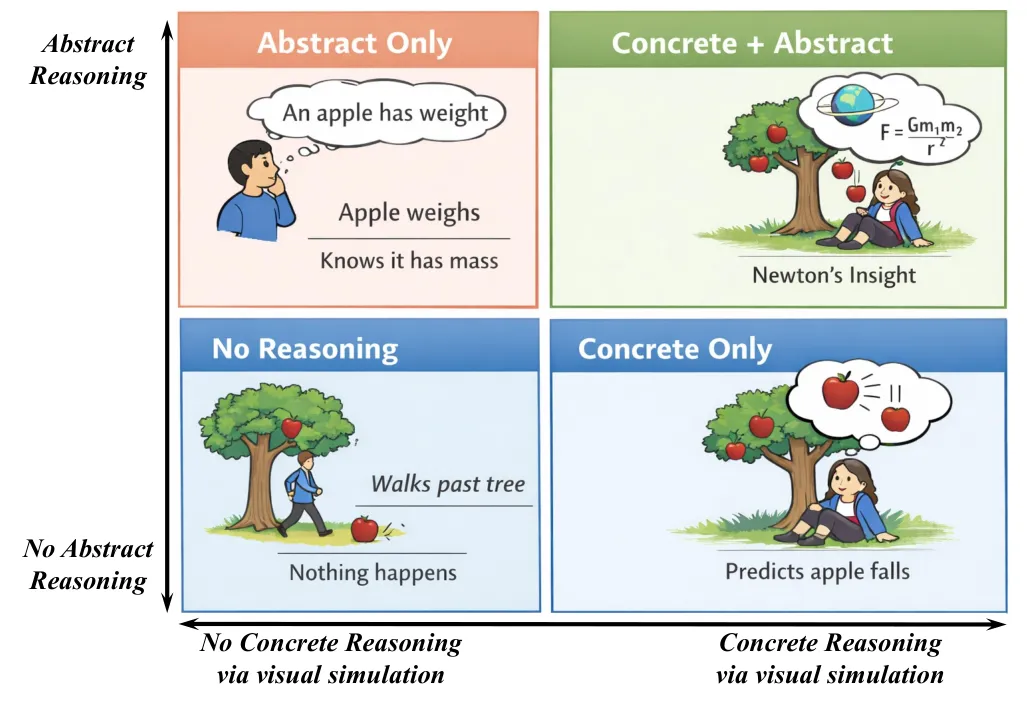
Two different objects being predicted
A large language model predicts the next token given text. Its reasoning strength comes from operating on symbols, rules and goals, and its most reliable training signal is a verifiable answer. DeepSeek-R1 is the cleanest demonstration: pure reinforcement learning against rule-checked rewards took AIME 2024 pass@1 from 15.6 to 71.0 with no human reasoning data, and the released model scores 79.8. The same paper is explicit about the limit: the recipe needs a checkable answer, so it does not obviously transfer to tasks where correctness cannot be scored in text.
A world model predicts the next state of an environment given the current state and an action. In 2026 that means video-scale models: Cosmos 3 reads and writes language, image, video, audio and action inside one mixture-of-transformers network and was the top policy model on RoboArena at release; Kairos is a 4B model with linear-cost temporal attention that renders a 480P rollout in 11.4 seconds on a single RTX 5090 and leads PAI-Bench at 80.84; WALL-WM jointly denoises future video and robot actions and averages 75.86 Task Progress on real-robot manipulation against 55.64 for pi-0.5. None of these models is trying to be a better language reasoner. They are trying to be a better physics predictor that a policy can roll out against.
The question people mean by “world model vs LLM” is therefore not which one is smarter. It is which one to consult for a given decision, and how to combine them without letting a photorealistic but wrong rollout poison the answer.
Key numbers
| Measurement | LLM | World model | Setting and source | Same harness? |
|---|---|---|---|---|
| What is predicted | next token | next scene state, given an action | Definition | n/a |
| Training signal that works best | verifiable answers (RL on rule rewards) | future frames, actions, physical alignment | DeepSeek-R1; Cosmos 3, Kairos, WALL-WM | n/a |
| AIME 2024 pass@1 from pure RL | 15.6 → 71.0 (R1-Zero), 79.8 released | not applicable | DeepSeek-R1 | n/a |
| Spatial lookahead QA, VRQABench | 61.8 (SFT MLLM, no simulation) | 72.4 with gated world-model rollouts | PF-OPSD, Qwen3.5-9B student | Yes |
| Open-domain physical prediction, OpenWorldQA | 59.6 | 70.5 | Same | Yes |
| Value of verifying rollouts | n/a | 72.4 → 65.2 without verification; → 66.4 without advantage weighting | PF-OPSD ablations | Yes |
| Physical-AI video benchmark, PAI-Bench | n/a | 80.84 (Kairos 4B), ahead of Cosmos 2.5 2B and 14B | Kairos paper | Within world models |
| Rollout latency, 480P | n/a | 11.4 s on one RTX 5090; 3.0 s on four A800 | Kairos | n/a |
| Per-step cost vs horizon | grows with context (KV cache) | O(n) with hybrid linear temporal attention | Kairos, Theorem 2 bound | n/a |
| Real-robot manipulation, Task Progress | not applicable | 75.86 (WALL-WM event mode) vs 55.64 (pi-0.5) vs 39.97 (DreamZero) | WALL-WM internal suite | Within robot policies |
| Generalization to novel scene and instruction order | not applicable | 53.75 vs 18.50 (same model, fixed-length chunks) | WALL-WM ablation | Yes |
| Modalities in one backbone | text (plus bolted-on encoders) | language, image, video, audio, action | Cosmos 3 | n/a |
The only rows that compare an LLM with a world model on the same task are the PF-OPSD rows, and even there the comparison is “MLLM alone” against “MLLM plus gated world-model rollouts”. Everything else measures each family on its own ground.
Where the world model wins
Anything that depends on what happens next in a scene. The PF-OPSD benchmarks were built to isolate this: maze and Sokoban-style puzzles where the answer depends on simulating a few steps ahead, and real-video physical prediction from Charades, Something-Something and Oops. Giving a 9B multimodal LLM access to Helios rollouts, and training it when to use them, lifts accuracy by 10.6 and 10.9 points. The robot results are the other half: WALL-WM’s event-mode supervision doubles generalization Task Progress over the same architecture trained on fixed-length chunks, and Cosmos 3 turns the same network into a RoboArena-topping policy because it can emit actions, not just captions.
Cost curves also favor world models for long horizons. Kairos’s temporal factorization keeps per-step generation cost roughly flat as the rollout grows, and its Theorem 2 bounds long-horizon error under a contraction assumption, which is the kind of guarantee autoregressive text generation does not have.
Where the LLM wins
Anything checkable in symbols. R1’s rule-based rewards work because a math answer or a unit test is exact; that exactness is what let RL discover long chains of thought, self-checking and backtracking on its own. World models have no equivalent signal for “was this rollout correct”, which is why the PF-OPSD authors had to build a teacher with privileged access to true futures.
Trust is the second win. A video world model’s rollout is stochastic and can look photorealistic while being task-wrong: a ball settling in the wrong cup, a maze agent walking through a wall. Feeding such a rollout to a reasoner is worse than ignoring it. PF-OPSD’s ablation quantifies this: remove rollout verification and VRQABench drops 7.2 points, more than half of the total gain. The LLM’s job in the combined system is not to defer to the simulation but to grade it.
When to use which
- Math, code, planning over explicit rules, anything with a verifier: LLM, trained or prompted the R1 way. A world model adds cost and no signal.
- Robot control, contact-rich manipulation, “what happens if I push this”: world model or world-action model. WALL-WM and Cosmos 3 are the current reference points; the LLM, if present, handles instruction parsing.
- Visual questions that hinge on a few steps of physical lookahead: LLM plus world model, with a learned gate. Copy PF-OPSD’s structure: decide whether to simulate, verify the rollout, weight it, and never let the deployed model see a true future.
- Long rollouts on consumer hardware: a linear-attention world model such as Kairos, not a quadratic one; the 11.4-second single-GPU number is the reason.
Limits and open questions
The single controlled LLM-versus-LLM-plus-world-model result uses two benchmarks built by the same team, image-conditioned and short-horizon, and a teacher that relies on Gemini-3.1-Pro with gold futures, so reproducing the gate is expensive. World-model benchmark wins are partly data wins: Kairos trains on roughly 100,000 hours of human video, and Cosmos 3 is a 294-author effort. Robot comparisons (WALL-WM against pi-0.5 and DreamZero) run on internal suites with the team’s own rubric. And no paper here measures the failure that matters most in deployment: how often a verified rollout is still wrong, and what that costs downstream.
FAQ
What is the difference between a world model and a large language model?
An LLM predicts the next token and reasons over symbols, rules and goals in language. A world model predicts the next state of a scene given an action, today usually as video plus actions. R1-style LLMs learn best from verifiable answers; world models such as Cosmos 3, Kairos and WALL-WM learn from future frames and physical alignment.
Is a world model better than an LLM for reasoning?
For reasoning over rules and checkable answers, no: DeepSeek-R1 reaches 79.8 on AIME 2024 with no simulation at all. For reasoning that depends on physical lookahead, adding gated world-model rollouts to a 9B multimodal LLM raised VRQABench from 61.8 to 72.4.
Can an LLM use a world model’s simulation reliably?
Only with verification. Rollouts are stochastic and can be photorealistic but wrong. In PF-OPSD, removing rollout verification cut the benchmark gain from 10.6 points to 3.4, so the model must learn when to invoke, trust and weight a simulation.
Do world models replace VLA robot policies?
They are merging. WALL-WM denoises future video and actions jointly and beats pi-0.5 on real-robot Task Progress (75.86 vs 55.64); Cosmos 3 emits actions from the same network that generates video. The distinction is becoming one of training recipe rather than model class.