
World Models · Robotics · Efficient AI
Kairos: A 4B Native World Model Stack for Physical AI
Kairos packs a world model into 4B params with linear-time Hybrid Linear Temporal Attention, leads PAI-Bench at 80.84, and runs a 480P rollout in 11.4s on one RTX5090.
Quick answer
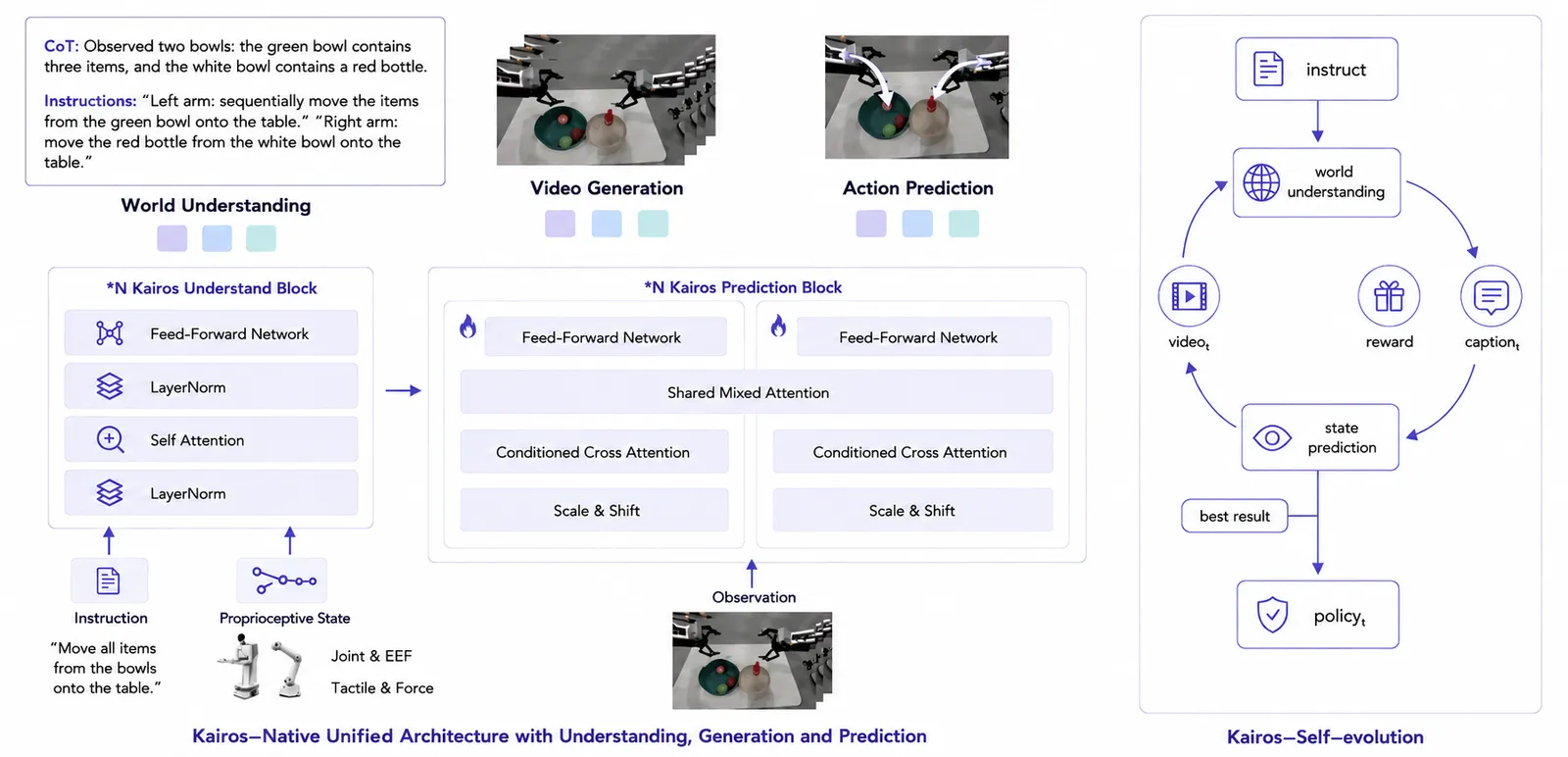
Kairos is a 4B-parameter world model built as a deployable stack, not a standalone video generator. Its core engineering bet is Hybrid Linear Temporal Attention, which drops generation cost from O(n squared) to O(n) by splitting time across three branches: sliding-window attention for local dynamics, dilated sliding windows for mid-range dependencies, and gated linear attention for persistent global memory. The general 4B model leads PAI-Bench at 80.84 and scores 8.94 on WorldModelBench; the robot variant hits 80.03 on PAI-Bench-robot. A 480P rollout runs in 11.4s on a single consumer RTX5090, or 3.0s across four A800s. The genuinely new scientific claim is a formal bound (Theorem 2) showing this temporal factorization keeps long-horizon error from blowing up, assuming the global-memory branch is contractive.
What a “native world model stack” actually means
The framing is three verbs: learn, maintain, run. Kairos learns through a Cross-Embodiment Data Curriculum that orders open-world video, then roughly 100,000 hours of human behavioral data, then robot interaction logs as a staged developmental path, trained at progressive resolution (256P up to 720P, 1 frame up to 241 frames). It maintains state with the unified architecture below. It runs through deployment co-design targeting both server GPUs (A800/A100) and consumer hardware (RTX5090, plus the METAX C500).
Two of those three pillars are packaging. The curriculum and the deployment work are solid engineering, but they are the kind of thing any well-resourced lab assembles. The part worth reading closely is the attention mechanism and the bound attached to it.
How Hybrid Linear Temporal Attention limits drift
Long-horizon world models fail the same way: small per-step prediction errors compound until the rollout diverges. Kairos attacks this by factorizing temporal memory across scales instead of running full quadratic attention over the whole history. Local detail goes to sliding windows, mid-range structure to dilated windows, and the long tail to a gated linear attention branch with a delta-rule update that acts as persistent memory. This is the same linearizing instinct behind work like Full Attention Strikes Back and sparse schemes such as MiniMax sparse attention, applied to the temporal axis of a generative rollout rather than to text context.
Theorem 2 is where the paper earns its claim. It states that if the global-memory branch uses a gated delta update that is contractive with factor rho under 1, and the hybrid predictor approximates the true components within error epsilon, then the excess risk stays bounded by roughly (Lepsilon + L_Gxi / (1 - rho)) squared as t goes to infinity, with L and L_G Lipschitz constants. Read the assumptions, not just the headline. The bound holds only when the memory update is genuinely contractive, and that contraction factor rho is a learned, empirical property, not something guaranteed by the architecture. The theorem says drift cannot accumulate without bound under those conditions; it does not say drift is small.
Why the 4B size is the real story
A 4B model leading PAI-Bench against Cosmos 2.5 at 2B and 14B is the efficiency-capability claim doing the work. The point is not that Kairos beats every larger model on every metric; the linear-attention rollout means inference cost grows linearly with horizon length while a quadratic baseline grows with its square, so the gap widens the longer you generate. That is what makes single-RTX5090 deployment plausible at all. Compare this to action-first systems like pi0 flow VLA, where the policy is the product; here the world model is meant to be the substrate a policy rolls out against, closer in spirit to a world-action model than to a pure video generator.
Key results
- PAI-Bench: 80.84 for the general Kairos 3.0-4B model and 80.03 for Kairos-Robot 480P, reported as leading the benchmark against Cosmos 2.5 (2B and 14B), WAN 2.2-5B, and Lingbot.
- WorldModelBench: 8.94 for the general model; the robot variant reports 9.08 on WorldModelBench-robot TI2V.
- DreamGen Bench (robot): 0.529 physical-alignment and 0.609 instruction-following for Kairos-Robot.
- VideoPHY: 45.55 for the general 4B model, a physical-plausibility benchmark.
- Inference latency (480P): 11.7s on one A800 (23.5GB memory), 3.0s across four A800s, and 11.4s on a single consumer RTX5090.
- Complexity: the hybrid operator is O(n) in horizon length versus O(n squared) for full temporal attention, with Figure 3(c) showing roughly flat per-step DiT inference time as the rollout grows.
How to read the headline
“State-of-the-art” here is benchmark-leading at 4B, which is a different and more useful claim than beating frontier-scale models. The honest comparison is capability per parameter and per second of latency, and on that axis the linear-attention design is doing real work. Be careful with two things. First, world-model benchmark wins are partly a function of the training data and harness, not the architecture alone; a Cross-Embodiment Data Curriculum at 100,000 hours of human data is a competitive moat that has nothing to do with the attention math. Second, the theoretical bound is a boundedness guarantee, not a smallness guarantee, and it rests on a contraction assumption the paper does not measure on real rollouts.
Limits and open questions
The biggest gap is that the formal bound’s central assumption, that the gated delta update is contractive with rho under 1, is asserted as a condition rather than demonstrated empirically on trained checkpoints. Without a measured rho, the guarantee is conditional. The paper also reports leading scores without, in the available text, a full ablation isolating how much each of the three attention branches contributes, so the relative value of dilated windows versus gated linear memory is unclear. Benchmark scores like PAI-Bench 80.84 are single numbers without variance or seeds in the visible tables. The efficiency numbers are latency at 480P; there is no reported throughput at the full 720P/241-frame setting the curriculum trains toward. And “consumer-grade” deployment at 11.4s per 480P rollout is fine for offline generation but still far from the real-time observation-action-feedback loop the abstract motivates.
This paper is one of the sources behind World Models vs LLMs.
FAQ
Does Kairos prove a formal bound on long-horizon error accumulation?
Yes, conditionally. Theorem 2 states that if the global-memory branch’s gated delta update is contractive with factor rho under 1 and the hybrid predictor approximates the true dynamics within error epsilon, the excess risk stays bounded by about (Lepsilon + L_Gxi / (1 - rho)) squared as t grows. It guarantees error cannot grow without bound under those assumptions; it does not prove the error is small, and the contraction factor rho is not measured on trained models in the available text.
How does Kairos run a world model on a single RTX5090?
The Hybrid Linear Temporal Attention operator is O(n) in horizon length instead of O(n squared), so per-step inference cost stays roughly flat as the rollout lengthens (Figure 3c). A 480P rollout takes 11.4s on one RTX5090, 11.7s on one A800 using 23.5GB, or 3.0s split across four A800s. Linear scaling is what makes consumer-hardware deployment viable for long generations.
What does Kairos-4B score against Cosmos 2.5?
The 4B Kairos 3.0 model leads PAI-Bench at 80.84 and the robot variant at 80.03, reported as ahead of Cosmos 2.5 at both 2B and 14B, WAN 2.2-5B, and Lingbot. The framing is capability per parameter: a 4B model leading models up to 14B, helped by the linear-time rollout rather than by raw scale.
What are the three branches of Hybrid Linear Temporal Attention?
Three temporal scales. Sliding-window attention captures local dynamics, dilated sliding windows capture mid-range dependencies, and gated linear attention with a delta-rule update maintains persistent global memory. Factorizing time this way is what lets the model drop to O(n) cost while keeping a long-horizon memory, and it is the structure the error bound in Theorem 2 relies on.
One line: Kairos is the bet that a 4B world model with linear-time temporal attention, leading PAI-Bench at 80.84 and running in 11.4s on one RTX5090, is a more deployable foundation for Physical AI than a larger quadratic one. Read the original paper on arXiv.