
Video Generation · Diffusion Models · Efficient AI
Echo-Infinity vs MIGA: Two Routes to Infinite-Length Video Generation
Echo-Infinity learns what to remember: 24-hour rollouts past 1.3M frames at 18.5 FPS on one H100, VBench-Long 82.01 at 240s; MIGA changes only the sampler and lifts VideoCrafter2 to 97.82 at 1000+ frames.
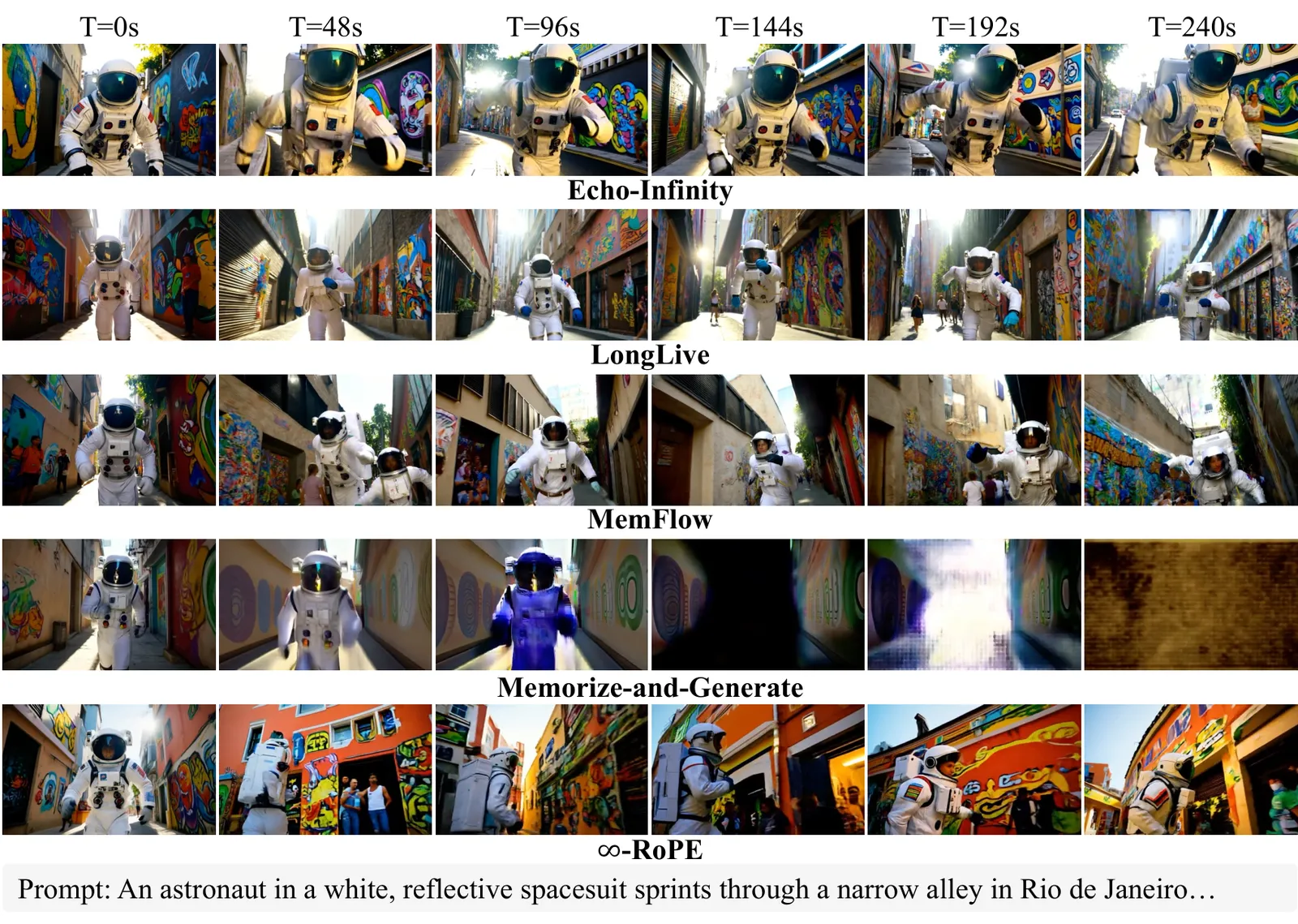
The shared problem: the video forgets where it started
Every autoregressive video model is trained on short clips, and every one of them drifts once you roll past the training length: subjects morph, backgrounds wander, physics quietly changes its mind. The two papers in this comparison attack that drift from opposite ends of the cost spectrum, and the pairing is the point. Echo-Infinity pays training cost once to learn what to remember; MIGA pays nothing at training time and instead fixes the sampler so a frozen short-clip model can stream past 1000 frames.
They also answer different operational questions. Echo-Infinity is about interaction: a model that receives actions or new prompts while it runs and must stay coherent for hours, at frame rates a human can play with. MIGA is about file length: taking the video diffusion model you already have and producing a long, consistent clip without retraining it. Both report “constant memory”, and both report VBench-family scores, but the numbers sit on different bases and different regimes. Read on for what is actually comparable.
How each one works
Echo-Infinity: a learned, fixed-size memory. An autoregressive video diffusion model attends to history, and history grows without bound. Prior infinite-video methods curate that history with a fixed rule: a KV-cache window, a fixed compression ratio, or inference-time RoPE stretching. Echo-Infinity replaces the rule with a small set of learnable Memory Query tokens. When a frame leaves the local attention window, its information is folded into these queries through attention plus a gating mechanism, so the queries carry a compressed summary of everything seen so far, trained end-to-end with the diffusion transformer. Because the memory is a fixed-size token set, per-frame compute is constant at any length, and the model itself learns which history to filter, abstract, and compress. A Unified Relative RoPE Recipe anchors sink frames and caps temporal position ids at the base model’s pretrained maximum, removing the finite-RoPE extrapolation failure that otherwise caps autoregressive rollout length.
MIGA: a sampler that aligns what the frozen model sees. Sliding-window samplers such as FIFO-Diffusion already stream long videos without training, by denoising a queue of frames sitting at staggered noise levels. The train-inference mismatch is the catch: the base model was trained to denoise frames that all share one noise level, and the window feeds it a mixture it has never seen, so quality degrades and the video drifts. MIGA adds two training-free mechanisms. Two-stage Training-inference Alignment first runs a zigzag iterative denoising over a narrow window (the paper finds 4 frames is the optimal width) to bring frames toward a shared noise level, then applies unified noise-level denoising that matches the training distribution. Dual Consistency Enhancement adds a self-reflection step in which the model re-examines its own predictions, plus long-range frame guidance that anchors new frames to earlier ones (optimal setting: 6 guidance frames). No weight is touched, which is why the method transfers across base models.
Key numbers
| Measurement | Echo-Infinity | MIGA | Setting and source | Same harness? |
|---|---|---|---|---|
| Headline quality score | VBench 85.35 total (5s clip); VBench-Long 85.61 at 30s | VBench 97.82 overall (128 frames) | Different bases, clip lengths, and VBench variants | No |
| Quality at long horizon | VBench-Long 82.01 at 240s; semantic 59.53 | NarrLV 79.32 scene / 67.87 target attributes / 67.94 target actions (Wan2.1-1.3B) | Long-horizon regime, different benchmarks | No |
| Consistency | (not reported separately) | 97.66 subject, 96.99 background; +4.7% and +2.0% over FIFO-Diffusion | Within MIGA’s VBench run | Yes, within MIGA |
| Speed | 18.5 FPS on one H100 | not the headline; sampler adds zigzag, self-reflection, guidance compute per frame | Echo-Infinity vs rival memory methods | Partial |
| Speed context | LongLive 20.7, MemFlow 18.7, Memorize-and-Generate 21.7 FPS | n/a | Rivals within a few FPS of Echo-Infinity | Yes, within Echo-Infinity |
| Maximum demonstrated length | 24-hour rollouts exceeding 1.3M frames in real time | 1000+ frames | Stability demonstration vs practical clip length | No |
| Memory growth | constant per-frame compute via fixed Memory Query set | constant memory via sliding window | Both claim constant | Yes, both |
| Internal ablation | (not reported on the page) | TTA alone +2.03, DCE alone +1.73 overall | MIGA ablation, both halves carry weight | Yes, within MIGA |
| Bases shown | one AR video DiT family | VideoCrafter2 (16 latents), Wan2.1-1.3B (21 latents) | MIGA shows transfer across bases | n/a |
Read the first two rows for what they do not say. MIGA’s 97.82 and Echo-Infinity’s 85.35 are both “VBench” numbers, and it is tempting to read 97.82 as better. They are not comparable: MIGA’s score comes from a 128-frame VideoCrafter2 generation evaluated on the standard VBench suite, where consistency sub-metrics already sit in the high 90s for every method; Echo-Infinity’s 85.35 is a 5-second clip score and its 82.01 at 240 seconds is the number that reflects the regime this comparison is about. A model scoring 97.82 at 128 frames is not “ahead of” a model holding 82.01 at 240 seconds; the two numbers describe different distances from the starting frame. The honest cross-paper statement is narrower: both methods hold quality far longer than their own no-intervention baselines, and each paper documents that within its own harness.
What each paper is really claiming
From Echo-Infinity, the claim is about sustained rollout. The 24-hour, 1.3M-frame demonstration is a stability and throughput result, stated as the first of its kind, and the speed story is deliberately modest: 18.5 FPS on an H100 sits in the same band as LongLive (20.7), MemFlow (18.7), and Memorize-and-Generate (21.7). The differentiator is that the learned memory keeps VBench-Long at 82.01 at 240 seconds where fixed-schedule caches drift. The paper’s own long-horizon semantic score, 59.53 at 240s versus 81.49 at 5s, is the honest caveat: visual quality holds longer than meaning does.
From MIGA, the claim is about cost of entry. It does not train a better video model; it makes the model you already have stream 1000+ frames without collapse, at constant memory, with a VBench gain of roughly 2.8 points over FIFO-Diffusion (97.82 vs 95.02) and under one point over FreeLong (96.95). The ablation is the integrity check: TTA alone adds +2.03 and DCE alone adds +1.73, so both halves of the method carry weight. The NarrLV numbers on Wan2.1-1.3B (67.87 target attributes, 67.94 target actions) are the honest caveat: narrative semantics stay in the high 60s even when the picture looks stable.
When to use which
- You have a good short-clip checkpoint and need long offline videos: MIGA is the cheaper path. No retraining, no new weights, transfers across at least two base families, and the consistency gains (+4.7% subject, +2.0% background over FIFO-Diffusion) come from sampler changes you can ablate independently.
- You need real-time interaction, not just a long file: Echo-Infinity is built for it: 18.5 FPS on one H100 with constant per-frame compute, plus an interactive regime the paper evaluates at 60 seconds (81.71 quality, 34.10 CLIP score). That is the profile a game, simulator, or embodied rollout requires.
- You cannot train at all: MIGA is the only option of the two; Echo-Infinity’s memory queries are trained end-to-end with the backbone.
- You care about what happens after minute one: neither paper solves semantics. Echo-Infinity’s own semantic score drops from 81.49 (5s) to 59.53 (240s), and MIGA’s narrative-attribute scores sit in the high 60s. If your use case needs long-range story coherence, budget for a revisit-style evaluation, not just VBench.
- You are choosing along the streaming-axis too: if your real constraint is per-chunk latency for live streams rather than total length, test-time scaling methods such as Stream-T1 are the adjacent option worth benchmarking before committing to an infinite-length design.
Limits and open questions
Nobody has run these two methods under one harness, so “learned memory versus train-free alignment” has no shared-benchmark answer yet. Echo-Infinity’s numbers come from a single backbone family, and the learned compression is not characterized on hard cuts or out-of-distribution scene changes over very long rollouts; its 24-hour claim demonstrates throughput and stability, not hour-scale semantic coherence, and VBench-family metrics do not measure that either. MIGA inherits every weakness of its base model and adds per-frame sampler compute, so “constant memory” does not mean free: the wall-clock cost of zigzag denoising, self-reflection, and guidance frames is not the paper’s headline and deserves measurement before deployment. Both papers evaluate on their own base models at their own resolutions, which is exactly why the cross-paper table above marks every row for comparability. The open question both leave behind is the same one: what memory design keeps semantics, not just pixels, stable at hour scale, and no benchmark in either paper answers it.
FAQ
Can I compare MIGA’s 97.82 with Echo-Infinity’s 85.35 VBench scores directly?
No. MIGA’s 97.82 is a 128-frame VideoCrafter2 generation scored on the standard VBench suite, where consistency sub-metrics already sit in the high 90s for all methods. Echo-Infinity’s 85.35 is a 5-second score, and its long-horizon counterpart is 82.01 at 240 seconds on VBench-Long. Different bases, clip lengths, and suite variants: the numbers describe different regimes, not a ranking.
Which method produces longer videos?
By demonstrated scale, Echo-Infinity: 24-hour rollouts exceeding 1.3 million frames in real time. MIGA demonstrates 1000+ frames, which covers most practical long-form needs. The two demonstrations also mean different things: Echo-Infinity proves stability under real-time interaction, while MIGA proves a frozen short-clip model can be pushed past its training length without retraining.
How does Echo-Infinity keep per-frame cost constant?
Through a fixed-size set of learnable Memory Query tokens. Evicted frames are folded into the queries via attention and gating, so history is summarized rather than stored, and per-frame compute does not grow with video length. A Unified Relative RoPE Recipe caps temporal position ids at the base model’s pretrained maximum to prevent extrapolation failure.
Does MIGA need any training or fine-tuning?
No. It is entirely a sampling-time intervention: two-stage training-inference alignment plus dual consistency enhancement, with no weights changed. That is why it transfers across base models such as VideoCrafter2 and Wan2.1-1.3B, and why its ablations (TTA alone +2.03, DCE alone +1.73 on VBench overall) can be toggled independently.
When would I still pick a streaming method instead of either one?
If your constraint is per-chunk latency on a live stream rather than total length, streaming test-time-scaling methods are the adjacent family to benchmark. Infinite-length memory and per-chunk speed are related but separate problems, and a method strong on one axis tells you little about the other.