
Mixture of Experts · Language Models · Diffusion Language Models
dMoE: Block-Level Expert Routing for Diffusion LLMs
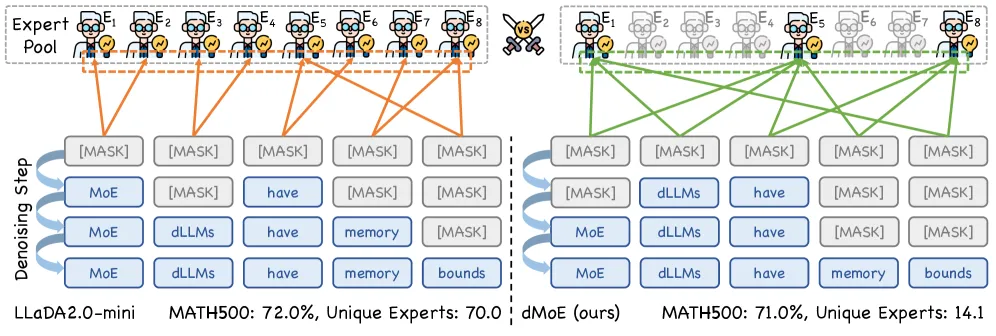
dMoE aligns token-level MoE routing with block-parallel decoding in diffusion LLMs. On LLaDA2.0-mini it cuts unique experts per block from 69.5 to 14.6, keeps 99.11% accuracy, and frees 76-80% of expert memory.
Quick answer
dMoE makes Mixture-of-Experts diffusion language models cheap to run by routing whole decoding blocks instead of individual tokens. On the open MoE diffusion model LLaDA2.0-mini, it drops the number of uniquely activated experts per block from 69.5 to 14.6 while retaining 99.11% of the original accuracy, cutting expert-weight memory by 76.64% to 79.84% and delivering a 1.14x to 1.66x end-to-end speedup. The fix is conceptual, not a heavier model: it aligns where experts get chosen with how diffusion LLMs actually decode.
The mismatch dMoE targets
Diffusion language models do not decode left to right. They unmask a whole block of tokens in parallel over several denoising steps. MoE routing, inherited from autoregressive transformers, still picks experts per token. When a block of tokens each independently selects its top-k experts, the union of experts the block touches explodes. The paper measures this directly: a single block on LLaDA2.0-mini activates 69.5 distinct experts on average, even though each token only uses a handful. Every one of those experts has to be resident in memory for the block’s forward pass, so block-parallel decoding turns MoE’s promised sparsity into a memory bottleneck instead of a saving.
That is the core observation: per-token routing and block-parallel decoding pull in opposite directions. Token routing wants maximal per-token freedom; block decoding wants a small shared working set so the parallel step stays cheap.
How block-level routing works
dMoE aggregates the token-level expert scores inside a block into one block-level distribution, then forces every token to choose from a shared coreset of experts.
The mechanism has four steps. First, compute the normal token-level routing scores for each token in the block. Second, sum the normalized scores across all tokens to form a single block-level expert distribution. Third, apply top-p selection on that distribution to pick an expert coreset whose cumulative routing mass passes a threshold. Fourth, restrict each token’s final expert choice to that coreset. Tokens still route individually, but only among the experts the block as a whole considers important.
The “learnable” part matters: the coreset is derived from the model’s own learned routing scores, not a fixed assignment, so high-traffic experts survive and long-tail experts that one stray token wanted get dropped. Because tokens in a diffusion block have bidirectional dependencies and are decoded together, the paper argues they should share an expert basis for coherence anyway, so the coreset is a feature, not just a compression hack.
Key results
- Activated experts: 69.5 to 14.6 unique experts per block on LLaDA2.0-mini, roughly a 79% cut in the block’s expert footprint.
- Accuracy retained: 99.11% of the original model’s performance across the evaluated benchmarks.
- Memory: 76.64% to 79.84% reduction in expert memory usage, the direct payoff of a smaller resident expert set.
- Latency: 1.14x to 1.66x end-to-end speedup, depending on the operating point.
- Benchmarks: evaluated on MATH500, GSM8K, ARC-C, and an MMLU math subset, against baselines including a Top-4 expert cap and the DES-S and DES-V dynamic expert-sharing methods.
Why this matters now
Diffusion LLMs are the most credible current challenge to autoregressive decoding, and the strongest open ones, like LLaDA2.0-mini, are already MoE models. That means the routing-versus-decoding mismatch is not a corner case; it sits on the main path of the most promising architecture combination in open language modeling. dMoE shows the mismatch is fixable at the routing layer without retraining a dense model or shrinking the expert pool, which is what makes MoE diffusion LLMs deployable on tighter memory budgets.
Limits and open questions
The paper is explicitly marked work-in-progress, so the evaluation is narrow. All numbers come from a single base model, LLaDA2.0-mini, so it is unproven whether the 14.6-expert coreset and the memory savings hold on larger MoE diffusion models or different expert counts. The benchmark set is reasoning-and-knowledge heavy (MATH500, GSM8K, ARC-C, MMLU math) and does not include open-ended generation, code, or long-context tasks where block coherence pressure may differ. The headline 99.11% retention is an average; the paper does not, in the material available, break out which benchmarks lose the most, and the top-p coreset threshold is a knob whose sensitivity is not fully characterized here.
This paper is one of the sources behind Diffusion vs Autoregressive Language Models.
FAQ
What problem does dMoE solve?
dMoE fixes the clash between block-parallel decoding in diffusion LLMs and per-token MoE routing. When every token in a parallel-decoded block independently picks experts, the block touches 69.5 distinct experts on average on LLaDA2.0-mini, all of which must sit in memory. dMoE collapses that to 14.6 by sharing one expert coreset across the block.
How much memory does dMoE save?
dMoE reduces expert-weight memory usage by 76.64% to 79.84% on LLaDA2.0-mini, with a 1.14x to 1.66x end-to-end latency speedup, because far fewer experts need to be resident for each parallel decoding step.
Does dMoE hurt accuracy?
dMoE retains 99.11% of LLaDA2.0-mini’s original accuracy across MATH500, GSM8K, ARC-C, and an MMLU math subset. The small drop reflects forcing every token in a block to route within a shared expert coreset instead of choosing freely.
What model does dMoE run on?
dMoE is demonstrated on LLaDA2.0-mini, an open-source Mixture-of-Experts diffusion language model. The paper is marked work-in-progress and reports results on that single base model, so generalization to other MoE diffusion LLMs is not yet shown.